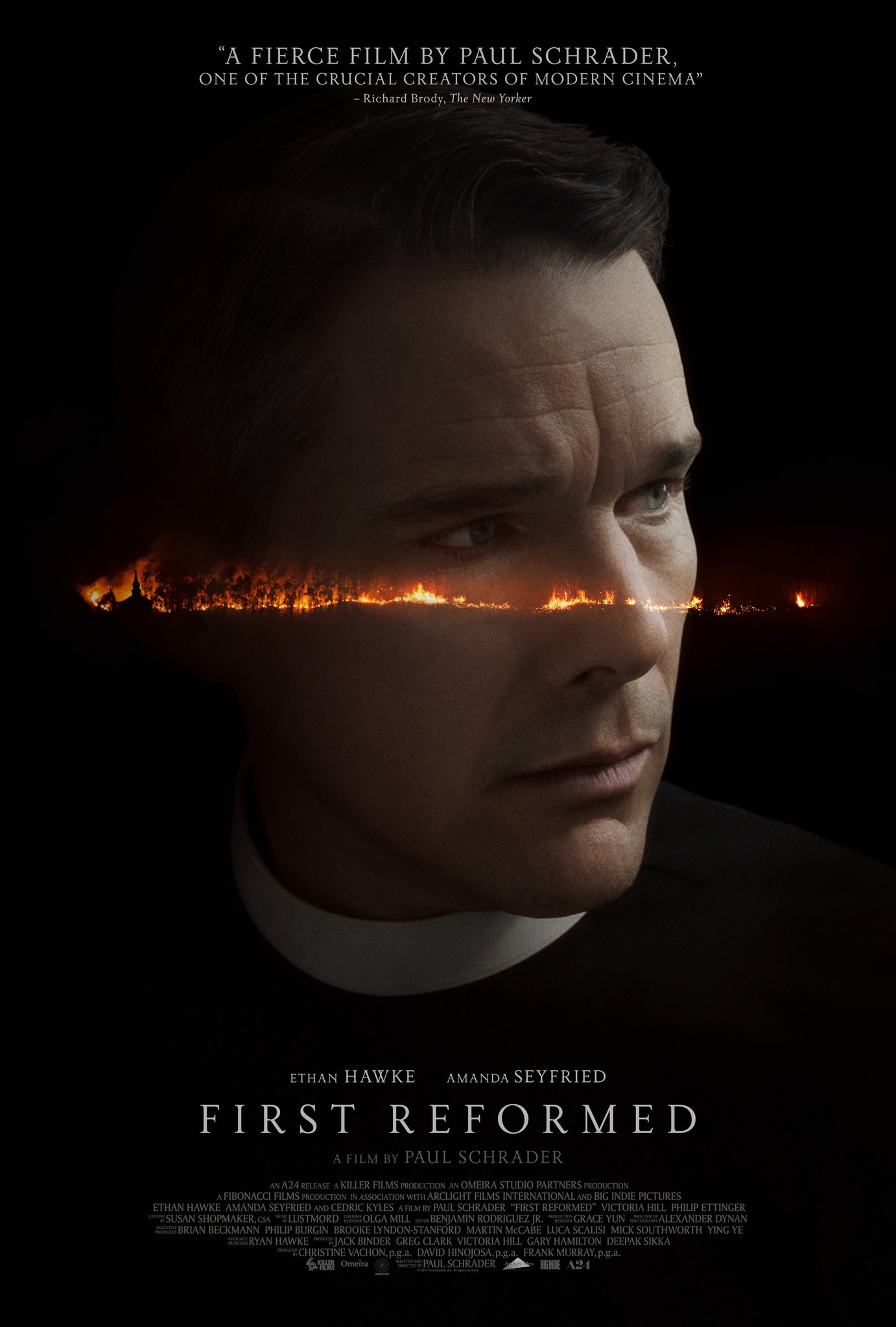
 Nobody writes tortured protagonists quite like Paul Schrader. He has worked in constructing some of the most complex characters ever depicted on screen, such as Travis Bickle in Taxi Driver, Jake La Motta in Raging Bull, Julian Kaye in American Gigolo and Jesus Christ in The Last Temptation of Christ. Schrader is a magnificent writer and director, and throughout his career, he has given us intricate representations of fragile, insecure masculinity, and portrayed the inner-turmoil of ordinary individuals with such precision and sensitivity. His most recent film may be his very best, especially from the perspective of the director. First Reformed is an astonishing film – a brooding, relentlessly bleak and hopelessly dark depiction of a man descending into a place of inescapable darkness. Taking its cue from films such as Robert Bresson’s Diary of a Country Priest and Maurice Pialat’s Under the Sun of Satan, this film is one of the most extraordinary representations of the intersections between the faith and the anxieties of a religious man who slowly starts to reconsider his place in the world. It would be amiss to not call First Reformed a film very much in the style of the great moral traditional films of the 1970s, films that look at the American experience through the eyes of an ordinary individual in the hostile world. In no uncertain terms, First Reformed is a masterpiece, and one of the year’s best films.
Reverent Ernst Toller (Ethan Hawke) has just started a project: every day, for a year, he is going to write in a journal. This journal will contain his thoughts, his anxieties, his insecurities, fears and experiences that he garners throughout his days. For reasons unbeknownst to the audience, he intends to burn that journal at the end of the one-year period. His existence is quite banal – he is the pastor at a local church, which is the oldest operating church in the area. It is owned and operated by Abundant Life, a megachurch which preaches peace and tolerance, but secretly has an alliance with various malicious individuals, such as the owners of Balq Industries, an energy company that is polluting the area and feeling very little remorse for their activities. Toller meets a young couple (Amanda Seyfried and Phillip Ettinger), who he helps counsel. However, when tragedy strikes, Toller starts to spiral out of control, discovering that he may not know himself at all. He starts to question everything, most specifically his faith: his faith in God, his faith in humanity and most importantly, his faith in himself. He starts to challenge everything he considered to be true and starts to realize that perhaps what he thought was reality was instead a delusional construction, a denial of the injustices occurring around him. Toller determines that he needs to find a way to bring change in some way to this hostile world, and as he sinks deeper into depression (aided by alcohol abuse), as well as the likely possibility that he has some form of cancer which is slowly killing him, he decides that it is better to take life-altering actions and bring more peace to the world, rather than remain complacent.
Ethan Hawke is an astonishing actor. He is a performer who has done amazing work in both the mainstream and the arthouse, imbuing his performances with irreconcilable truths and unabashed complexity. First Reformed features perhaps Hawke’s greatest screen performance to date, and I can’t adequately express how brilliant he was here. His performance is volcanic and intense, but never excessive or unnecessary. It is a performance that requires vast amounts of authentic introspection and silent nuance from the actor, and Hawke provides that in an abundance. Such a simple performance in how understated and sensitive it was, but it was one brooding with unquenchable rage and inextricable despair, even if it isn’t overtly shown. Schrader has never relied too heavily on the external actions of his characters, with the mind of his creations being complex battlefields, where fears and anxieties envelope hope and logic as these individuals grapple with existential crises. Despite the excellent performances from those around him, such as Amanda Seyfried and newcomer Phillip Ettinger, as well as a rare serious performance from Cedric Kyles (otherwise known as Cedric the Entertainer), First Reformed belongs entirely to Hawke, who has quite simply never been better. Such control over a character is rarely seen, and I cannot recall such a discreet performance being so unbelievably moving. If nothing more, First Reformed is an example of the artistry of Schrader when it comes to creating complex characters, as well as Hawke in interpreting these kinds of nuanced individuals. I am still shaken by this performance, with it leaving an indelible impression.
First Reformed is a film about the intersections between life inside the church and that outside, both literally and metaphorically. By focusing on a lonely priest, Schrader is able to look at the experiences of a man slowly starting to doubt his faith, not because of any reason other than he is starting to realize that there is a world out there that he has been so blind towards, with the true suffering being obscured by the comforting walls of his parish. This film is not anti-religious – if anything, it continues Schrader’s fascination with the limits of faith, something that he has been actively exploring for most of his career. Thematically, First Reformed carries a hefty load, looking at how faith is certainly nothing to be ashamed of – while many similar films portray dedicated faith as something ridiculous, to be mocked, First Reformed is more intent on showing that it can be comforting and bring warmth and assistance to those who need some guidance and that perhaps being faithful is an enviable trait. Schrader investigates what happens when someone loses that faith and is unable to find the solace in the guiding words that they had previously considered to be the irreparable truth. The stark contrast between the extent to which someone can be ignorant to the truthful realities that are not too far out of sight, and the blissful retreat into unintentional apathy are explored in detail throughout this film, and while it may take nearly the entire film to get to the core of the narrative, but for the most part, First Reformed is composed of a series of episodic moments in the life of an ordinary individual who goes from being a man of God to a man without God, hopelessly lost in a world he realizes he just simply cannot recognize. Every film Schrader has made, whether as writer or director, has led up to First Reformed, which is undeniably his most complex film. It makes the philosophical nihilism Taxi Driver seem like the drunken ramblings of a college upstart compared to the serpentine complexities of this beautifully impenetrable film.
I think First Reformed could’ve been absolutely anything, and to be fair, Schrader has not always been the paragon of an artistic auteur, especially of late. This is precisely what makes First Reformed such an unexpectedly great film – it finds Schrader returning to the style that first made him such a notable writer and director, where his career was defined by intimate character studies that looked at existential themes and issues much larger than the characters that populate these stories. It seems that every protagonist or anti-hero from Schrader’s previous works are filtered through the character of Reverend Toller, with this character being the embodiment of doubt and uncertainty, an individual grappling with his own place in the world. I will be entirely honest here: First Reformed is a film that shook me and made me actually start to reconsider my own existence. This is a moody, layered film with a number of complexities, but it towers above its often depressing themes to provide some profound commentary on life. Despite its religious overtures, First Reformed is not limited to faith in God. It is a film about humanity, about the desire an individual feels to make some change, to leave some legacy, as well as the challenges that come with the often-incorrect realization that perhaps we just aren’t good enough to make any change, and sometimes extremism is the only way to leave the message one wants to convey. It is a thought-provoking work, a great piece of art that leaves the audience with something to think about, and the bleak and hopeless nature of this film, while unpleasant, is a good catalyst for conversation, and through the multitude of themes present throughout the film – palpable and abstract – it makes some bold assertions that are unquestionably powerful and extraordinarily resonant.
First Reformed is an astonishing film. A complex masterpiece, Paul Schrader proves his mettle once again as one of our greatest living storytellers, especially of gritty, brutally bleak stories about lonely men facing their own fragility and insecurities, traveling through a hostile, unforgiving world that seeks to destroy rather than protect. Moreover, First Reformed looks at a popular theme that persists throughout the filmmaker’s work, that of religious belief and the struggles that come with the possibility that even heavenly solace can’t bring comfort to the individual. Ethan Hawke gives the performance of his career, playing the unquestionably complex Reverend Toller with equal parts fierce devotion to his cause, as well as fearful insecurity that he may just not be doing enough. First Reformed is a great film about faith and morality, and it has a genuine truthfulness that works alongside the bleak view of society that pervades the film to create one of the most resonant films of the year. There is simply nothing quite like First Reformed, an astonishing achievement and a masterpiece of modern American filmmaking.
 The Postmodern Pelican