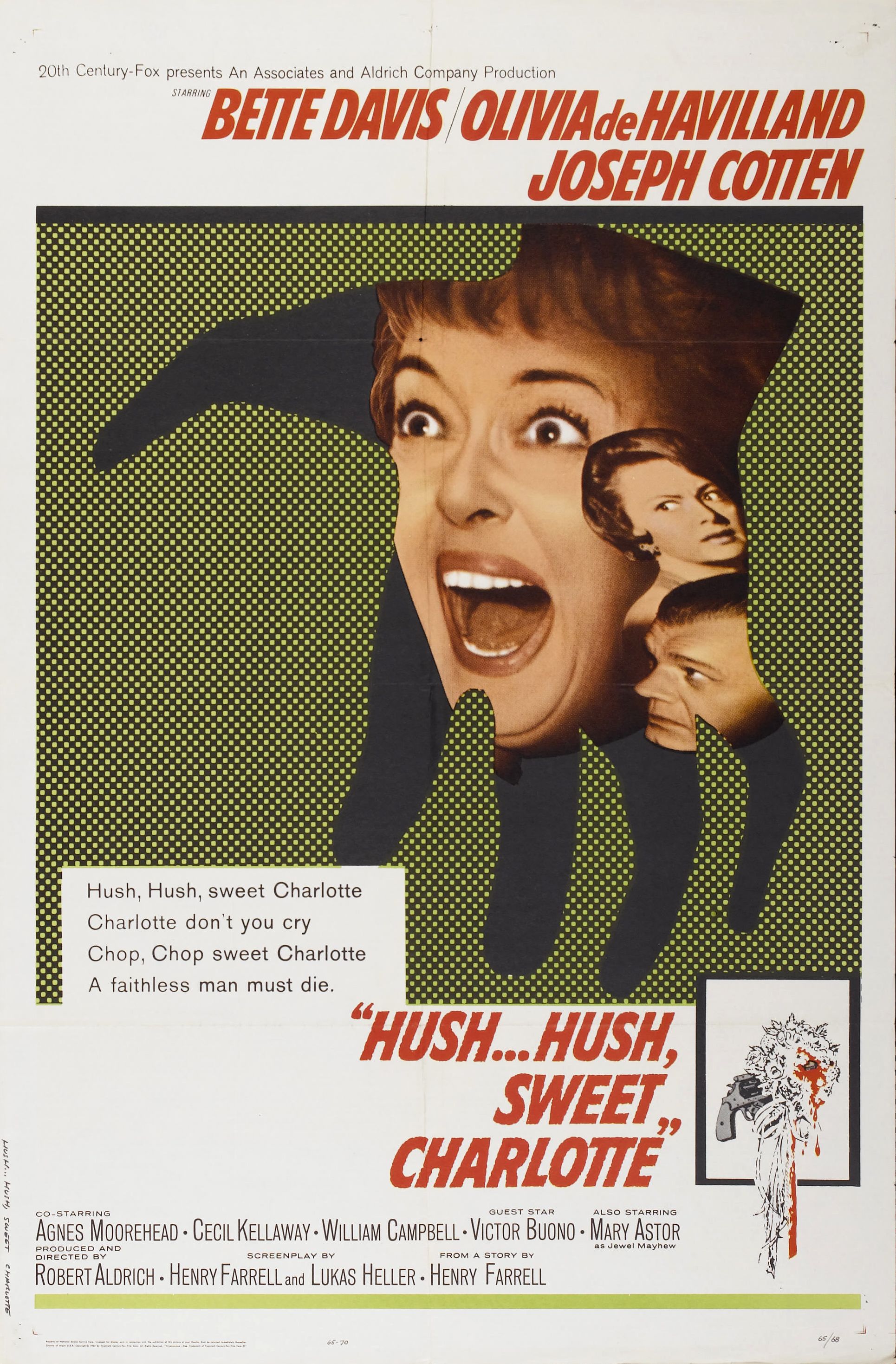
 Cinematically, when lightning strikes, why shouldn’t a filmmaker try and replicate that success, even if there is very little chance that it will be as successful? In 1962, Robert Aldrich directed Whatever Happened to Baby Jane?, one of the greatest horror films ever made, and a film that persists to this day as a towering masterpiece of unhinged, psychological cinema. It gave stars Bette Davis and Joan Crawford arguably their best late-period work, as well as ushering in an era of new artistic horror in an era defined by lowbrow, mindless scares and predictable stories designed to entertain rather than challenge the audience. He followed up this film with a forgettable western called 4 for Texas which was just a vehicle for the Rat Pack, before making a film directly inspired by the success of Whatever Happened to Baby Jane? The film was Hush…Hush, Sweet Charlotte, and while it objectively never reaches the impossible heights of the definitive classic that inspired its inception, it is an extraordinary and effective psychological work of masterful terror that sees Aldrich managing to create something excellent and subversive, another frightful film that sees some of the greatest performers of their generation engaged in a bitter and sinister cat-and-mouse game, deceiving each other in the most extraordinary ways. There are few films as eccentric as Hush…Hush, Sweet Charlotte, a film that kept me captivated throughout and one that lingers on in my mind long after having watched it.
Hush…Hush, Sweet Charlotte is about the titular Charlotte (Bette Davis) a faded Southern belle who has become reclusive, living in her family’s enormous mansion on a plantation, being tended to by her dedicated, loving housekeeper, Velma (Agnes Moorehead). Her home is soon to be demolished to make way for a new bridge, but Charlotte refuses to leave, which causes tension between her and the authorities, who find her steadfast defiance exhausting. In an attempt to evade the impending authoritative action, Charlotte calls on her last remaining relative, her cousin Miriam (Olivia de Havilland), a self-made individual who rose from the charitable pity of Charlotte’s father to a wealthy New York businesswoman. Miriam needs to deal with Charlotte and her defiance, as well as her growing delusions, with her cousin apparently being haunted by visions of her dead lover, whose murder decades before remain a controversial event, with many believing it was the scornful Charlotte who decapitated him for his refusal to elope. As the days go on, Charlotte starts to grow more mentally unstable – but is she really haunted by the memories of the past, or is there a sinister plot being orchestrated by Miriam and Charlotte’s shady doctor, Drew Bayliss (Joseph Cotten), in an attempt to inherit her wealth?
Bette Davis is probably the greatest actress who ever lived, and I stand by this statement with steadfast conviction. Whether in the earliest days of her career, where she stole hearts and captivated minds with her stark talents and unrivaled beauty, or in the later stages of her life when she continued to use her extensive skills in a wide variety of films, she was an astonishing, magnetic screen presence. What impresses me the most about Davis is that even in the latter portion of her career, she continued to make daring choices, many of which defined her career. Her performance as the titular Baby Jane Hudson in Whatever Happened to Baby Jane? may be her most beloved performance, second only to Margo Channing in All About Eve. Hush…Hush, Sweet Charlotte makes for a fascinating double-bill with Baby Jane, mainly because other than the similar subject matter, her performances are so radically different, yet strangely complementary, allowing her to give unhinged portrayals of unstable women on the verge of complete self-annihilation. Her performance in this film was astonishing, and considering how Baby Jane Hudson was such a despicable character, it was quite refreshing to see her play the victim of the malice of others here. Davis could find complexity in a performance with even the most simple character, and her exceptional skills make Hush…Hush, Sweet Charlotte, and her performance all the more resonant, with this being amongst the very best of her storied career.
We are so unquestionably fortunate to have an actress like Olivia de Havilland in the world, mainly because she is one of the most exceptionally-gifted performers of her generation, and over the course of her career, she’s given performances that easily soar over those of her contemporaries. Hush…Hush, Sweet Charlotte gives de Havilland one of her most memorable characters, and despite the fact that she’s acting across from Davis, she dominates the film. There was not much else for Davis to do in this film other than to be hysterical and unrestrained (she does brilliantly, though), but it is de Havilland who bears the brunt of playing the most complex character. Oscillating between sickeningly sweet to despicably cold, her icy performance sets a new standard for cinematic villains – complex, filled with motive and cause, and deliriously sardonic, alluring to the point where the audience wishes for her success. Much like Whatever Happened to Baby Jane?, this film thrives on the interactions between its two equally-strong leads, both of which are beyond brilliant here, with their chemistry being palpable and their individual interpretations of their respective characters being truly marvelous. However, when pressed to choose, I’d easily go with de Havilland, because it takes so much to convey such a nuanced villain, and while the audience will likely go into this film with the intention of experiencing another great Bette Davis performance, its Olivia de Havilland who leaves the most lasting impression.
Finally, in spite of the towering performances of its two leads, Hush…Hush, Sweet Charlotte benefits from an exquisite ensemble, with Agnes Moorehead completing the trifecta of astonishing performances within this film. Moorehead plays the dedicated but fiery housekeeper with exceptional grace and unrequited brilliance, being perhaps the only purely-good character in the film, someone who is deeply dedicated to her mistress to the point where she sacrifices her own life after an attempt to bring attention to the malicious travesty being asserted on Charlotte. Joseph Cotten, as good as he was, was overshadowed by the three main actresses, but still managed to hold his own, playing the sycophantic young doctor who betrays his ethics in an attempt to get rich. Cecil Kellaway is endearing as the gentle British investigator who slowly unearths the decades-old mystery of the Hollis House, bringing a lot of warmth into an otherwise arid and bleak film. Victor Buono, working again with Aldrich after his terrific supporting performance in Whatever Happened to Baby Jane? has a much smaller role, but shows off his range, playing the brutish father of Charlotte in the opening scenes of the film, effectively playing a character much older than his years would suggest. Hush…Hush, Sweet Charlotte also features a very early performance from a dashingly young Bruce Dern, who may not do much, but does provide interesting insight when comparing his small performance here and his subsequent career. Hush…Hush, Sweet Charlotte has a wonderful cast, with iconic veterans and promising newcomers mingling in this complex psychological thriller, each one giving memorable performances.
Hush…Hush, Sweet Charlotte is a great film specifically because it is such a complex work and something that elegantly abandons restraint and becomes an unhinged masterwork. Aldrich was relying on much of what made Whatever Happened to Baby Jane? such a success, and while the results here may not be as resonant as before, it helped establish the extremely popular “biddy horror” genre, which may have been short-lived, but were masterpieces at their best, and camp classics at their worst. Hush…Hush, Sweet Charlotte manages to be a shocking film, and one that veers into the territory of horror, often being unsettling or quite frankly, terrifying at some moments, but it is also not a cheap film, and while it does have a heightened artifice and a rather satirical perspective, it is never exploitative or dull, with every moment in this film serving a specific purpose, with a general authenticity pervading the film. It may not be the most cerebral film, nor is it particularly challenging, but it is a subversive work and fits effectively within its genre, perhaps even helping to define a cinematic era, where films like this could be made. It is an enchantingly brilliant piece, and a testament to the power of effective intersections between filmmaking, writing and acting.
Thematically, Hush…Hush, Sweet Charlotte is quite straightforward, but it does evoke certain concepts and discussions that are more nuanced than what is overtly represented on the screen. Essentially, this is a film about insanity, with the titular character falling deeper into mental instability through what she believes to be the ghosts of the past, whether literally or metaphorically being haunted. On the surface, one could misconstrue Hush…Hush, Sweet Charlotte as simply being an attempt to have Bette Davis, amongst the greatest screen performers to ever live, scream hysterically for two hours. Of course, it is far more complex than this simple reduction would suggest. Through the cinematic techniques used, whether they be technical innovation (such as in the oddly unique cinematography) or the thematic content which allow for a blurring of genres before such a concept was even possible. Many different genres occupy this film – horror, psychological thriller, family drama, Southern Gothic and dark comedy, amongst many others. Its ability to grapple with distinct concepts such as these that have been mentioned here that demonstrates how innovative this is. Hush…Hush, Sweet Charlotte is far from being a mindlessly camp film – it a nuanced masterpiece that conceives of broad themes that it seamlessly integrates into this straightforward story, resulting in something truly wonderful.
Hush…Hush, Sweet Charlotte is a masterpiece. Robert Aldrich followed up his iconic film with one that I may consider, depending on how I feel on that day, better than Whatever Happened to Baby Jane? Bette Davis, the greatest actress in the world, plays a unique character that exists in a hostile world. However, as brilliant as Davis was, it were interactions with Olivia de Havilland and Agnes Moorehead that gave this film its heart, with this trio being absolutely astonishing. It may not be considered “high art”, but it is definitely something extraordinary in its own way, and what it lacks in narrative depth it makes up for in purely euphoric escapism and a story that any devotee of the actresses that defined the classical age in Hollywood would utterly adore. Hush…Hush, Sweet Charlotte is a wonderful film and a truly memorable work that will hopefully endure just as much as its iconic predecessor. It is a marvelous film, a subversive blend of genres, and a twisted, fun film that weaves together an unpredictable story that keeps the audience captivated, resulting in a truly memorable, unusual and unexpectedly wonderful experience.
 The Postmodern Pelican