 Ten years ago, my mother took me to see Mamma Mia!, and I was immediately transfixed by this experience. Perhaps not a towering masterpiece (not that it ever attempted to be), but it was an energetic and exuberant musical that paired some of the most iconic songs ever recorded with beyond brilliant performers in a silly but entertaining film that doesn’t take itself too seriously, yet still being able to touch on some serious issues that may not be particularly overt, but do form the basis of the storyline to some extent. Several years later, for whatever reason, someone had the idea to revive the film, which is nothing short of a cult favorite (and a beloved one at that), but also one that never really begged for a sequel. Despite loving the original, the idea of making a sequel to this film, especially so many years later, was unquestionably perplexing to me, and I remained unfortunately cynical, thinking that Mamma Mia! Here We Go Again was just a desperate attempt to pander to the same audience with the same formula that made the original such a camp classic. I have rarely been more pleased to be wrong, and not only does Mamma Mia! Here We Go Again utilize the same winning formula that made the first such a success, it improves on the previous film’s shortcomings and comes up with one of the most endearing films of the year, something that can be considered the ABBA jukebox musical equivalent of The Godfather Part II (not really, but you understand what I mean). Vivacious and adorable, it is one of the rare sequels that exceeds its predecessor and atones for some of the more lovable shortcomings of the original.
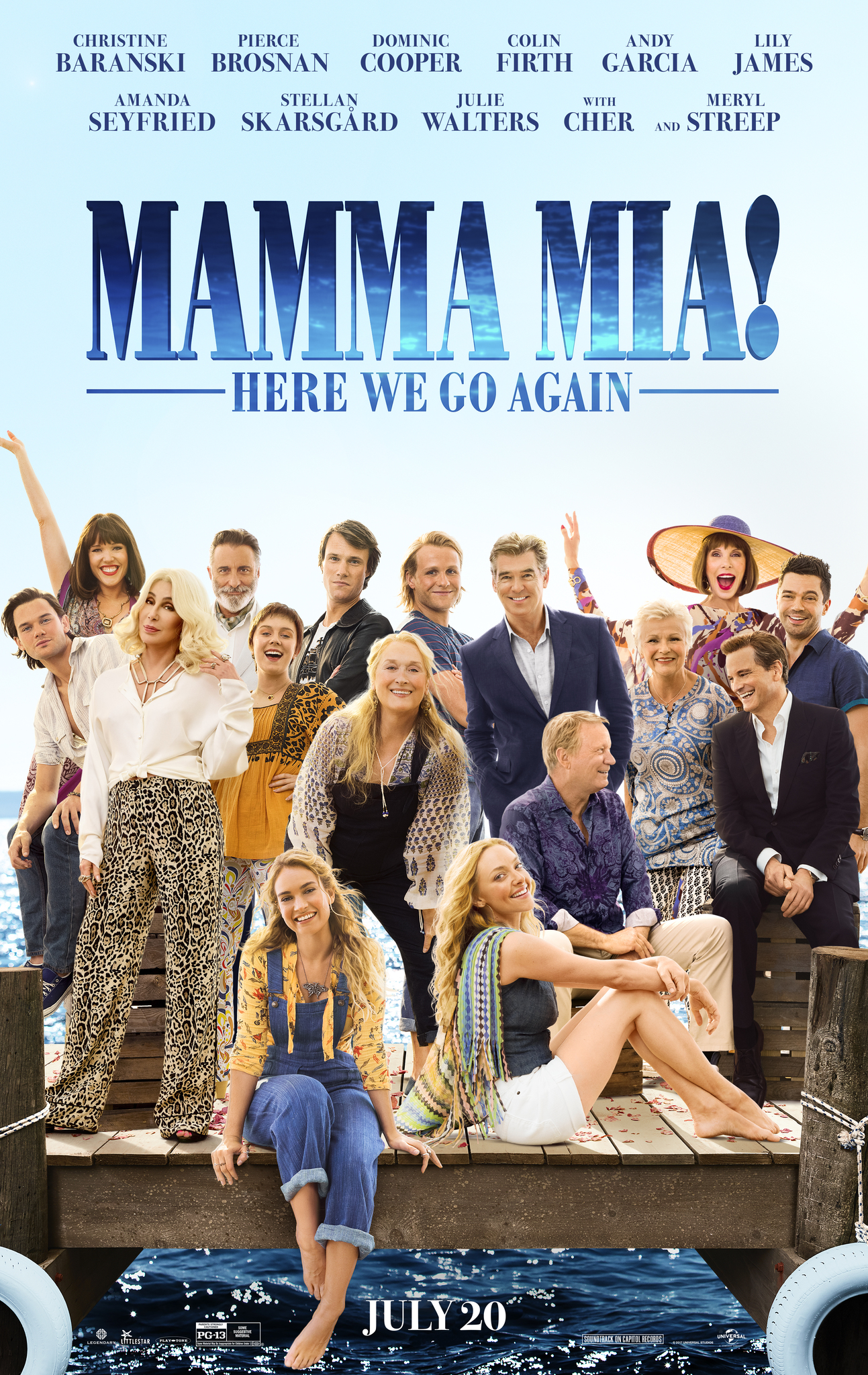
Mamma Mia! Here We Go Again takes place a few years after the events of the first film. Donna, played previously by Meryl Streep (in possibly her most enjoyable performance to date) has since died, perishing through means that aren’t disclosed, but it is made very clear that everyone misses her dearly. Her daughter, Sophie (Amanda Seyfried) has since renovated the hotel and made it the vision her mother had always had for it. She plans a grand re-opening of the now-named Hotel Bella Donna, which is heavily influenced by her late mother. She invites several people, including Donna’s oldest friends, Tanya (Christine Baranski) and Rosie (Julie Walters), as well as her three potential fathers, Sam (Pierce Brosnan), Harry (Colin Firth) and Bill (Stellan Skarsgård), as well as her absent grandmother, who “never shows up” according to Sophie. The events leading up to the Mediterranean shindig is juxtaposed by the main story, whereby we see a younger Donna (Lily James) navigating a hostile world, falling in love and having her heart broken by the various men who come into her life and promptly leave, all foregrounded with her journey to the Greek island where she is destined to spend the rest of her life. More than anything else, we get glimpses into the formative years of the young Donna, which allow the audience unfettered access into the experiences that shaped her into the woman who is so admired and dearly missed, especially her daughter, who does her best to make her mother proud of her, even from beyond the grave. Insecurities, anxieties, and heartbreak ensue as we are able to track the formative journey of the individual who would grow into the sage woman who we first encountered in the first film.
Full disclosure: Mamma Mia! Here We Go Again is a bit of a disordered cacophony of joyful vivacity – but I mean that in the best possible way. It is as muddled and convoluted as the previous film, but it finds its charms in a certain rugged disorder and incoherency (the final musical number attests to this, and this film requires audience members to be well-versed in suspension of disbelief). If this review seems to be somewhat scattered, understand that it is because I’m trying extremely hard to bring all the threads of this film together and make something coherent of it – because ultimately, it is a strangely post-structuralist film, serving to be both a prequel and a sequel, which suggests at an audacity previously unseen in this kind of mindlessly-escapist film. Obviously, literary and philosophical deconstruction wasn’t the most likely of motivations behind this film, and the intention for this bilateral narrative structure was probably due to the fact that the filmmakers wanted to bring back the same people and setting that drew audiences in droves to the first film, but obviously didn’t have enough of a storyline to justify an entirely new film, so the foray into the past was the most feasible decision. Only a film like Mamma Mia! Here We Go Again could be so unintentionally experimental, and while it could be perceived as having resulted in something quite narratively confusing, but its a gamble that did work, for the most part at least. Ol Parker may not be the most innovative auteur, but he inherited a mammoth task in making a follow-up to one of the most popular movie musicals of the past few decades, and he does admirably in giving audiences exactly what they had hoped for, and then some.
Perhaps the most defining element of the original film that made it quite an unexpected pop culture moment was the cast – a small, quaint ABBA musical managed to wrangle some extraordinarily talented performers to lend their skills to an otherwise absurd premise. Mamma Mia! Here We Go Again understands that this is one of the main reasons audiences enjoyed the film, because we much prefer seeing recognizable performers making endearing fools of themselves in this unrequitedly foolish but entertaining film, as opposed to professionals more adept at this kind of thing (I shudder at the thought of professional singers and dancers occupying these leading roles). Mamma Mia! Here We Go Again brings back essentially the entire cast of the original, as well as expanding upon it considerably, adding several new faces, many of which play the younger counterparts of the original cast (and special kudos needs to go to the casting director of this film – they went truly above and beyond in casting the roles with actors that not only resembled the original performers but had their mannerisms and quirks down perfectly). Mamma Mia! is a film that is almost immune to overt hatred, because it so well-meaning and endearing, and thus these established performers can simply let loose, and they seem to be having just as much fun in making the film as we do in watching it, with their enjoyment being palpable and pivotally contributing to the unhinged entertainment value of the film as a whole. For all of their shortcomings, both films are made exponentially better by the fact that the cast is really having a great time being in this film, with their joy being infectious, making it almost impossible to not find these films entertaining in some way. I have personally seen some of the most hardened cynics I have ever met subtlely tapping their foot along, and as hyperbolic as it is to say, a film like this has the power to unite audiences, because it has global resonance, and its inoffensive but meaningful message has the simple intention of spreading infectious joy. Mamma Mia! Here We Go Again keeps this same formula for being accessible, lovable and well-intentioned, and makes it most certainly worth watching.
In the endeavor to replicate the success of the first film, Mamma Mia! Here We Go Again did its best to duplicate exactly what made the first special, but at some cost. Meryl Streep, for whatever reason, is almost entirely absent throughout the film (most likely to her aversion to appearing in sequels), appearing only in the two final scenes, but she is a constant presence throughout. Despite the lack of Streep and her idiosyncratic interpretation of Donna, Mamma Mia! Here We Go Again has nearly everyone else returning, especially Amanda Seyfried, who takes the central role in the present-day narrative, and she improves upon her performance from the first substantially, humanizing Sophie well beyond simply being an inquisitive young woman, and into someone actually interesting. Colin Firth, Pierce Brosnan, and Stellan Skarsgård are as reliable as ever, but are more the scene-stealing foils, as opposed to being as consequential to the film as they were in the first film. Christine Baranski and Dame Julie Walters, who are almost unspeakably iconic in everything they do, based on long careers of enduringly brilliant performances, once again steal every moment they are on screen, and while they were clearly brought in entirely for their relentless charms and eccentric personalities, rather than being central to the storyline, they are marvellous, and continue to prove themselves to be astonishing in every performance, regardless of how middling the roles are. Perhaps it is nostalgia, but I was really glad to see these characters again. Mamma Mia! has such a special place in my heart (as it does for many people), and I became extremely fond of these characters, so to encounter them again a decade later was quite a mesmerizing and nostalgic experience. Regardless of what this film did with these characters, they were always going to be welcome presences, and this has to be accredited to the dedicated performances, as well as the loving care in representing these characters in their stereotypical but adorable quirks.
Mamma Mia! Here We Go Again centers mostly on the 1979 storyline, with much of the film being built around looking at the earlier life of Donna, her friends, and her various beaus that she encounters through her journey of self-discovery. Lily James is on the verge of being a major star, with performances in Cinderella, Baby Driver, Downton Abbey and Darkest Hour, amongst others, forming an enviable career that is far from peaking, with James only impressing me more with every performance she gives. Mamma Mia! Here We Go Again does not let expectations down as all, as she is as lovely and charming as ever, occupying a role previously interpreted by the performer considered the greatest of all time (the felicity of this statement remains to be seen, but Streep really is a force to be reckoned with, even within the confines of her two-scene performance in this film). James commands the screen with a silent intensity and endless charisma, as well as high-spirited animation, giving a performance that is almost unexpectedly great. The film shows Donna and her self-realizing journey, and depicts her as a fully-formed character, which is brought to life wonderfully by James, who works alongside many great performers, particularly Hugh Skinner, Jeremy Irvine and Josh Dylan, who embody the younger versions of Harry, Sam and Bill respectively with nuance and lively sensitivity. Both the returning cast and the new cast are terrific and deserve massive acclaim for their tremendous performances, that are layered, nuanced, and more than anything else, relentlessly fun. Also, as if it even needed to be mentioned, Cher is in this film. That may be the only thing that matters if we are being entirely honest.
Let me be frank: Mamma Mia! Here We Go Again doesn’t do anything that the original film didn’t do in terms of its execution (narratively, as I mentioned before, it is a bit more complex). However, it does manage to create a more meaningful story, imbuing it with depth that was previously missing from its predecessor. There are some stunning moments in this film that are emotionally resonant, such as Streep’s rendition of “My Life, My Love”, which sets a standard for heart-wrenchingly gorgeous musical performances. There is unexpected nuance present throughout this film, and while it may never lose sight of its central intention of being an exuberant, entertaining experience, it does cover some thematic ground that the previous film only briefly touched on. Mamma Mia! Here We Go Again exceeds the previous film, fixing many of the issues that afflicted the first one, but not erasing the charms that defined it. It may be more emotionally-charged, but it all works in the favor of a film that is enchanting and diverting, but never mindless or superficial. Mamma Mia! Here We Go Again far exceeds the expectations I had for it and finds the perfect balance between amusing entertainment and emotional gravitas.
You could say I am looking at this film through the lens of the nostalgic experience of seeing the first film a decade ago, or you could say I was always biased towards this film, because I can never pass up the opportunity to see some of my favorite performers intermingling with bright new talents to the joyful eccentricity of ABBA. But ultimately, Mamma Mia! Here We Go Again is a delightful film, one that is far better than what it could’ve been, and rather than being a shameless attempt at replicating the pop culture phenomenon of the first film, it contributes a sequel that is hilarious, heartfelt and almost entirely irresistible. If you’re going to make a sequel no one actually asked for (let’s be honest about that), the least you can do is make it good, and Ol Parker certainly did just that here. It provides fans with the same formula that won us over in 2008 while adding just enough to make it distinct and entertaining it its own right, rather than a shameless rehashing of what came before. Mamma Mia! Here We Go Again was surprisingly great, and probably the most fun I’ve had watching a film this year, making this one of the year’s most surprisingly effective films of the year, and a treasure of a movie musical that exceeds its slight reputation and delivers something really wonderful.
 The Postmodern Pelican