 Here’s a fact that I have made very clear throughout the years: I love Mike Leigh. I adore his films, and one in particular (as I’ve said on multiple occasions) is Naked, possibly my personal favorite film, and something I revisit often. It may be perceived as poor writing to constantly start my reviews with these personal anecdotes, but when it comes to Leigh, I feel the impulse to make my ardent admiration for his work abundantly obvious. Naked, in particular, is one of the bleakest social satires ever made, a dark and twisted journey into the underworld of the London, viewing the recognizable city as less of a welcoming capital and more of an ominous metropolis of secrets and lies. Yet, prior to having made this arid masterwork, Leigh made another film, one that stands in stark contrast to the aforementioned Naked. The film is Life Is Sweet, a film I actually saw before I watched Naked, but due to the fact that I was still a neophyte, and because I didn’t have many thoughts to impart at that time, I didn’t write anything about the film. Now, having just undergone another viewing, I felt it was a good time to look at this film again. I had high hopes for the second viewing, and I can assure you that they were all met, and I found myself seeing it as one of Leigh’s towering masterpieces (but then again, I consider nearly everything Leigh makes to be a towering masterpiece, so that is either giving him too much credit, or making myself seem indecisive and very trigger-happy with the “masterpiece” epithet). Needless to say, Life Is Sweet is a charming social comedy and proof that Leigh is one of our great realist filmmakers.
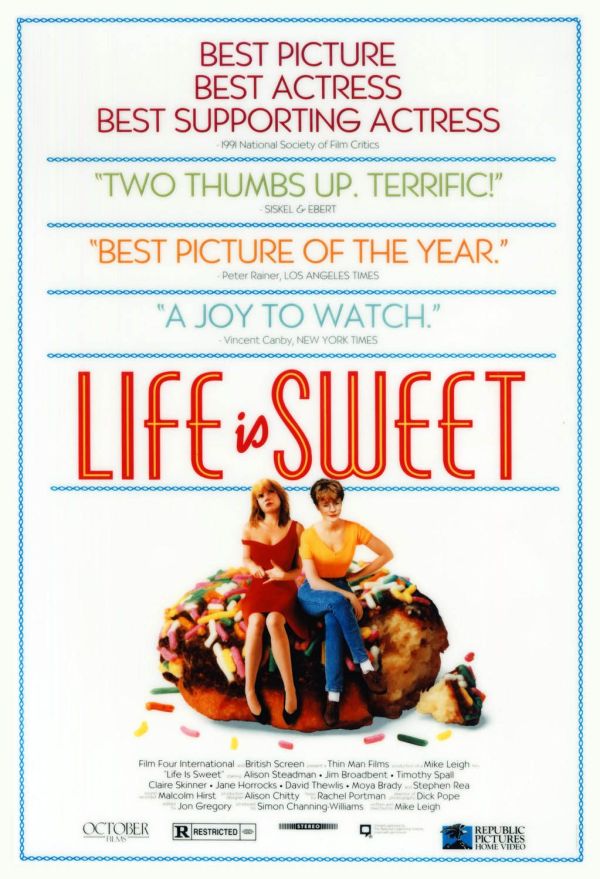
Andy (Jim Broadbent) and Wendy (Allison Steadman) are an ordinary married couple living in working-class London. Andy is a chef at a local hotel, and Wendy dabbles as both a dancing teacher for young children, as well as working as a salesperson at a clothing shop targeted at the younger members of society. The couple has a pair of offspring that don’t quite qualify as this, however. Natalie (Claire Skinner) is a reserved, dour young woman who works as a plumber, while in the meantime, her twin sister, Nicola (Jane Horrocks) believes that by spreading her perception of political correctness, as well as spouting out her ideas of an ideal world (which include rapid insults to everyone, including her own family) will help change the world. The film follows the family over the course of a few days, with various misadventures and happenings that show the family having to deal with a variety of strange and wonderful circumstances, such as Andy buying a derelict food van off of his friend (and habitual enabler), the unemployed ruffian Patsy (Stephen Rea), as well as the grand opening of the restaurant by Andy’s friend and protege, Aubrey (Timothy Spall) who is young and ambitious but utterly incompetent. Very much might not happen throughout the course of the story, but we see a family simply going about their lives, filled with moments of loving joy and petty resentments that many families experience on occasion, especially ones where ego plays a central role.
Leigh has found possibly the most exquisite stable of regular collaborators, which have worked with him throughout his career, and Life Is Sweet is not an exception, featuring some of his more notable collaborators, some of which would go on to give some of the most defining performances of their careers through their work with the filmmaker in other projects. Jim Broadbent, who has always been a reliable supporting performer, is placed at the forefront of this film, and much like in his later collaboration with Leigh, Another Year, Broadbent is able to showcase his endearing everyman sensibilities with his performance as Andy, an ordinary man who may not be particularly special, but he is a hard worker who provides for his family, as well as being a dedicated husband and a loving father. He may not be perfect, but he has a good heart. Allison Steadman is terrific as Wendy, and readily-armed with a witty remark or a warm compliment, she is a welcome presence in the lives of everyone she encounters. Steadman is a fantastic actress, and Life Is Sweet has one of her finest performances, never relenting from the endless warmth and genuine good-natured joyfulness. In both Broadbent and Steadman’s performances, there is a strong authenticity, and there is a profound lack of moments that ring as untrue throughout the film. They really do work well together – a statement to Leigh’s keen eye for casting his films with the right actors, as well as both Broadbent and Steadman’s chameleonic talents as performers, able to blend together with anyone in any situation.
In addition to these two central parental performances, the central quartet is completed by the two actresses playing the twin daughters of the main couple at the core of Life Is Sweet. Claire Skinner is excellent as Natalie, the quiet and private young woman working in a field almost entirely dominated by men, but managing to make a good living and earning the respect of both her co-workers (who see her as a peer) as well as her clients, who she treats with the utmost respect. The same cannot be said for her sister, played with marvelous excess by the wonderful Jane Horrocks, who does her very best to appear as the polar opposite to Skinner, bringing out the inherent hatefulness in her character of Nicola, who uses her apparently outspoken feminist disposition to mask her hidden insecurities, as well as her personal ailments that influence both her mental and physical health. Playing two very different characters who are supposed to be juxtaposed by a number of factors, both Horrocks and Skinner are tremendous, finding a complexity in a pair of characters that could have easily been nothing more than plot devices to drive the story forward. Leigh is too generous of a filmmaker to allow any of his talented actors to go to waste, and thus both are given a substantial amount to do throughout the film.
I must not neglect to mention two other performances which are worth noting. Firstly, Timothy Spall, another great but unheralded character actor, has a pivotal and memorable role as Aubrey, the oafish friend, and entrepreneur to the central couple, playing him as both lovably sweet as well as broadly idiotic. It takes a special actor to make the audience both love and hate a character, and Spall manages to do that here with his committed performance. The other is David Thewlis, who may have a diminished performance (only appearing in two scenes), but makes an indelible impact as one of Nicola’s lovers, who only spur her insecurities and anxieties through his abusive nature. Both Spall and Thewlis would subsequently go on to give their best performances under the guidance of Leigh: for Spall, it was his remarkable turn as J.M.W. Turner in Mr. Turner, and for Thewlis, it was his unquestionably brilliant performance as Johnny in Naked (which I personally consider one of the great screen performances of all time), and while neither may be particularly great here, they are memorable and imperative to the film as a whole.
Life Is Sweet is a really great film, and it sees Leigh doing what he does best – telling honest, human stories. Life Is Sweet came out in 1990, and it was only his third feature film, after a series of televisual films (some of which, however, were utterly remarkable, such as Meantime), and while it may not be considered quite as audacious as some of his more daring films, it does tower in its thematic content. This is a film about family, and it looks almost unflinchingly at the ties that bind us and keep us together. It is a film populated by imperfect people who are not particularly bad individuals, nor do they act in ways that are morally or ethically dubious, being relentlessly human in their actions. Leigh, in making this film, seems to intend to just tell a simple story about a family, looking at their various experiences and exploits without creating too much of a storyline, because that would suggest that he needs to create progression, which is something Leigh is not particularly interested in, rather looking at life as a series of moments, relishing in the present day’s experiences rather than looking at the overarching grand narrative of life. Leigh never shies away from showing things as they are, creating moving comedy about an ordinary family that is made out to be extraordinary through the magnificent perspective of Leigh and his unhinged empathy for human existence and the relationships we have with each other.
Leigh often makes films that examine life, and they often range from miserably bleak (Naked) to downbeat and heartbreaking (All or Nothing, Meantime). Life Is Sweet is distinct from these films insofar as it may be the warmest film Leigh has made to date, other than perhaps Another Year (which also had its fair share of serious examinations of life). The title of the film is not one created in vain: Life Is Sweet looks at life through the perspective of a family who may not be perfect, and may have their own personal quandaries and quarrels, but are ultimately happy, or at least approaching something that resembles happiness. This is a film filled to the brim with joy, being an exuberant celebration of life, a bold and unrelenting ode to the happiness that comes out of simple existence. Leigh is a great social filmmaker, and like any realist, he is able to look at life from both sides, through the heartbreaking and dull, to the joyful and endearing. This film has an overabundance of heart, but it is also never twee, and it does not ignore the more downbeat aspects of life, and there is no shortage of conflict in this film – however, the more bleak examinations are done in a way that is realistic, but not indelible – conflicts between characters don’t last an eternity, but rather are moments of vulnerability between individuals that are caused by each person’s flaws, and repaired by their adoration for each other, whether or not they are articulated as such. Life Is Sweet is a joyful celebration of things as they are, and Leigh deserves credit for making a film that is simultaneously heartwarming and heartbreaking.
Mike Leigh is one of the most important filmmakers of his generation, and the sooner we acknowledge his significance in a contemporary cinematic landscape, the better. From kitchen-sink realism in the 1970s to sweeping historical epics such as Mr. Turner and the forthcoming Peterloo, Leigh has left his mark on the cinematic world. Yet, even when he is at his most playful, such as in the instance of Life Is Sweet, he shows considerable talent, as well as admirable empathy, for the subject of humanity. He constructs a sensitive, heartwarming and lovable story that is not without serious subject matter but isn’t defined by it either. Life Is Sweet may not be the defining film in Leigh’s career, but it is certainly one of his more endearing films, a subtle, nuanced portrayal of an ordinary family, featuring terrific performances, a simple story, and a well-meaning execution. There isn’t much more that one can ask for from a film like Life Is Sweet, which remains one of Leigh’s most endearing achievements.
 The Postmodern Pelican