 I went into Duck Butter not knowing much about the film. I knew that it was directed by Miguel Arteta, who co-wrote the film with the star of the film, Alia Shawkat. I had heard that it was quite a unique film and one that was unlike anything really being made nowadays. The fact that it was an independent comedy hailing from the minds of one of the most interesting filmmakers working in small-scale cinema, as well as one of the most talented young performers of her generation was more than enough to motivate me to give Duck Butter a chance. It was quite an experience, and while I cannot say that I completely loved it, it is a film with an interesting concept, and a great experimental tone that sets it apart from many other romantic comedies being made now. If a film cannot be particularly great, it can compensate for its shortcomings with an audacious concept, and that is certainly something Duck Butter has an abundance of.
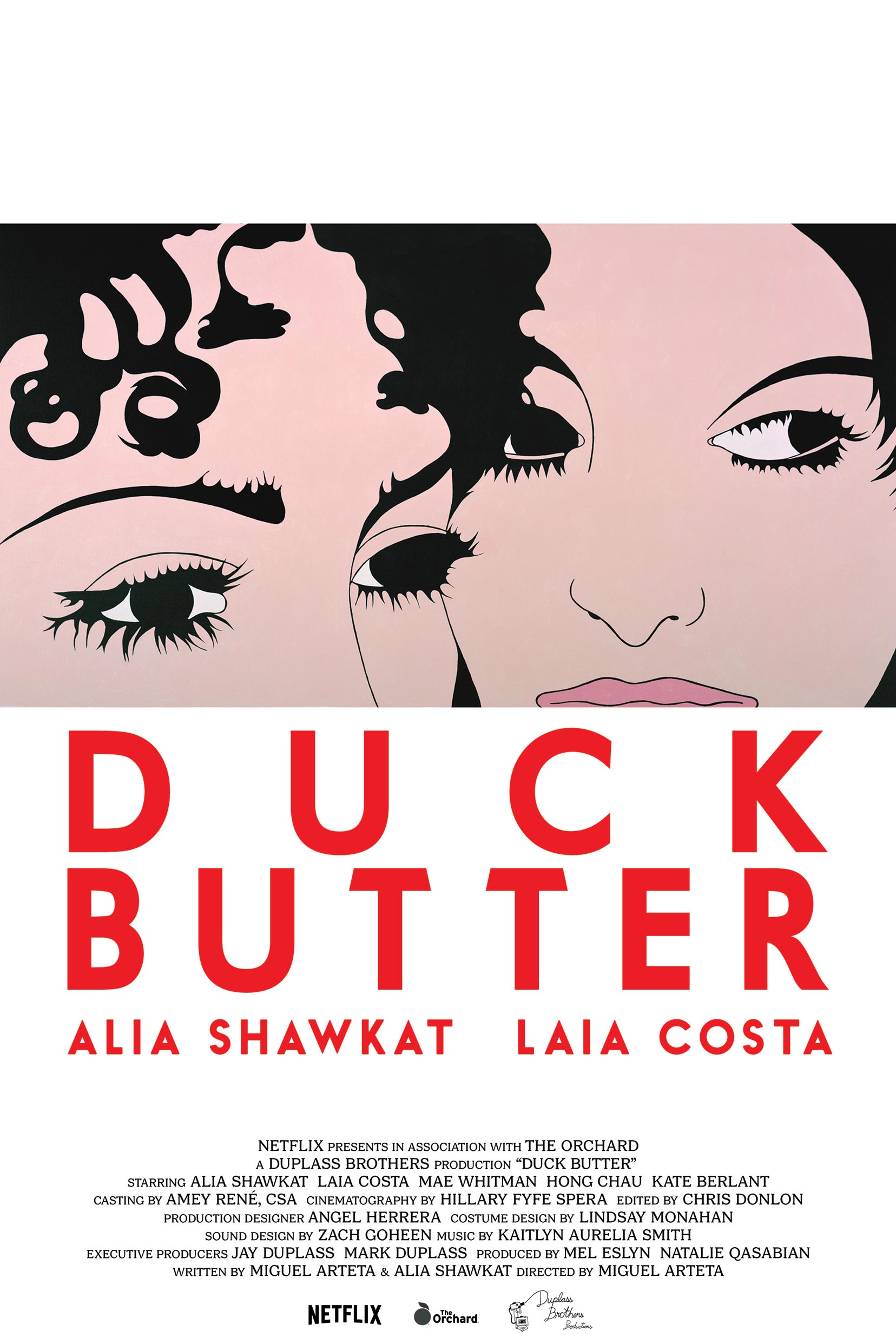
Duck Butter is about Naima (Alia Shawkat), who works as an actress on small projects, normally quaint, extremely independent films where she is usually relegated to inconsequential supporting roles. She seems to be on the verge of a breakthrough with a supporting role in a film from indie film icons Jay and Mark Duplass (obviously playing themselves in the film). However, Naima is an outspoken young woman, and even if she is not particularly aggressive with her opinions, she is willful enough for her thoughts on the creative process to result in her being fired from the project. To pick herself up, she meets up with Sergio (Laia Costa), an alluring singer that Naima had met the previous night at a local lesbian bar, and had been suitably charmed by. The duo decides to try an experiment – over the course of the following twenty-four hours, they are going to try and find a new use for intimacy, as a way of getting to know each other better, by having sex every hour over that period. What starts as an exciting and vaguely erotic experiment eventually blossoms into an intimate friendship, but one that is bound to be tested by the two insecurities and anxieties of these two individuals, and nearly as fast as they fall in love, they start to resent each other, and through their frequent love-making, their pasts come into play with terrifying clarity.
Alia Shawkat and Laia Costa are two of the most exciting new voices in cinema today, despite coming from varied acting backgrounds. Shawkat made her career as the scene-stealing Maeby in Arrested Development and then subsequently worked in a series of independent projects, both cinematic and televisual, showing herself to be a particularly talented actress when playing eccentric but well-meaning millennials. Costa has mostly worked in Spanish-language productions, with her breakthrough being Victoria in 2015. These are two actresses I did not ever think I would see collaborating, but yet, after seeing them in this film, it makes me wonder about what other pairings of seemingly-unrelated talents could possibly result in something this great. Duck Butter is built entirely on their performances, is an intimate character study about two individuals slowly forcing themselves to become radically intimate in the hopes of discovering details about the other, and ultimately themselves. Both are terrific, and while Shawkat is as tremendous as she always is, it was Costa who I felt gave the more memorable performance. Despite the film being focused on the character of Naima, she remains constant throughout, with her insecurities being central to the film. It is Sergio who draws our attention, with Costa playing her as an enigmatic, troubled young woman with a past she clearly intends to forget. There are other performances in this film (including from the tragically underrated Hong Chau, who is on the verge of her big breakthrough), but Shawkat and Costa are front-and-center throughout the film, which is both a glowing merit and a glaring shortcoming in terms of this film.
Duck Butter is an interesting film, and it is, more than anything else, an admirable experiment, both in the story it tells (which may be slightly unrealistic, but we can easily suspend disbelief), but also in the themes it covers. Independent cinema has the ability to tell stories not normally told and to cover subjects that mainstream films tend to usually overlook. Duck Butter is a great queer film, looking at a relationship between two young women who may embrace their sexuality, but don’t deny that they are still questioning it. Being such an intimate character study of two ordinary individuals allows this film to explore sexuality in a way that has many similarities to other erotic masterpieces such as Last Tango in Paris and Blue Is the Warmest Color, albeit not being nearly as good as these films, but rather being similarly-themed in their shared approach to be raw explorations of human sexuality. I admire Duck Butter for rising above its absurd premise and delivering a brutally-honest representation of sexual desire and queer desire in a way that is sensitive and not at all exploitative. Sometimes quite explicit, but artistically so, Duck Butter is unexpectedly profound in looking at the uncertainty that comes with sexual desire, and it quite significantly does not allow a heteronormative agenda take hold of this film, being proudly and unabashedly queer.
However, despite the praise I’ve given to this film, what made Duck Butter somewhat disappointing? Perhaps we should look at Arteta’s previous film, Beatriz at Dinner, which had many of the same qualities as this one: a quirky dark comedy that embraces its independent nature, with a strong female lead in the central role, and a layered, complex story that had thematic resonance. It had all the makings of a great film, yet it failed to bring them all together properly, and it just never peaked where it could’ve. Duck Butter had such a promising beginning, but it just falls apart in its third act, which is needlessly dark and convoluted. Duck Butter was an interesting experiment, and it was built around an audacious concept, but in an effort to both make this a feature-length film, as well as to give it some narrative grounding to situate the experimental core, a weak story was built around it, and as soon as the novelty of the film wears off, the film simply disintegrates into cliche. Arteta makes the mistake of trying to make these characters needlessly complex, and the film inserts unnecessary tension that is just never resolved. The final act feels detached from the promising first two acts, with the motivations of the characters being murky, and the story progression being vague and lacking in substance. It is unfortunate because Duck Butter had such potential, but due to the lack of attention paid to everything surrounding the central concept, it just doesn’t work nearly as well as one would’ve hoped.
Duck Butter is not a bad film, and it makes some bold statements. It is not a typical film, and it relishes in its absurd but alluring concept. There aren’t many films that are nearly as daring with how they represent both queerness and human sexual desire as this one, and I feel like Duck Butter can rival many of the more philosophical works that look at such themes, and if not for the disappointing third act, I would consider Duck Butter to be a great addition to the canon of queer films. It is not without its merits, as it has great performances from the two leads, both of which show great potential to develop into essential cinematic voices, in particular, Shawkat, who shows her prowess as both an endearing screen presence and a courageous writer here. However, it would be wrong to discredit Costa, who is beguiling and nuanced throughout this film. I found Duck Butter to be a film that has great audacity and is fully committed to its premise to the point where it loses sight of everything that converts a great concept into a good film, which unfortunately affected this film negatively, and made it far less brilliant as its premise would’ve suggested.
 The Postmodern Pelican