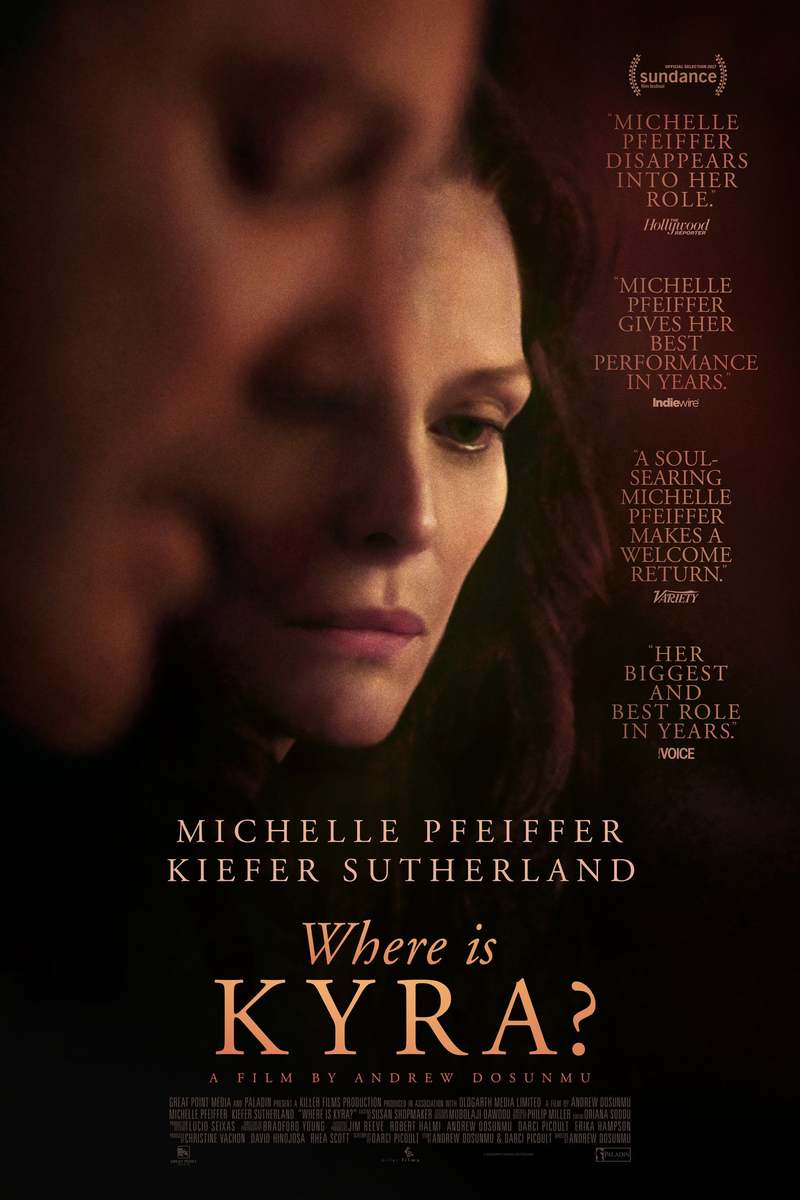
 I appreciate fearlessness in the arts. I genuinely admire those who can take daring, bold moves in creating something uncomfortable, polarizing but ultimately important, as it takes a lot of courage to make something that doesn’t always fit what is normally presented as great, popular art. Two artists I have been appreciating today are filmmaker Andrew Dosunmu and actress Michelle Pfeiffer, two extraordinary individuals who worked together to create one the year’s most heartbreaking but beautiful dramas, one that looks at various complex themes in a way that is bleak but never exploitative. Where Is Kyra? is an astonishing film, and one of the great independent dramas of the year, a film I found absolutely astounding in both its stunning simplicity and its meaningful story. Where Is Kyra? is a film that evokes images of the great realist films of the past, with a delicate portrayal of social issues as well as its relentlessly sad depiction of the troubled life of an ordinary individual, Where Is Kyra? may be an unquestionably difficult film to watch, but it is one that is almost entirely unforgettable.
Where Is Kyra? takes place somewhere in Brooklyn, where middle-aged Kyra Johnson (Michelle Pfeiffer) lives a sad existence, barely surviving in a hostile world. She was recently retrenched, as well as having gotten divorced from her husband a few years before. She has to take care of her ailing mother (Suzanne Shepherd), all the while frantically searching for employment, trying to find someone willing to hire a middle-aged woman without much experience to help her find a job. When her mother dies, Kyra discovers that through a clerical error on her part, the Social Security continued to send her mother her pension cheque month after month, which Kyra manages to exploit by dressing as her mother and fraudulently cashing in the cheques. Kyra is aware of the illegality, as well as trying to adhere to pleas from her boyfriend, Doug (Kiefer Sutherland) to stop, as if she is exposed, it could mean serious consequences. However, for Kyra, it is less of a decision and more of a necessity, as she needs to find some way to survive, and considering every attempt at employment she pursues results in a dead-end, she dares to face the consequences.
Michelle Pfeiffer – need I say more? I cannot think of many actresses as beguiling and talented as her, and throughout her career, she has been in a vast array of terrific films, always giving exceptional performances, regardless of what the role required from her. Pfeiffer, for some reason, has been somewhat obscured by some of her more bombastic contemporaries, which has resulted in her often falling by the wayside with more modern performances. However, I can make one bold statement, and one I will fight for, unequivocally: Where Is Kyra is perhaps her finest performance yet. It has been far too long since I have seen such sensitive interpretation of a fictional character brought to screen with such delicacy. Pfeiffer has the scarce but enviable quality of being capable of remarkable subtletly, and thus her performance here is nothing short of a complex portrait of a woman experiencing true hardships in a hostile world. In the hands of many of her peers, this role would’ve been played with unnecessary excess. Pfeiffer evokes vulnerability in a way hardly ever seen on screen, with her portrayal of Kyra being absolutely heartbreaking with its raw intensity and fierce honesty. Where Is Kyra belongs entirely to Michelle Pfeiffer, and while Kiefer Sutherland has some moments of quiet brilliance as well, nothing in this film can compare to Pfeiffer’s definitive performance, one that should hopefully remind modern audiences about the existence of one of the most extraordinarily talented actresses of her generation. Pfeiffer’s delicate portrayal of a fragile, perhaps even irreparably broken, woman is exquisite, and far too unsettling in how real it is.
Many filmmakers attempt to represent reality through their films, especially the neo-realists to come out of Italy and France, and the incredible kitchen-sink drama films of Thatcher-era Britain made by the likes of Ken Loach and Mike Leigh. It is not an easy feat to accomplish, representing life as it is, and many of these took a simple but effective approach to the “slice-of-life” sub-genre that audiences loved to see – they were well-meaning but not overly complicated representations of life. Where Is Kyra? can be considered very much akin to realism, but develops on the idea of looking at reality through willful audacity. Dosunmu does the seemingly-impossible by crafting one of the most stark and honest portrayals of suffering ever put on film, with the energy of reality pulsating throughout this film, resulting in an uncomfortable but almost transcendent experience. This is a film that takes an unhinged, brutally honest look at poverty and despair, featuring a protagonist (if one can say that of Kyra, a morally-ambiguous character if there ever was one) who is being impeded from living a fulfilling life through a combination of factors that may or may not be her fault: did her husband leave her because he was unfaithful, or because he just did love her anymore? Is she struggling to find a job because no one wants to hire an aging woman, or is she just not looking in the right places? Is Kyra really putting in all the effort she can to help herself out of the bleak, lonely existence she fears she will permanently be in? These are the questions posed by this film, which covers a wide variety of thematic aspects, crafting a brutally raw, emotionally-explicit social drama about loneliness, despair and class inequality that never lets the audience down for a single moment.
Where Is Kyra? would be an uncomfortable film even without its visual aesthetic, which only serves to increase the intense emotional brutality of this film. Acclaimed cinematographer Bradford Young, who has already forged a formidable career for himself with credits such as A Most Violent Year and Arrival, collaborates with Andrew Dosunmu for the third time, and his work in this film is nothing short of spellbinding. From a visual perspective, Where Is Kyra? is aesthetically as dark and brooding as the story it portrays, with the bleakness of the story only being emphasized by the way this film was photographed. Dosunmu and Young use lighting extremely well, creating a distinctive look that matches exceptionally well with the film’s tone. Every lingering moment of existential dread, every subtle movement Kyra makes towards becoming more destitute are all represented in this film’s astonishing visual aesthetic. It may be disquieting, especially through the use of effects that make some shots difficult to make out, but the cinematography was used as a powerful tool in this film, elevating this harrowing story into something much more bleak and arid, which was extremely effective and contributed massively to the overall impact this film had.
Where Is Kyra? is a great film, albeit quite a difficult, impenetrably harsh one. It is a haunting drama about poverty and loneliness and is anchored by a powerful performance that is likely the greatest Michelle Pfeiffer has ever given. It is a simple film, one that isn’t too preoccupied with inconsequential details or attempts to making this film more palatable for the viewer. It is an uneasy film to watch, and it approaches very bleak territory, but it is a marvelously complex social drama, one about the despair that can enter one’s life, and the resilience of the human spirit to survive, even if it doesn’t result in a particularly happy ending (the last moments of Where Is Kyra? are some of the most depressing I have ever seen). Where Is Kyra? is a film that makes an indelible impression, and leaves the viewer both traumatized by the raw honesty of the film and profoundly moved by the emotional resonance this film has. It is certainly a very special film, one that is understandably polarizing but is otherwise a complex, heartbreaking and unforgettable drama.
 The Postmodern Pelican