 Before he made two of the greatest English-language films of all time – Amadeus and One Flew Over the Cuckoo’s Nest – Miloš Forman was a defiant, rebellious filmmaker in his home country who helped define the period we now affectionately refer to as the Czech New Wave, representing the political tension and social strife in the communist state in raw, resonant film. His portrayal of society under the tyrannical socialist regime spreading throughout Europe was always bitingly acidic throughout the work of himself and his contemporaries, being bleak but moving representations of a society on the proverbial doorstep of the Soviet Union. While many of these films were often hopelessly sad and intensely philosophical films that attempt to condense sorrow and suffering into a palatable but distressing form, some of them possessed the enviable trait of having a sense of humor, and Forman was one of the central figures in creating social comedies that did not avoid showing the socio-political and economic effects on Czechoslovakian society and culture, but looked at them from a subversive, blistering perspective. Forman made some truly wonderful comedies that are intimate and idiosyncratic, such as the terrific The Fireman’s Ball (which was gloriously anarchic and chaotic in its satire), but perhaps his opus from this period of his career is the delightful Loves of a Blonde (Czech: Lásky jedné plavovlásky), a quaint, romantic comedy that manages to be delightfully funny as well as profoundly scathing in its social critique without being mean-spirited. There may even be times when I consider Loves of a Blonde to be Forman’s greatest achievement (but then I remember the towering masterpiece that was Amadeus, and I am swiftly corrected). Regardless, it is a masterwork of comedy being derived from the most difficult of circumstances, which isn’t only astounding, it is admirable.
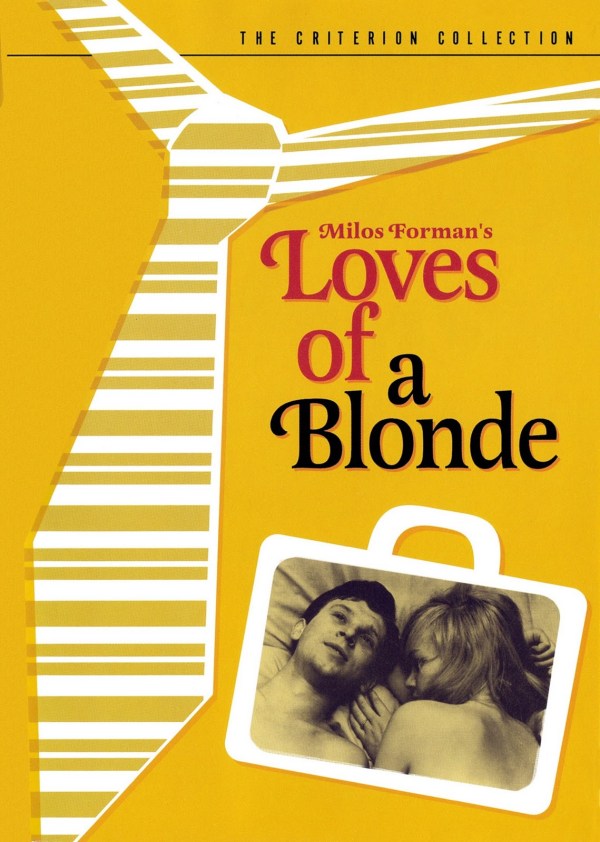
Loves of a Blonde is about Andula (Hana Brejchová), a young woman who works in a shoe factory in a small Czech town where women vastly outnumber men. In an attempt to boost morale and bolster productivity, it is decided – through conferencing between the military and the proprietor of the factory – to position soldiers near the town, and organize a social dance event to help incite relations between the repressed factory workers and the soldiers who are also in search of some memorable encounters. Andula, specifically, is growing weary of her lonely, bland existence, with her current beau being reliable but unexciting, and she wishes for something more, someone who can excite her and incite passion in her that extends far beyond the small town sensibilities that surround her. Throughout the film, Andula and her friends go in search of romance, aided considerably by the arrival of the soldiers into their small town, but when it turns out that these are not necessarily the kind of men that they were looking for – the strapping, youthful soldiers they were expecting are replaced by middle-aged, misogynistic buffoons, who are singularly incapable of possessing any charisma or redeeming qualities that would draw these young, eligible bachelorettes towards them. Instead, Andula’s eye is caught by the charming young musician, Milda (Vladimír Pucholt) who plays piano in the band brought in to perform at the dance, and very soon, a romance is blossoming between them, with the young pianist’s poetic sentiments and flowery language is a radical change from the often callous soldiers and country folk Andula usually interacts with. However, when Milda off-handedly suggests Andula visits him in Prague at some point (more of a courtesy brought on by the tense, romantic atmosphere at that moment, rather than anything he intended to honour), she takes it very seriously, and when she arrives on his doorstep, Milda’s conservative parents are anything but thrilled at the presence of a girl who was little more than one of their libidinous son’s inconsequential romantic conquests, rather than someone meaningful to him.
I found Loves of a Blonde to be a delightful film, an oddly progressive and forward-thinking film about romance, with many of the hallmarks that would later define romantic comedy being seen in this film. It is not the typical “meet-cute” situation, but rather the story of a young woman who is intent on finding love, and depending a bit too much on another person to give her the sense of belonging, but eventually realizing that sometimes throwing yourself at one person in particular can result in self-harm on an emotional level. Loves of a Blonde is a film that focuses on romance, but in a way that is small and intimate, rather than being a broad encapsulation of the feeling of searching for love. Throughout the film, or at least in the central storyline feature Andula (because Loves of a Blonde is not limited to her story), Forman explores themes of hasty infatuation, which is often followed by dreadful heartbreak and the despair felt when experiencing a broken promise, motivated by empty motives and fueled by the endorphin-filled delusions occurring at the moments of romance. It is a film about the other side of seduction, something that looks at the inextricably human aspects of falling for someone, perhaps not because of who they are as a person, but through a combination of their alluring manipulations, as well as the loneliness people like our protagonist feel. This is a film filled with characters driven by desire, one that never relents in showing these characters and their lovable foibles with affection and sweet-natured mocking. Forman didn’t make a particularly complex film here, but the themes are universal, and often transcend the simplicity of the story. These characters are also never viewed as archetypes – the soldiers may be driven by sexual desire, but they are not perverted. Andula may be young and beautiful, but she possesses logic and genuine emotions, and Milda’s parents may be conservative and traditional, but they are more blissfully ignorant than they are blindly faithful to social norms. Forman treats these characters with care, and it yields an authentic, tender representation of the subjects that the film focuses on.
Loves of a Blonde is not necessarily only about Andula, as I have mentioned previously. She is the central character, but there are several other characters that are focused upon throughout the film, all of which are played remarkably well. Forman crafts a subversive ensemble comedy, with brilliant moments come from several different sources, such as the salacious middle-aged soldiers who are planning to put aside their marriages for a moment and engage in indecent actions with any woman who will give them a second glance, or the bickering parents of Milda, who are astoundingly hilarious, and through which much of the final act of the film is filtered. Hana Brejchová, playing Andula, is wonderful, but this is not a particularly difficult performance, as she serves to be an embodiment of a young woman caught between two very different moments, that of youth and that of adulthood. Brejchová may not give a notably difficult performance, but she is natural and endearing, and her interactions with other characters show her effortless ability to oscillate between youthful innocence and childish naivety, and inexperienced but confident attempts at seduction. Vladimír Pucholt is great as Milda, the big-city pianist who fashions himself as a postmodern lothario when in actuality, he is just another slightly-chauvinistic young man who uses his assertive nature as a means to conceal his youthful insecurities, armed with his youthful lust for life and his penchant for over-abundant language. However, the two most distinctive performances come on behalf of Milada Ježková and Josef Šebánek, who play the middle-aged parents of Milda, both of which are absolutely hilarious, with their dedication to playing these irritating but endlessly likable characters being the highlight of the film. Loves of a Blonde is a film that features a well-constructed ensemble, and the natural performances given by each of these actors really elevates this film and makes it even more memorable, and considering these performers were non-professional actors, it lends even more authentic nuance to this film.
Loves of a Blonde is a film that is deeply optimistic and gentle in nature, but it does not lose sight of the social and political atmosphere at the time. In many ways, Loves of a Blonde is one of the finest (and only) communist romantic comedies, but instead of making any political statements in the way other films of the Czech New Wave did, Loves of a Blonde is more intent on being an earnest representation of the life of people living under the totalitarian regime. It is an affectionate portrait of ordinary people, as well as a scathing commentary on the mentalities that govern a society and influence how certain situations are generally perceived. Forman provides sharp and astute observations into the trials and tribulations of ordinary people in unremarkable locations, showing the more quaint and frivolous side of society, and the impact political actions can have on individuals in general – the epitome of the decisions of the upper-echelons of society directly influencing those at the bottom. It is a film that doesn’t intend to look at broad themes or make any profound statements on socio-political matters, but rather to be a simple and resonant comedy that takes an unflinchingly keen insight into the often-banal, but sometimes difficult, the existence of the ordinary person. The film is more focused on looking at the disparity between generations, commenting on outdated traditions and archaic beliefs, looking at different people – the youthful Andula and her friends who constitute the younger generation, the duplicitous, idiotic soldiers who form the middle-age faction, and Milda’s parents, who represent the older generation, with each different group having different interpretations of what is decent and how one should conduct themselves, with the interactions between different generations yielding fascinating views into various mindsets. The film is composed of several vignettes loosely-connected by the main character, rather than a consistent focus on a specific story, which gives Loves of a Blonde an even more realistic appearance and contributes to the general slice-of-life aesthetic that was intended for this film. There isn’t any over-arching grand narrative present in Loves of a Blonde – it is a chronicle of the lives of a few ordinary people living in less-than-ideal circumstances.
Forman truly was a masterful filmmaker, and Loves of a Blonde is one of his very best films. It is a sharply-written, relentlessly hilarious social comedy, brimming with exceptional performances and featuring insight into life under a communist state, looking at the sometimes harsh conditions with sensitive affection and lovable sardonicism. It is a captivating film, a realistic and good-natured portrayal of the lives of these ordinary people, and through the caring lens of Forman’s camera, these situations are presented as astonishingly nuanced. The stunningly simple cinematography, the memorable score, which is as subtle or bombastic as it needs to be depending on what is being conveyed, and a general warmth and tenderness that dismantle the socio-political cynicism implied throughout makes Loves of a Blonde a terrific film. This is a true gem, a daring Cold War comedy that keeps its message out of the political world and focuses on the social side of the era, where we are almost voyeurs to the happenings in a small town. Loves of a Blonde is a melancholic, endearing and often extraordinarily hilarious film, and one that keeps the audience engaged from start to end. This film is often so entertaining – whether in the moments of tender humor or broad slapstick – one often forgets that Loves of a Blonde represents a harrowing time, filled with sorrow and suffering, but one that Forman managed to depict with unwaveringly bittersweet optimism and unadulterated brilliance, and courageously dares to elicit laughs in a tragically desolate time.
 The Postmodern Pelican