 We all want to be ourselves. We can express who we are, show everyone our hidden talents and exhibit our unique traits and characteristics that make us nuanced, complex individuals. However, for some, there are aspects of their personal life that they cannot reveal to the rest of the world, due to intolerance and close-minded beliefs that govern society and unfortunately inform general perceptions of what normality actually is. This is the main theme behind Love, Simon, one of the most endearing films of the year. To be perfectly honest, it took me a while to warm up to this film, as there were many flaws and shortcomings that were present throughout the film, but what started as a film that I disliked at the beginning turned into an almost transcendent experience, a film I really loved, perhaps not necessarily because of the film itself, but for the message it conveyed. A film that seemingly subverts many tropes and conventions of the genre it belongs to, it rises above paltry material and despite its faults, it is one of the most soulful films of the year, a beautifully simple story about a young man trying to come to terms with his identity in a world that he feels may not be particularly accepting of him. Love, Simon may not be the definitive film of the Queer Cinema Renaissance we are currently in, but it is certainly a film that tackles complex themes relating to the LGBT+ community in a way that is loving, inoffensive (sometimes unabashedly safe) and pleasant, telling a story that may not be particularly realistic, but provokes some very important discussions to be had beyond the confines of this film. It is always the sign of a great work when it encourages discussion outside the work itself. I thought Love, Simon was an absolute delight, and I can honestly declare this as the most radical shift in how I felt about a film – what began as complete apathy ended in something very close to complete adoration. Love, Simon is not perfect, and it has some problems, but once you look at the message being conveyed, rather than how it is being conveyed, you find a very special film, an affectionate, adorably romantic and delightfully resonant film about acceptance and being the person you strive to be, even in the face of adversity.
Love, Simon is based on the young adult novel Simon vs. the Homo Sapiens Agenda by Becky Albertalli, and is focused on the titular character, Simon Spier (Nick Robinson), a 17-year-old living a pretty decent life – he’s got a loving family, a set of close friends and he goes to a school where is relatively well-liked, yet not particularly popular – he’s too ordinary to be noticed. However, he has a big secret: he’s gay. No one else knows, and he keeps this closely-guarded, struggling to come to terms with it, and having to endure the feeling of having to hide such a big part of himself because he feels like he is not going to be accepted if this detail about himself is revealed. When an anonymous message from a user named simply “Blue” appears on his school’s message board, professing the angst he feels at being closeted, Simon is shaken – there is someone who actually understands what he is feeling, and he can relate to much of what this mysterious person is experiencing. Over the following few months, Simon corresponds with Blue, never revealing his own identity or discovering the identity of his new, mysterious friend. Simon starts to realize that he is falling in love with Blue, but without knowing who he is, how can he be real? He relentlessly attempts to find out who Blue is, finding a set of candidates, and finding solace in the possibility that they may be a part of his journey to self-actualization. However, it motivates Simon to start questioning his own position in life, and drives him to work towards showing the world who he truly is, and hoping that Blue will eventually find his way out of the anonymous realm and into Simon’s life, where their virtual love can be made real, regardless of what those around them think. Simon spends much of the story trying to decipher who the elusive Blue actually is, with each candidate, in their own way, helping Simon realize who he is himself, and encourage him to embrace it and live his best life, regardless of the ramifications that may come his way.
The role of Simon Spier is not a particularly easy one, as the performer needs to navigate the fine, volatile line between being an archetype and being an independent, unique character. Nick Robinson, who has already developed quite a strong career, plays the titular role, and he did exceptionally well. However, this was not always the case, as I initially found Robinson’s performance to be flat, rigid and uncommitted – he seemed to be unable to inhabit the character well enough, and he seemed constantly awkward and uncomfortable – however, once the film has found its rhythm, and it understands what it wants to say, the true genius of Robinson’s performance is made evident. By no means is this a groundbreaking performance, and there are some issues I had with it, but for the most part, he found the truthfulness of the character and did it justice. Simon is not intended to be an entirely unique character – he is not supposed to be naturally charming, undeniably funny or anything that would make him stand out. The point of this character was that he was deeply ordinary, but an ordinary person who is undergoing an extraordinary personal change, coming to understand his own identity. Robinson is so effortlessly charming in nearly everything he has does so far (he managed to make the painfully mediocre The Kings of Summer watchable), and he portrays Simon exactly how he should’ve been – a likable but normal teenager who blends into the crowd, and then has to deal with standing out when his secret is exposed. Robinson is terrific, and while I was not initially sold on this performance, it really grew on me, and the authenticity of his emotions really moved me, with every moment being genuine. Robinson is a real star, and he is going to continue to grow as an actor, and the fact that he was able to deliver a performance that was simple but moving, making an otherwise plain character endearing and lovable, speaks towards his inherent traits as an actor and sets him up as one of the finest young talents working today.
However, Robinson’s character is giving the main focus, which is understandable, but it distracts from some of the other characters, many of which are played by actors who are remarkable in the roles. Katherine Langford is outstanding as Leah, Simon’s best friend. Langford gives the most nuanced performance of the supporting cast, with her characterization of Leah being simple but effective. She has a remarkable authenticity to her performance, being superbly natural in conveying Leah’s thoughts, and while the film does not give her (or any of the other supporting actors) much to do, she does enough to prove herself as an extraordinary actress, and that she is a talent on the rise, much like Robinson. Alexandra Shipp plays Simon’s other female friend, and she is constantly shown to have an endearing, undeniable charisma, and despite her character not having too much to do in her own right, or her own moments of introspection in the same way Langford’s character does, she is still fantastic. Jorge Lendeborg Jr. is very good as well but suffers from the fact that the other two friend characters were far better-written, and while he does have some great moments, they are usually at the expense of bolstering the moments of other actors. However, his efforts do not go unrewarded, as his performance is soulful, and he is responsible for some genuinely lighthearted moments, being the comic relief of the film, even if he doesn’t have too much to do.
Moving away from the younger cast, Jennifer Garner and Josh Duhamel are terrific as Simon’s parents who offer unconditional support and adoration to their son in his fragile, uncertain journey to self-realization. For the first two acts of the film, both Garner and Duhamel are relatively underused, which I initially attributed to the fact that this film only seemed to care about Simon, not developing the supporting character well enough. However, in the individual moments shared between Simon and each of his parents, both are wonderful – naturalistic and beautifully delicate in how they convey the emotions that are evoked. This film shows the despair in coming out, and it is even worse when it is to one’s own family, and while the family is perhaps slightly more understanding and accepting than what is realistic, the performances in those two moments were astonishing. Many people grappling with their identities wish that they had such unconditionally-loving, relentlessly-accepting parents. I need to give credit to the supporting performances in Love, Simon – these characters were not as well-written or complex as Simon, but the actors still have committed, nuanced performances and elevated the material, finding subtleties in these characters that would have been otherwise missing without such dedicated performances. Love, Simon relies quite heavily on its cast to be the emotional core of the film, and everyone is exceptional, doing more than what is required from some underwritten, and coming through with some lovely, touching moments that contribute to the overall tenderness of this sweet film.
Love, Simon is a film that attempts to be a subversion of traditional tropes, being a teen comedy like any of the other countless films that look at the high school years. Just like most of them, Love, Simon touches on the subject of romance, anxiety at the future, and the importance of friendship. The only difference is that Love, Simon is about a protagonist who happens to be gay, which is unfortunately not very common in mainstream films today, with gay characters often being relegated to scene-stealing supporting roles, rather than being central to these stories. Love, Simon dares to be different, and focuses on many of the same issues, while looking through the lens of an individual whose perspective is rarely viewed with such sensitivity and loving care as here. Love, Simon treads very familiar ground, but it does make some daring leaps in terms of how it portrays its lead character, showing him as someone ordinary who becomes extraordinary through slowly accepting who he is and working towards letting the world know who he is, and hopefully they will accept him too. I am torn as to whether the approach taken in this film was a merit or shortcoming of Love, Simon, because, on one hand, the idea to treat this story as any other coming-of-age romance shows a sense of inclusion and progression and doesn’t trivialize LGBT issues, but it also forces the story to get lost in its often overly-simplistic execution. This is one of the biggest shortcomings of the film, and the aspect of Love, Simon that initially made me feel very lukewarm about the film because through trying to comment on teen comedy conventions, it also brings along many of the same conventions that plague these kinds of films. There are some situations that seemed forced, and some of the writing was outright awful, with the dialogue often being peppered with cliches, especially in the more lighthearted moments. However, having said this, once the film finds its stride, it is almost unstoppably wonderful. I have very little doubt that while Love, Simon may not be a definitive constituent of queer cinema, it is quietly revolutionary in its own way, showing the uncertainties of teenage life, just focusing on one particular character and his own personal struggle. It is one of the better teen comedy films of the past few years, because it is unassuming and straightforward, and it chooses genuine heartfulness instead of over-ambitious filmmaking, and that is certainly a reason as to why Love, Simon is such a tremendous film. As I’ve said (and will doubtlessly say again), this is by no means a perfect film, and some of its most glaring faults are present right from the beginning, but once you abandon your preconceptions (and a bit of logic), there are few films as soaringly captivating and engaging as this.
I can talk about Love, Simon as a standard film endlessly, and examine it through the lens of other teen comedies – yet, that completely defeats the purpose, and would neglect the fact that Love, Simon is a film that succeeds not on its execution, but on its message. Love, Simon is much more than just a teen comedy where the protagonist just happens to be gay. It is a vital film, a film that many young people who cannot grasp who they are, or struggle with their identity in some way, can relate. This is a film that may not be flawless, but those shortcomings are rendered completely inconsequential when considering this film as something much larger, a mainstream comedy that introduced complex themes to a wide audience, as well as being a story that those who have ever experienced such uncertainty and anxiety based on who they are can see themselves and their experiences reflected in. Love, Simon is a progressive film, focusing entirely on the concept of acceptance. Simon Spier may not be a particularly noteworthy protagonist in the traditional sense – he is an ordinary young man, without any traits that make him exceptionally special – yet, through this story, we see the struggles of many people reflected. Love, Simon is not about Simon – its about everyone who has ever felt like they do not belong, or have to hide who they are to please the world around them, feeling the overwhelming fear that if they reveal who they are, somehow those who are closest to them will be driven away by such a revelation. Love, Simon may not be a groundbreaking LGBT masterpiece, but it is trailblazing in its own right, being a film that says that one should never feel that their identity makes them less of a person, and while it is not always feasible to proverbially shout it from the rooftops, the cathartic, liberating experience of showing the world who you are and having them accept it is made evidently clear throughout the film. Arguably, Love, Simon shows only one story – and one that is filled with strangely accepting characters – and one that doesn’t show the harsh, difficult circumstances some brave individuals who reveal who they have to endure, but it still preaches something unquestionably important: acceptance and tolerance, for everyone, regardless of who they are.
But honestly, I just cannot limit myself to talking about this film like every other review. I can’t just use flowery, formal language and look at this from a purely cinematic perspective, or imply its overall importance without connecting to it in some way. I need to write from the heart as well, because this was nothing short of a moving experience, and the way it conveys the message, particularly in the second half of the film (which was far superior to the middling first act) was nothing short of astonishing, and it meant a great deal to me. Love, Simon is an important film and one that delivers a message of utmost significance in a way that was profoundly touching, and will certainly connect with multitudes of people. Love, Simon is one of the year’s most acclaimed films, not because it is another of an enduring set of lovable teen comedies, but because it strikes a particularly profound note with so many people, and its raw emotional resonance exceeds its often dull execution. Beyond this film’s glossy and safe exterior, there is a message that begs to be told, and while Love, Simon is not the first film to deal with such themes, it is one of the most poignant, and the fact that this story was told in a mainstream film, one that has reached wide audiences, really warms my heart. I was not intent on liking this film, and I approached it like any other film, perhaps with a touch of apprehension due to the fact that what I had heard, from a cinematic perspective, did not inspire much confidence. I thought it was poorly-written at the outset, and felt clunky and awkward at times – but when the core of the story kicked in, and we saw the struggle Simon experienced in coming to terms with his identity and grappling with the uncertainty of what he is feeling, it completely sold me. The moments when Simon simply utters the words that change his life, letting the world know the truth about himself, sent chills up my spine, and the film reduced me, as embarrassing as it is to say, an emotional mess. I rarely am moved by artificial sentimentality (and as much as I have said Love, Simon is an emotionally-resonant film, it is guilty of pandering to elicit certain responses, but it does it well), but I found myself holding back the tears throughout this film.
Anyone who has ever felt different will respond to this film – Love, Simon does not intend to be resonant to only the LGBT community – this is a film about outsiders, about rebels who do the most defiant thing of all: they dare to be different. Some of them flaunt it proudly, others conceal it for the fear of being rejected, but their struggle is no less admirable. Love, Simon is a film that makes the bold statement that regardless of who someone is and what makes them different, they are as equally deserving of utmost affection and adoration as everyone else. It shows that no one should have to feel ashamed to not conform to what society sees as being normal or conventional. Anyone who has ever felt a sense of not belonging will relate to this film in some way, and it will doubtlessly tug at the heartstrings of anyone who wants a sweet, endearing film about coming to terms with who you are. This is a film that focuses on love and acceptance, and it appeals to a wide audience through its lovable, captivating story of just expressing who you are. Love, Simon wears its heart on its sleeve, and never avoids making it clear that acceptance and tolerance are not privileges – they are fundamentally important to every person, and something that everyone should be able to experience, especially when they decide to take the admirable step towards defying societal norms. What this film intends to say far surpasses how it says it, and for what it lacks in terms of a story it more than compensates for in its message, with the central story being engaging and heartwarming, and the discussions this film has provoked are worth more than anything else.
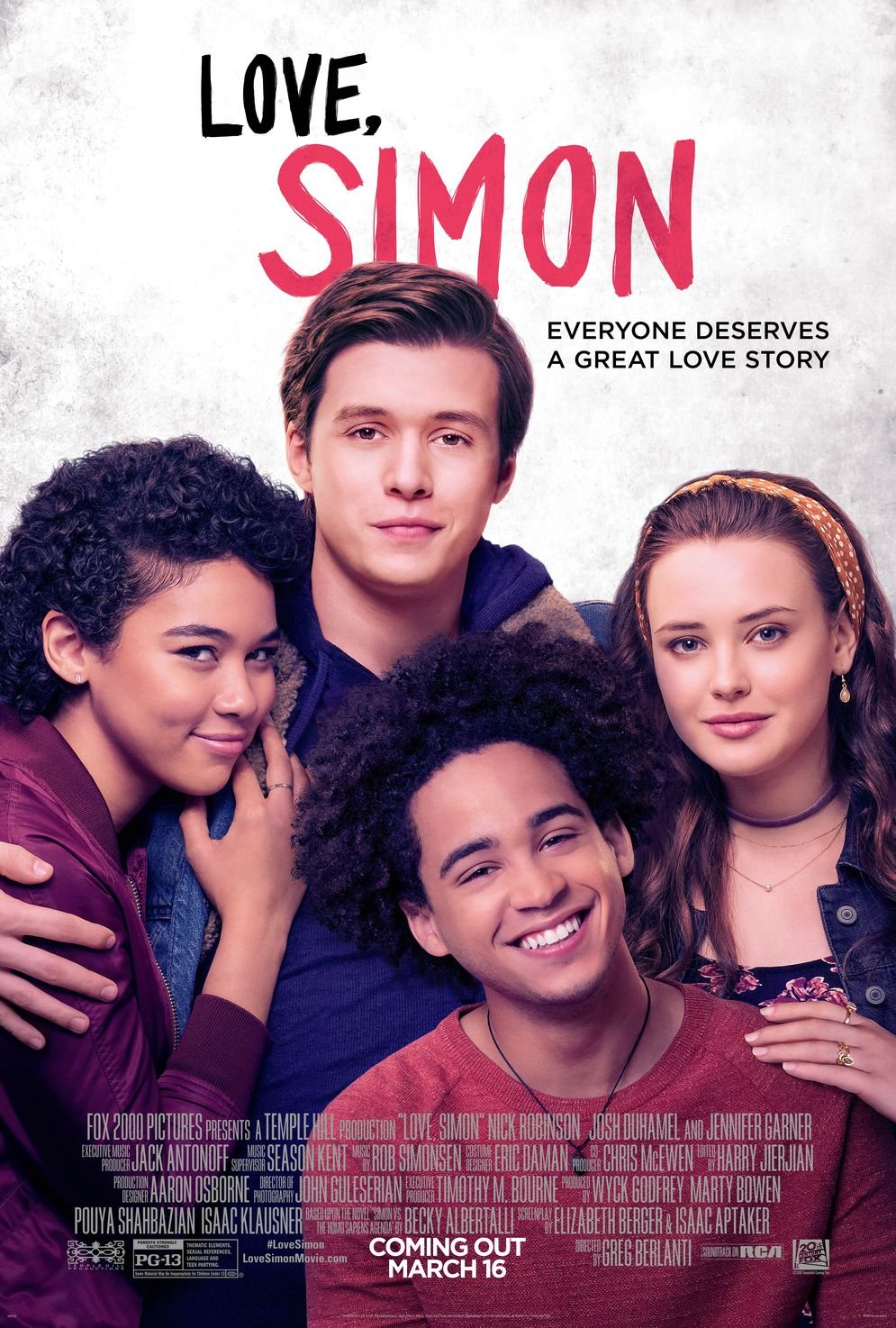
I apologize if this review, especially the previous few sections, have been overly verbose or repetitive on certain ideas. Love, Simon truly struck a chord with me, and I found myself reeling at how profoundly moving it managed to be, and it proved to be a film that meant a great deal to me, and judging from the overwhelmingly positive reception this film has received from all around the world, I am sure it has moved people from all walks of life in much the same way. Over the past few days, I have not stopped thinking about this film, and in spite of its flaws, it has an intention that has lingered on, and it is admirable for its representation of a gorgeous but simple story about self-realization and acceptance. It overcomes narrative shortcomings and faults in the filmmaking with a beautiful story of inclusion and acceptance. It may certainly not be perfect, and it is plagued with some problems, such as narrative inconsistencies, middling dialogue and average characterization for many of the characters, as well as often being unnecessarily saccharine and too sentimental at times, but these don’t matter that much when one considers how progressive this film was. The tagline of this film is “everyone deserves a great love story”, and that is exceptionally clear throughout, with the affectionate and heartfelt story being bold and progressive for this kind of film.
Even though, cinematically, Love, Simon isn’t particularly daring and remains notably safe in how it executes the story, its bold stance in making a specific point deserves acclaim. This is a film made for everyone who does not conform to what is considered conventional and wants to be themselves, regardless of what others think. In some instances, it is easier for some than for others, and this film does focus on one specific story and one that is arguably too straightforward to be entirely realistic, but this is utterly inconsequential in considering the importance of the message. I really thought Love, Simon was a terrific film, one that dismantled my cynicism and moved me considerably through its undeniably adorable charms. More than anything else, Love, Simon is a film that conveys the profoundly moving but exceptionally simple sentiment: accept yourself, be proud and most importantly…exhale.
 The Postmodern Pelican