 We really need to talk about Hereditary. Every word of what I am about to say is absolutely and undoubtedly true, rather than being the result of hyperbole or over-emotional excitement, and I stand by everything I am about to express. I have taken time to absorb this experience, and pondered my multitudes of thoughts and attempted to come to terms with the emotions that this film evoked. I have come to one conclusion, and I do not say this without realizing the magnitude of what this implies: Hereditary is the scariest film I have ever seen, and based on what others have said, it is not a lone sentiment, but rather a perception that many others feel as well. It takes quite a bit to scare me, and Hereditary terrified me in a way that nothing ever has before, to the point where it assimilated so deeply into my psyche, even my dreams were impacted by this film. It is a film that quite literally gave me heart palpatations, and I struggled to verbalize exactly what I felt. There has been no work of fiction that has left me at such a loss for words, and the aftermath of Hereditary is unlike anything I have ever felt before. I left that cinema almost broken from this experience – it shook me profoundly, and not many films are able to elicit such a visceral reaction from me. I am not immune to scary films, but Hereditary was something completely different, something truly sinister. It is a film that I am still failing to understand – not necessarily thematically or in terms of the storyline, but rather emotionally. I have been struggling to get my mind around this awe-inspiring film, and perhaps the best way to describe it is as follows: it is an audacious, brilliant and effective film, and one that I most certainly never want to see again. A film filled with unpleasant surprises, gruesome violence and a genuine sense of maliciousness that haunts the audience long after the inappropriately-upbeat final credits have ended. Forgive me if this review seems to be incoherent and slightly inconsistent and nonsensical – I am still processing this experience, and grappling with the myriad of thoughts that linger in my head about Hereditary, one of the most uncomfortably incredible films I have ever seen.
I want people to see Hereditary – not only because it is a brilliant film, but also because it is an experience that I feel everyone should have. Therefore, I cannot in good conscience talk about what this film is about specifically, because the marketing and promotion for this film has been very effective in selling this film as something it is not, which proved to be one of the least horrifying surprises contained within this film, but one that subverts expectations and allows this film to take some unpredictable turns that very few audience members would suspect. However, it is also a film that I feel the need to discuss in certain ways, and that would require some mention of various details that do verge on revealing the hideous story at the core of this film. Therefore, if you have not seen this film, read this review at your own peril. Personally, I don’t even consider this a review – I think of this as a psychotherapy session of thoughts, a post-mortem discussion of my nerves that were viciously slain throughout this film, as well as a way of me to work through an experience that I will not deny was almost entirely traumatic – I’m still reeling from the intense and horrifying . Some may call this a disclaimer, others an explanation for my own fragile emotional state – personally, I consider this a very stern and solemn warning: Hereditary is utterly horrifying, and soaringly audacious in every way. Ari Aster is both a genius and a sadist for putting audiences through this film, making Hereditary one of the most daring debuts of any filmmaker of the current century, and has set him up as one of the most talented young directors of this new generation, someone whose career I am keenly going to observe, if for no other reason than to just prepare myself for his next terrifying fable.
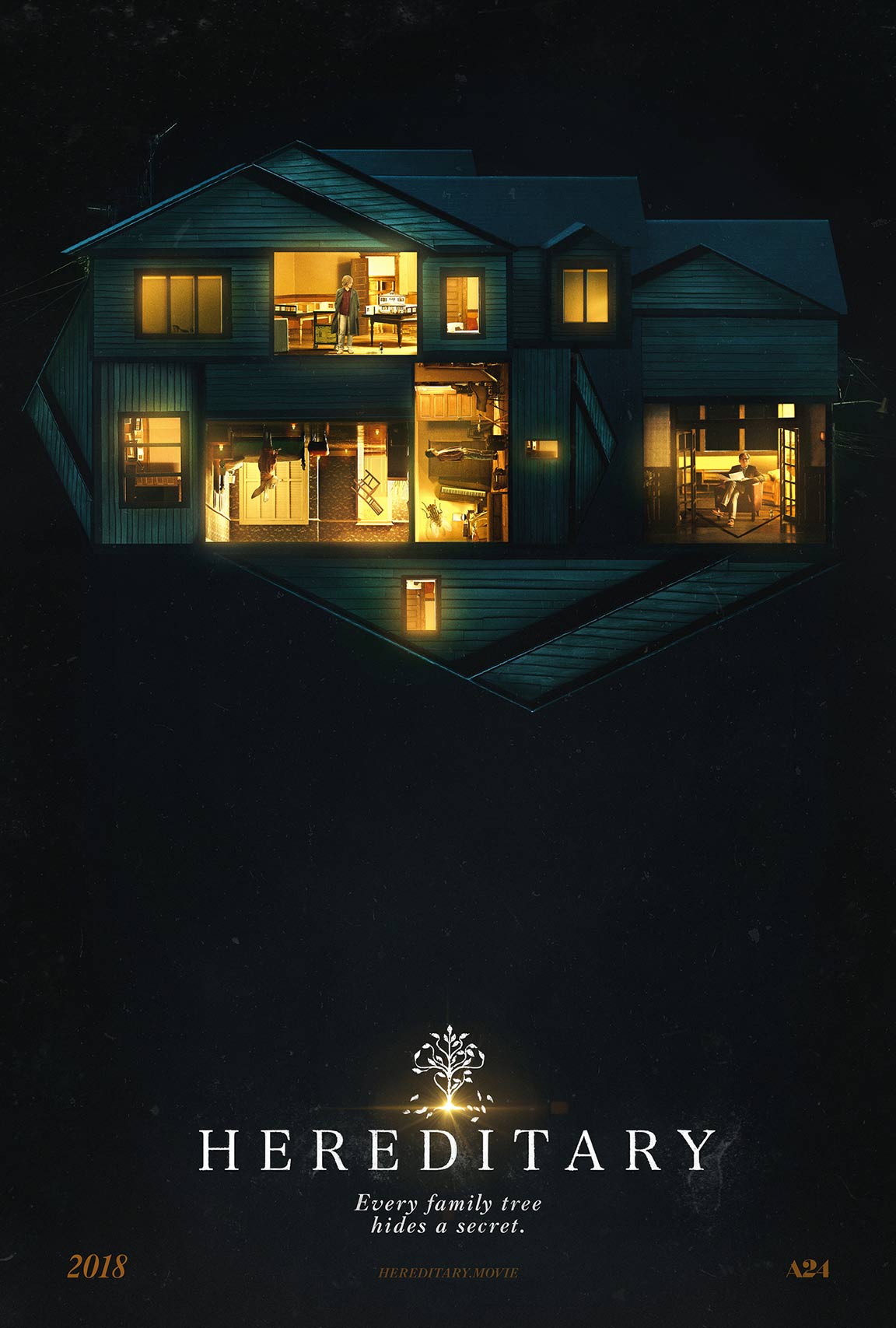
Hereditary is one of the most idiosyncratic horror films of the past decade, and is centered on the Graham family, led by patriarch Steve (Gabriel Byrne), a doctor, and his wife, Annie (Toni Collette), an artist known for her detailed and highly-personal miniature models, which seem to be a method for her to work through her various traumas in a way that keeps her relatively sane and grounded. They live in their beautiful home with their children, Peter (Alex Wolff) and Charlie (Milly Shapiro). However, this is not a happy family, with tragedy striking from the very first moment, where the family is preparing for the funeral of their grandmother, whose death is not only a saddening moment for the Grahams, but also the catalyst for the events that follow the family, unleashing paranormal pandemonium on these innocent individuals who are a part of a family that have some truly sinister secrets lurking beneath their idyllic surface. The past comes out to play, and is intent on following the members of their family, reminding them of their past transgressions and ensuring that they never forget that there is always someone out to get you. The supernatural realm starts to impinge upon the family, and it does not intend to be particularly faciliative of the family’s fears, rather attempting to tear them apart, as the mysterious past starts to become uncovered, and from which there is certainly no possibility of escape. I highly suggest watching Hereditary to understand exactly what I am referring to here – there are some things to which words simply cannot do any justice, and the story of Hereditary is simultaneously the most shocking and subversive, as well as malevolently twisted and terrifying I have yet to see.
Toni Collette is such a terrific actress, being able to be naturalistic and engaging in nearly every genre of film. One of her most well-regarded performances is in the iconic The Sixth Sense, a horror film that managed to become an unexpected cultural touchstone. In Hereditary, Collette is returning to these horror roots with a performance that may just be the best English-language female horror performance of the twenty-first century, and as hyperbolic as it sounds, it is something I am actively considering to be true. There are few horror performances as nuanced and complex as Collette’s here, and her depiction of Annie, a troubled woman who wants to keep her family together, while trying to rid herself of the pervasive curiosity that eventually leads to unhinged chaos being inflicted onto the family she tries so unbelievably hard to protect. Collette is fearless in her performance, and she conveys a unit set of emotions that are rare in these kinds of films. Her grief is heartbreaking, and her fear is palpable, not to mention the third act that sees Collette’s performance take an unpleasantly terrifying turn, which gives her the opportunity to play this character from a radically different standpoint, with two moments in particular being the subject matter of the most terrifying nightmares – and if you have seen the film, you will know exactly which two moments I am referring to. Collette has an admirably great scene-partner in the under-heralded Gabriel Byrne, who may not have the most well-developed character in comparison to the others, but his performance is still profoundly moving, and as the last possible beacon of humanity in an otherwise unsettling, horrifying world, he represents normality and order, with the downfall of those logical paragons being co-timed with his own unfortunate demise in a manner that is indelibly disturbing, as are most of the moments in this film.
There are other performances in Hereditary that make indelible impact, such as that of Milly Shapiro, who makes an explosive debut as the young daughter of the family, a character who is an unsettling blend of innocent and sinister, holding onto her own secrets. There is something strange about her character of Charlie, and serving as the central character in the film, she remains enigmatic and mysterious, with her condition remaining entirely unspoken, which suggests that perhaps she suffers from an otherworldly affliction brought about by the forces of malice to wreak havoc on those who love her unconditionally. Ann Dowd, a wonderfully reliable character actress, also has a pivotal role as Joan, the support group participant who reaches out to Annie to offer her help, and eventually leads her down a path of pure anarchy, serving as the catalyst for pandemonium. However, the most impressive performance in this film – one that even eclipses the astonishing work from Collette, comes on behalf of Alex Wolff, who is unpredictably brilliant as the teenaged son who is left damaged and beyond repair after a certain tragedy, becoming the central figure in a plot development that exceeds the boundaries of what is acceptable, and verges on being profane in its unrelenting immorality and depravity. Wolff is unequivocally brilliant, and this performance, much like Collette’s, will be a defining one in the canon of great horror performances. Hereditary is distinctive for not only having a strong but diabolical story, but also performances that elevate this story into the region of almost nefarious flair.
I have seen many horror films, and they usually range from endearingly fun to heartwarmingly entertaining, even at their most bleak and violent. Contemporary horror films, especially those with similar thematic framework to Hereditary (what this is I won’t mention, if only to keep some element of horrific surprise for those who are uniniated to this film’s malicious charms) usually do utilize scare tactics effectively, and create a sense of fear, but in a way that is exhilirating rather than wholly terrifying. Hereditary is different for a number of reasons, but right from the outset, one aspect is more overt than any other: this is a film completely lacking even an iota of joy or levity. The reason Hereditary lingers on for so long in the mind of the viewer is not because it had genuinely terrifying moments – it is because there was a truthful sense of evil in this film. It is a sinister story that feels ultimately too bleak to be entertaining. There is a palpable sense of malice the flows throughout the film, removing any possibility of warmth. From the first unsettling moment to the excruciatingly horrifying final shot, Hereditary is unnerving, cold and harrowing. What makes Hereditary such a spine-chilling horror film is the ways in which it subverts traditional horror film conventions, and while it does rely on some familiar elements, it ultimately manages to be far more eerie and menacing than any other film of its ilk. While most other horror films are aimed to entertain through scaring the audience, Hereditary seems to intend to be a terrifying, alarming and blood-curdling nightmare, from which very little joy or enjoyment can be derived. The key to the success of Hereditary lies in its relentless dedication to being indescribably dark and hopeless, which is one of its biggest merits.
However, as chilling as the supernatural elements of this film are, the true core of Hereditary lies in its approach to representing something quite literally very close to home – family. This is a film about the bonds we form with the people closest to us and while the paranormal aspects of this film are unbelievably effective, the film finds its true soulful terror in how it looks at familial relationships. This is a film about a group of individuals combating demons – not necessarily only malevolent entities from the realms of the underworld, but rather the relentlessly disturbing imprint of the past, which follows these people around, constantly reminding them of the past transgressions of their ancestors and themselves. Hereditary uses its horror structure to be something far deeper, a metaphor for a family broken by the unbearable weight of secrets and deception. None of these characters are without flaws, and often are shown to be deeply troubled individuals, featuring their own psychological disformaties. Beneath the surface of an endlessly terrifying horror film, there is a poignant and resonant story about trauma and the process of grieving, and how a tragedy can result in erratic behavior that could either bring a family closer together, or draw them further apart. Hereditary is not a simple horror film, and it has some very distinctive narrative depth that transcends the boundaries of horror filmmaking, utilizing its fragile understanding of the human condition and the bonds of family in a way that is realistic but never anything less than agonizing and petrifying. What this film stands for remains to be seen, and I have very little doubt that Hereditary will be subjected to constant analysis and interpretation, with Aster’s meticulous detail providing more insight into what this film represents, which extends far deeper than what we are initially presented with.
Ari Aster is one of several filmmakers that make their debut feature film by using the sources of inspiration as the core of their films, allowing their stories to flourish with the assistance of what came before, without relying too heavily on pastiche or homage. I could count over a dozen overt references to pre-existing horror films that were clearly influences on Aster in the making of Hereditary – there are elements drawn from Rosemary’s Baby, The Shining, Don’t Look Now, Carrie and multitudes of other works that set the groundwork for this film. I could easily write a scene-by-scene analysis of the panoply of references peppered throughout this film (if I ever gain the willpower to endure this experience again), and it is clear that Aster was highly inspired by those who came before him. Moreover, much like any of the now-established filmmakers who started their careers along similar trajectories, using their inspirations as the core of their films, Aster seems to have made a film that is most certainly going to become an enduring classic of horror cinema. There are countless moments of unrivalled genius in this film, almost too many to even comprehend, that will definitely find their way into the hallowed company of truly iconic works of terror. I am in awe as to how Aster was able to create something so undeniably brilliant out of nearly nothing, using an audacious concept and combining it with bold filmmaking, where the director manipulates the filmmaking process in a way that is even more sinister and unique, with some moments of awe-inspiring beauty and nightmare-inducing fear. Aster, through reckless intrepidity, has made a masterpiece of modern horror, and one that will transcend time, and most certainly be looked on as a distinctive, important piece of filmmaking, gazed upon in the same way we look at films such as The Exorcist, The Shining and Psycho, amongst the many other legendary horror films that are now considered towering represenatives of the genre. This judgement is definitely premature, and almost pretentious, because an individual does not get to decide what films stand the test of time, but I have very little doubt that Hereditary will not become a definining horror film of this generation, which will endure to succeeding generations, who will most likely marvel at the bold fearlessness imbued within this film. Once again, not a trace of hyperbole present in these sentiments.
I am unbelievably conflicted on what to say about Hereditary. On one hand, I want this film to be seen – independent horror films provide some of the most fearless and bold stories, and we are currently in a renaissance of contemporary horror, with Hereditary being one of the brightest examples of this kind of daring filmmaking. Yet, I also cannot suggest such a brutal, horrifying experience to anyone. I am torn between recommending running towards or away from the cinema – and if that is not indicative of an effective film that provided exactly what it intended to, I have no idea what is. It is a film that I just cannot love – but that does not change the fact that it is nothing short of a contemporary masterpiece, and a film that is undeniably going to become a distinctive, iconic addition to the canon of the greatest horror films ever made. This film is a a cinematic experience I won’t soon be forgetting, regardless of how hard I try.
 The Postmodern Pelican