 Most people, myself included, enjoy seeing films that challenge and stimulate our minds, giving us something to think about through defying conventions and being unique and approaching familiar stories in new ways. However, from time to time, one just needs a dose of pure escapism, usually on behalf of an entertaining but conventional film, such as Finding Your Feet, an endearing and charming British comedy that may not be entirely remarkable, but it has merits of being one of the most delightful films of the year so far, one about seizing the golden years of one’s life and engaging in an ambitious marathon towards the unresolved dreams and unaccomplished achievements that often haunts those in their autumn years. Finding Your Feet is a well-meaning film that may not offer too much in terms of the filmmaking, and it may be dreadfully predictable, but it is truly an amusing and quaint little comedy about human relationships, as well as second chances, and a film that is both laugh-inducing and tear-jerking, a meaningful ode to romance and friendship, and focused intently on exploring human nature, through a lens of endearing and often irreverent comedy that results in something arguably conventional and oftentimes excruciatingly predictable, but still well-meaning, inoffensive and absolutely delightful.
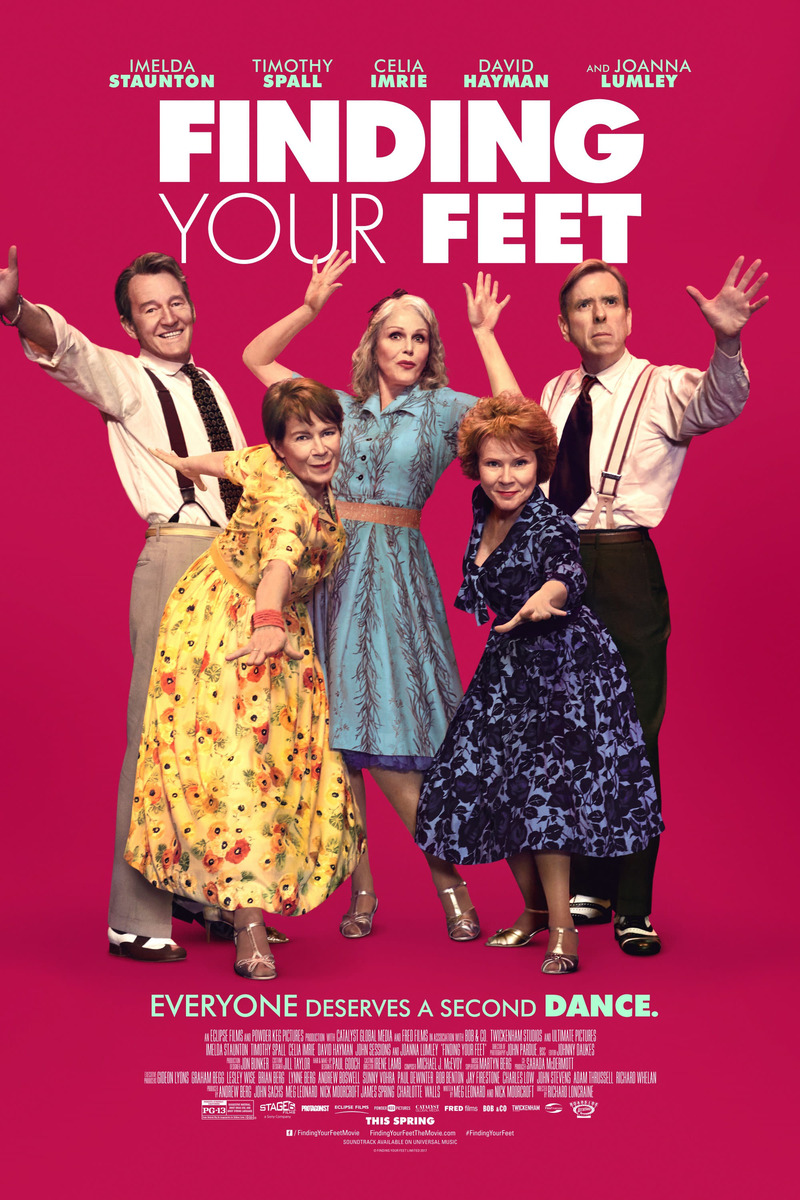
Sandra Abbott (Imelda Staunton) leads a seemingly idyllic life, married and living in a luxurious home with bundles of friends an overabundance of wealth. Her husband (John Sessions) has been made a life peer, and thus making Sandra even more pompous, with her unearned title of “Lady” almost immediately going to her head, which she believes gives her superiority over those around her. Her perfect existence is dismantled when she discovers her husband has been having an affair with her best friend. Instead of trying to fix their broken relationship, Sandra retreats to her sister, Bif (Celia Imrie), a free-spirited woman who lives her life to its full potential, and what she lacks in material wealth she more than adequately makes up for in joie de vivre. The two sisters are initially in conflict, and their personalities clash considerably, until Bif forces Sandra to attend her weekly dancing class, where she meets some of Bif’s fellow free-spirits, such as Jackie (Joanna Lumley), an eccentric and endearing serial divorcee, Ted (David Hayman), a humble but hilarious fellow and most notably Charlie (Timothy Spall), a handyman who balances his gruff exterior with tender moments, as he deals with the fact that his wife is in the last stages of Alzheimer’s disease, and she can no longer even recognize her husband. The joyful atmosphere and interactions with people who are not driven by affluence or wealth, but rather meaningful human connections, brings Sandra out of her shell and perhaps even permits the possibility of a late-stage romance, especially because Sandra and Charlie seem to grow quite fond of one another. Through the haze of marijuana smoke (“purely for medicinal purposes”) and the gleefully blaring sound of dance music, Sandra sees her life start to change considerably, and she becomes a new, independent woman who realizes that it is never too late to start over.
One of the most significant merits of Finding Your Feet is its cast. It is not a loud or bombastic film and not one that relies on grandiose filmmaking techniques, but rather depends on an ever-reliable cast who deliver exceptional performances. Moreover, it constructs an ensemble of highly-respected but perhaps underexposed British character actors, who are frequently utilized as consistent supporting presences, rather than being cast in prominent leading roles. Imelda Staunton is a well-regard actress, and while she has had her fair amount of decent leading performances, such as the towering Vera Drake and her exceptional theatre work, her talents were mostly limited to the supporting capacity, which is not entirely undeserving (she did give the best performance in the history of the Harry Potter film franchise, which really is saying something). As Sandra, Staunton is able to portray a complex character, a woman with a fall from grace rarely seen, moving from the prestigious elite of the nobility, sipping champagne and engaging in banal small-talk with some of the wealthiest and most influential people in Britain, to the common folk, dancing in a church hall with a motley crew of geriatrics and retirees. Staunton has always excelled at playing characters on either side of the socio-economic spectrum, and Finding Your Feet allows her to explore elements of both. I think she is one of the most brilliant actresses of her generation, and her unbridled commitment to each and every role she is given is unprecedented, and she is an astonishing actress, capable of running the gamut of emotions with any performance. It was wonderful to have such an exquisite actress in a role such as this, and Finding Your Feet serves to be an exceptional showcase for Staunton’s talents, as well as her impeccable chemistry with absolutely any actor.
Finding Your Feet assembles quite a cast, all of which give terrific performances. John Sessions is marvelous in his brief role as Sandra’s cheating husband, and Joanna Lumley and David Hayman are wonderful in their small but memorable performances, being utilized well, but not taking up too much of this film. With the exception of Staunton, two performers stand out most distinctively – Timothy Spall, who is arguably the greatest living British character actor (contentious but I will argue this theory with all my might), and Celia Imrie, who is truly a marvel of an actress. Both Spall and Imrie are recognizable and endearing performers, but it is very rare that they have the opportunity to make much of an impact, usually being used as supporting presences to bolster the performances of more well-established, famous actors. Finding Your Feet benefits from the fact that while the leading characters are all played by well-known and respected performers, they are not distractingly famous, which gives opportunities to people like Spall and Imrie, who normally do not get considered for such fully-formed, complex roles (not that they don’t make an impression in other films – I often would watch a film if I knew either Spall or Imrie were in the cast, regardless of the size of their roles). Spall is a really great actor, and his unique blend of everyman charisma and profound pathos make him an unconventionally endearing romantic figure in this film. Celia Imrie is also tragically unheralded, and she has constantly given terrific performances in films that use her well, but not to her full extent. Bif is one of her more fully-formed, complex characters, with her own distinctive arc, playing a pivotal role in the progression of the story. Imrie extends far more than being a scene-stealer, rather dominating the film and giving quite possibly the best performance in the film, as well as one of the most touching, resonant performances of the year. In such a varied, talented cast, everyone is terrific, but it is Imrie who is the true heart of Finding Your Feet.
There has been quite an influx of these endearing British comedies that place respected veterans in humanistic but hilarious situations, normally ones that require focusing on the concept of second chances and characters gaining a new lease on life through some change or enterprise. The Best Exotic Marigold Hotel, Calendar Girls, Song for Marion, The Lady in the Van and many others have all revolved around the same thematic concept. Finding Your Feet is certainly not an exception, and while predictable, it is a delightful formula almost immune from failure, because there are few things that are as foolproof as endearing comedic performances from some of the nation’s most respected thespians. However, despite being one of several films with a similar approach, Finding Your Feet is still unique, particularly because it focuses on many different aspects of second chances, as well as some far more grave subject matter, such as the inevitable death of loved ones. It is a film that proudly wears its heart on its sleeve, focusing on the influence individual actions can have on other people. It may veer towards over-sentimentality, but it all works in favor of this film’s core, which is intent on exploring the delicate bonds we form with other people, and how the guiding support and unconditional love of others can help us overcome even the most difficult of challenges. Finding Your Feet is not a groundbreaking film, but it has the noblest intentions and the most endearing spirit, and it all works towards creating a truly lovely film.
Finding Your Feet is nothing that hasn’t been shown before. It treads very familiar ground, and it does not contribute anything innovative to a taut formula. The difference is that it uses these conventions to its advantage, utilizing cliche and expectations to make something predictable, but still affectionate and charming to a fault. It masters tonal balance, and while it is possible to see exactly where this film is going, the emotional resonance of the story still elicits unexpectedly strong sensations of surprise. It hits all the well-developed beats set out by previous films of this ilk, but through understanding its own simplicity, and never attempting to be anything more than just an engaging and lovable story about second chances. The cast is exceptional, with standout performances coming on behalf of Imelda Staunton, Timothy Spall and especially the prepossessing and wonderful Celia Imrie, who gives an astonishing and unexpectedly complex performance. Finding Your Feet is a film that is not afraid to look at tragedy, such as the dissolving of long-standing relationships, or the death of a loved one, but it is, more than anything else, a celebration of life and of living every moment to its most poignant and moving capacity. Finding Your Feet may be predictable, and it may be overly sentimental at times, but by the end of it, most audience members will be wiping away the tears, and whether they are tears of sadness or laughter remains to be seen. I found Finding Your Feet to be one of the most charming, accessible and lovely films of the year, and regardless of how predictable it is, it is still a really wonderful film with a story that brings out the best in a talented cast and a cast that elevates simplistic material into a tremendously entertaining experience.
 The Postmodern Pelican