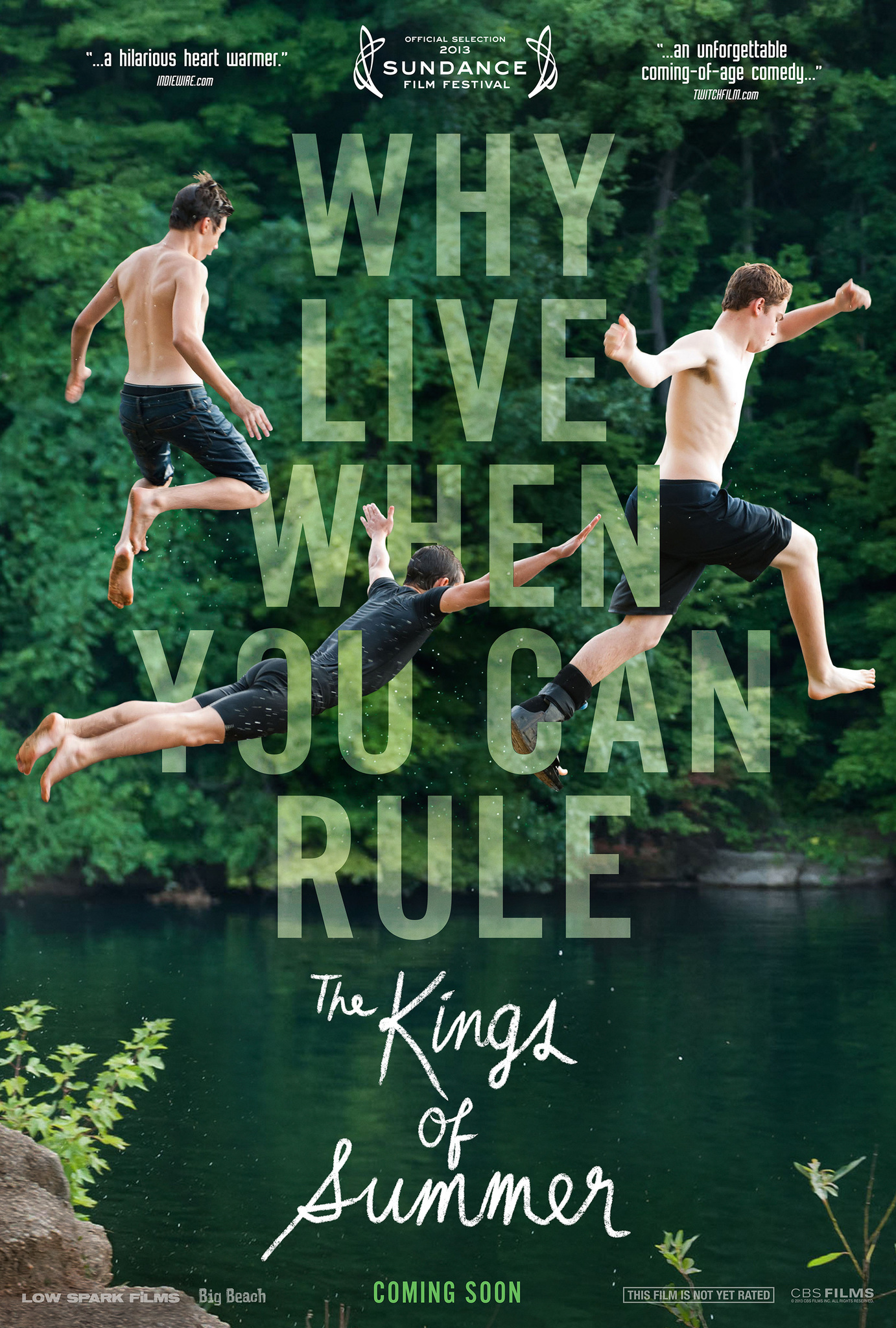
 The coming-of-age story is certainly not one that is lacking in terms of literature, particularly cinema. There are few stories quite as resonant as those about growing up, due to the fact that most of us, regardless of our upbringings, can relate to the insecurity, uncertainty, and anxiety of getting older. These kinds of stories have been written for centuries, and they strike a chord with many people. One of the recent films that I feel is noteworthy for what it has to say on the process of coming of age is The Kings of Summer, an unusual but charming independent comedy that manages to be as sweet and endearing as it is grave and profound, but only to an extent, as this film does have some considerable shortcomings. Certainly not a perfect film by any means, The Kings of Summer has definite resonance, and it manages to be a great debut for Jordan Vogt-Roberts, and a showcase for the exceptionally talented cast, all of which work together tremendously in the construction of an entertaining but deeply flawed film.
Joe (Nick Robinson) is a rebellious and troubled young man who lives with his widowed father, Frank (Nick Offerman). Frank is a stern and sometimes unreasonable man whose attempts to bond with his son are impinged upon by both individuals’ egotistical desires and stubborn refusal to accommodate the efforts of the other to form a meaningful relationship. An attempt to bond turns into a big catastrophe, which causes Joe to run away from home with his best friend, Patrick (Gabriel Basso), heading into the nearby woods, where they hope to establish new, liberated lives as their own men. They have the help of the unusual Biaggio (Moisés Arias), and very soon they have built a home for themselves in the wilderness, and are soon sustaining themselves, being completely free of any discerning parents or societal rules. However, as usual, there is underlying tension, and the friendship of the boys is put to the test through difficult circumstances, and their attempts at bonding and growing closer may result in them being drawn even further apart.
This film assembles a trio of very promising young actors in the main roles, as well as a set of notable supporting players, each of which is wonderful in their own way. Nick Robinson, who is constantly developing as an actor, has the leading role of Joe Toy, the troubled young man who has to deal with the death of his mother, as well as the harsh and clinical personality of his seemingly-unloving father. Robinson has undeniable charm, and he is adept at leading this film, imbuing it with youthful energy and distinctive pathos. I am certainly not surprised to see his profile only grow with each passing performance, because he has a certain quality that makes him an endearing performer, capable of thoroughly moving performances. Gabriel Basso and Moisés Arias both have wonderful moments at Joe’s friends, and while Basso’s character may not have as much to do as I expected, he was still terrific and he did the most he could with an underwritten character with murky motivations. Arias carefully navigates the line between being a welcome comic relief and an unbearable nuisance, and he does succeed in making his character endearing, despite the fact that it is wholly unrealistic. Nick Offerman, perhaps the most underrated comedic actor working today, is wonderful as Joe’s father, who does his best to be there for his son, even though he acknowledges his own imperfections. I have yet to see a project with Offerman in it that I wasn’t enamored by his astonishing skills as a performer, and while his character of Frank is otherwise nothing particularly special, Offerman is great. There are a plethora of other reliable supporting performances, most of which are on behalf of some truly extraordinary comedic actors, all of which manage to do something special in this film.
The Kings of Summer is not anything groundbreaking or extraordinary. For all intents and purposes, it is a conventional coming-of-age tale, and there is nothing particularly noteworthy about it. One of the most significant problems I had with The Kings of Summer extends to the fact that while it does try and make profound statements about growing up, it seems almost unrealistically heightened and unnecessarily melodramatic. Independent cinema, the movement in which films like The Kings of Summer normally would thrive, is built around fragile and realistic portraits of humanity, where conventions and cliches can be safely discarded. The Kings of Summer is far too uncanny, a film that certainly purports to show the coming-of-age experience, but focusing more on how it delivers the message rather than how it says what it wants to say. The Kings of Summer is a film that had such strong potential, but the inexperience of the crew is shown in unfortunate clarity because while this film has a vision, it fails to achieve it entirely competently. None of these characters resemble anything particularly realistic, and there is nothing The Kings of Summer says that countless other films have said with more originality. By far, the least interesting aspect of this film is perhaps the element I expected to be the most profound, the experience of growing up. This is a film written by, directed by and starring young people, those who had recently experienced the same uncertainty that these characters are going through, and one would hope there were be a tangible sense of personal connection between the filmmakers and the film. Dare I say it, The Kings of Summer is not a bad film in this regard, it is just a particularly dull one, not contributing to an already expansive corpus of coming-of-age films, many of which are able to counteract their trite stories with charming execution, but The Kings of Summer being more focused on attempting to be profound, it often loses sight of where it wants to go.
However, despite being relatively underwhelming in terms of the approach to the coming-of-age story, The Kings of Summer does make some interesting statements regarding another central theme, that of nature. This entire film is built around the notion of exploring the relationship between nature and city, rurality, and urbanity, civilized and primitive. In this film, the wilderness is not merely the realm of the unknown, the location of peril and danger and a complete lack of creature comforts. It is a means of escape. These characters find liberation in returning to nature, finding their freedom not in the march of technological progress, but in the regression into the uncertain and unpredictable natural world. These characters become animalistic, free from conventions or rules, and able to exist on their own terms, surviving through their own skills and abilities. I found this aspect of The Kings of Summer particularly inspiring – not many works of literature view nature in such a positive way, showing it as a liberating force, a place in which one can truly exist as themselves, free from the urban shackles that they feel keep them bound from expressing themselves fully. Of course, there isn’t an absence of peril, as the film’s climax will show, but the free-wheeling, limitless quality of nature is explored wonderfully in this film, and it seems that despite not being particularly interesting as a whole, The Kings of Summer thrives on its unique perspective on the interplay between the natural and urban. It is this film’s most profound strength, and if it had been explored with a bit more enthusiasm, the result could’ve been far better.
However, putting what was said before aside, The Kings of Summer has one glaring flaw that detracts from the entire experience. I cannot fault it for not being able to say much about the experience of growing up, nor can I comment on the fact that it didn’t explore the most fascinating aspects of the story in enough detail. However, the one aspect of The Kings of Summer that cannot be explained is the tonal inconsistency. This is a film that does not know what it wants to be, attempting to deftly navigate between genres to be something profound and entertaining, but seemingly does not succeed at any of them. This is a definite example of the proverb “jack of all trades, master of none”. It attempts to be a meaningful family drama, a hilarious youthful farce, and a profound coming-of-age story, but instead of oscillating effectively between them, it becomes a cluttered, almost incoherent set of scenes loosely strung together. The result is a greatly diminished film that simply cannot be bothered to focus enough to create something that executes its simple story effectively. At times, this felt like Stand By Me through the lens of Terence Malick, but without the innovative warmth and technical prowess. I am not entirely sure what Vogt-Roberts was trying to achieve when he made this film, but the inconsistency is a massive shortcoming of this film, which I had hoped would overcome its dull simplicity with notable execution, and it, unfortunately, did not succeed.
I found The Kings of Summer to be a middling film. It is definitely very charming, and it has a certain rebellious streak that I enjoyed. However, I found it to be unable to say anything particularly profound, and its intention of being a portrait of the transition between childhood and adulthood was well-meaning but ultimately did not result in a particularly good film. This film is not able to balance its extensive corpus of predecessors, and thus comes across as shallow and dull. The characters do not appear to be particularly realistic, the situations are unnecessarily melodramatic, and the great performances of the cast are not nearly enough to compensate for a while that had good intentions, but flawed execution. I said it previously, but The Kings of Summer was a good debut for Jordan Vogt-Roberts, who certainly has talent (as evident by last year’s terrific Kong: Skull Island), but to make a good film out of such a mediocre, lifeless script as The Kings of Summer was difficult, and the result was an entertaining but unmemorable film that had a lot to say, but nothing countless films haven’t said before. The Kings of Summer is not a bad film, just not one that is particularly groundbreaking.
 The Postmodern Pelican