 What is it about a debut film that excites me so much? There is something so profoundly fascinating about the first film of a filmmaker’s career – and we can look back at the early work of any of the great stalwarts of cinema and find clues in their debuts that would evolve into their signature style. Some of the most significant titans of filmmaking came from very humble origins, and it is always interesting to visit their earliest achievements. However, what is even more delightful and interesting, in my opinion, is looking out for newcomers, watching the debut films of contemporary, little-known filmmakers that could potentially morph into the next generation of brilliant filmmakers. These newcomers are often scrappy, audacious and insightful beyond their years, and they have been responsible for some amazing work. One of the most recent cinematic discoveries is Cory Finley, who crafted the film that I am tentatively calling my favorite of the year so far, Thoroughbreds. A brilliant dark comedy, Finley manages to balance the intense thematic content with a hilariously subversive approach to a very simple story, resulting in undeniably one of the most intricate and delightful dark comedies of recent years, and one that instantly launches Finley into the status of a young filmmaker on the rise.
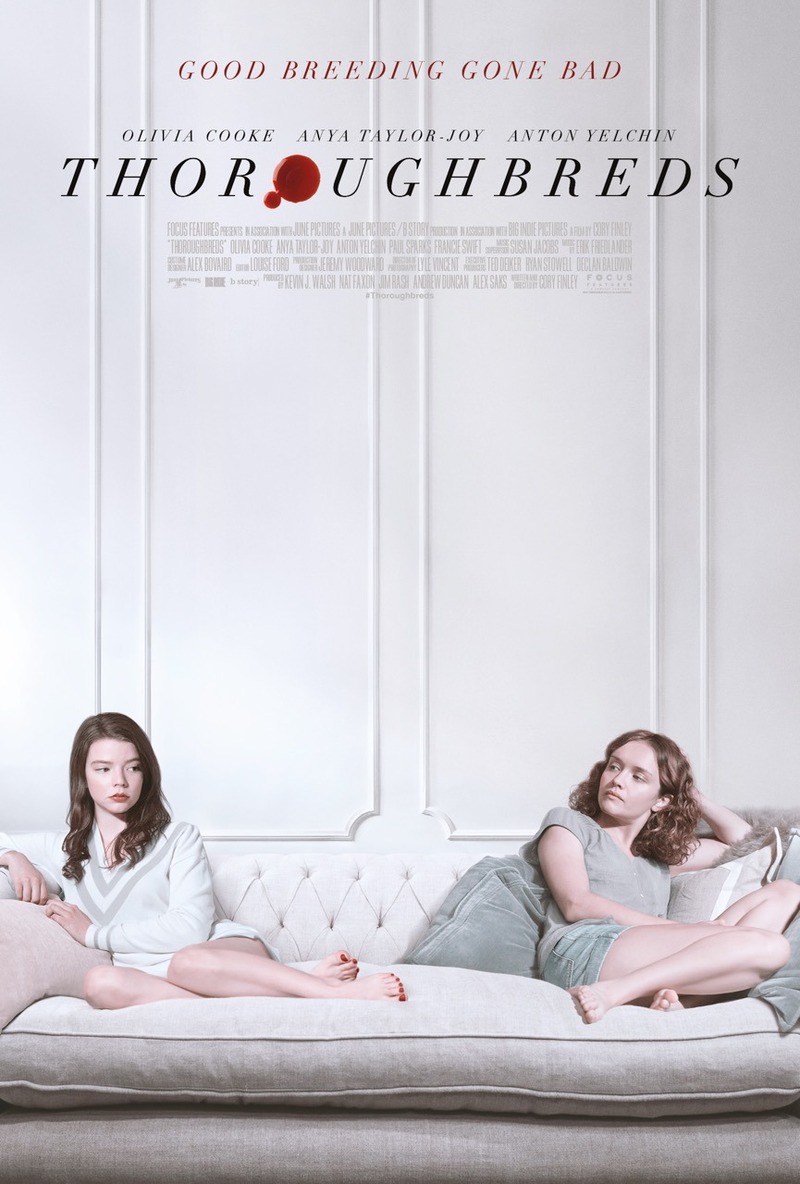
Amanda (Olivia Cooke) is a troubled teenager who is trying to make something out of her life, mostly just to please her mother, but also to move on from a particularly grisly incident that made her the hypothetical talk of the town. She reignites a friendship with Lily (Anya Taylor-Joy), who she had drifted apart from many years before after the death of the latter’s father. They are brought together again by force, with Lily being paid to tutor Amanda for the upcoming SATs. What is initially tension and resentment eventually becomes the foundations of the rebuilding of a great friendship, and the two girls learn more about each other – Amanda is completely void of emotions, and possesses some antisocial disorder that no one is able to diagnose. Lily is the archetypal high-class, privileged girl who enjoys her tranquil, spoiled existence, even if she downplays it in order to relate to the more scruffy Amanda. However, she possesses her own problems: she has been expelled from the prestigious private school she attended (claiming instead that she just finished the semester early), and even worse, her step-father, Mark (Paul Sparks) is an abusive, manipulative brute who cannot wait to be rid of Lily, never forgetting to break her down at every possible opportunity. Amanda proposes that she and Lily get Mark killed, and what started out as a joke evolves into a plan, and they hire a drug dealer with delusions of grandeur, Tim (Anton Yelchin) to execute the task – but of course, there are a few obstacles in the way, and the girls see a darker side of the world that they did not think existed.
Olivia Cooke is one of this generation’s finest young actresses – starting her career on the ill-fated Bates Motel, and building up a filmography that was the perfect balance between arthouse acclaim (Me and Earl and the Dying Girl, Katie Says Goodbye) and mainstream blockbusters (Ready Player One, Ouija). Even if some of these films were not particularly good, Cooke was always noteworthy in them, and she possesses such as beguiling quality about her. Thoroughbreds gives her one of the most fascinating characters of her career, where she plays the emotionless, vaguely-psychopathic Amanda. Cooke is quite simply extraordinary in this film, with several of her moments being utterly astonishing, such as the chilling soliloquy towards the beginning of the film, where she describes how she feels nothing, as well as the horrifying moment where she reveals the cause of her bad reputation, whereby she did something so heinous (yet, somewhat heroic and empathetic), she could be sent to prison for it. That moment has to be one of the most uncomfortable, difficult scenes of the year, and considering it comes in the form of such a hilarious (albeit very dark) film only supports the bleak overtures Finley seems to relish in imbuing his film with.
Cory Linley managed to not only get the supremely talented Olivia Cooke in his film, but also another superb rising star, Anya Taylor-Joy. An actress who has already become a significant “scream queen” for her roles in the exceptional The Witch and the tremendous Split. Thoroughbreds has Taylor-Joy at her most subtle so far, but she is still capable of internal intensity that is rarely seen so explicitly. Her performance as the conflicted and troubled Lily is truly magnificent, and her ability to draw empathy out of a character who is so realistically despicable is outstanding. Lily, unlike Amanda, is terrifyingly real and is a representation of an entire demographic of spoiled but conflicted individuals who are subjected to inner turmoil that goes against their comfortable external lives. Taylor-Joy is such a unique actress and manages to convey the emotional plight of the character with such unexpected grace. It also helps that she and Cooke have terrific chemistry, with their interactions being touching and hilarious in equal measure. They play off each other well, and they use the dynamic of portraying characters that are, at the surface, polar opposites of each other well. Both characters descend to quite questionable moral territory, and the actresses rise up to the challenge swimmingly, providing career-best performances.
In addition to Cooke and Taylor-Joy, Thoroughbreds features two other performances worth noting. Paul Sparks, an unheralded character actor, is fantastic as the abusive and manipulative stepfather to Taylor-Joy’s character, who is able to emotionally exploit his stepdaughter to remind her of her spoiled subordination and the fact that she is not nearly as special as she thinks she is. Arguably, the film frames Mark as far more of an unlikable character than he actually is (because in all honesty, he doesn’t do much wrong other than be flippant and aggressive), but Sparks manages to find the true villainy in this character, which makes the plot against him so much more satisfying. The other great performance in this film comes on behalf of the talented Anton Yelchin, who the world lost far too soon. Playing Tim, a low-level drug dealer with aspirations to rule the world, Yelchin is terrific. Unhinged and hilariously sardonic, his performance is unlike anything seen before by the normally endearing and delightfully charming Yelchin. It is nothing short of a tragedy that Yelchin passed away before reaching his full potential because films like Thoroughbreds shows that he was a truly talented actor, someone capable of some extraordinarily unique character work. The entire cast of this film is absolutely astonishing, with an overabundance of chemistry between all of them, and the ability to make unlikable characters so watchable.
There is a lot to love about Thoroughbreds, but perhaps what makes it so extraordinary is that it is a hilariously honest and brutally scathing representation of privilege, and how the delusions of the upper-class can cloud their judgment in ordinary situations. What makes Thoroughbred work so well is that unlike many films of this ilk, whereby regardless of how despicable the actions of the protagonists are, they are still made to appear endearing and likable, it is entirely different here. There is not a redeeming quality in any of these characters, which makes despising them so enjoyable, because there is a complete lack of unnecessary redemption arcs or anything that would require the audience to want these characters to succeed with what they are doing – don’t get me wrong, the performances by the cast, especially the two leads, are absolutely wonderful and they are great in the film – but their adeptness at playing these horrible characters who are worryingly blind to how privileged they are makes Thoroughbreds extremely original, showing these characters in as negative a light as possible, and yet making this such a hypnotic experience. Thoroughbreds has been marketed quite heavily as an amalgamation of Heathers and American Psycho, and this extends much further that simply being similar in terms darkly comedic stories of murder – all these films present us with protagonists who are despicable, manipulative and unlikable, and through scathing indictments on the effects of privilege, the results are hilarious but bleak representations of society.
Finley not only impressed me with his storytelling abilities but also manages to support his narrative prowess with exceptional filmmaking techniques. A film like Thoroughbreds is perfectly able to thrive on the strength of the story and the performances of the cast, but in constructing this film, Finley ensured that it was visually as fascinating as the story it told. Intricate camera work and simple but effective design work alongside the narrative to create something very unique to look at, forming an unshakable sense of unease and disproportion. The minimalistic filmmaking supports the bleak message of the film, as well as emphasizing the sarcastic tone that runs through this film. It may not be particularly stunning at first glance, but the delicate techniques create an indelible atmosphere of tense but cathartic emotion. Very few filmmakers manage to balance style and substance so effortlessly in their feature films, but Finley manages to do so, and the result is absolutely astonishing.
Thoroughbreds is a great film. Olivia Cooke and Anya Taylor-Joy are wonderful in it, giving the best performances of their careers so far. The film itself is a delightfully twisted, hilarious and bleak portrait of society, one that subverts traditional tropes and cliches of the crime film and rather creates something original and fascinating. A character-driven piece that never fails to be stylish and visually unique, Thoroughbreds is an explosive debut from a filmmaker that has already made quite an impression with this film, becoming one of the new voices in independent cinema that I am most excited for. Thoroughbreds is a brilliant dark comedy about despicable people, and it is one of the most pleasant surprises of the year. Who needs mainstream fare when you have something like this? Finley made something astounding here, and I hope it gets the audience it deserves because a film as audacious and this deserves to be seen by a very wide audience. It is a film that lingers on the mind and is most certainly something extraordinarily special.
 The Postmodern Pelican