 Lynne Ramsay has made four feature-length films, each of which have been tense, gritty and relentlessly realistic views of society, with Ramsay being particularly adept at showing the most explicit and shocking version of humanity through her films. Her latest film is You Were Never Really Here, a brutal crime thriller that manages to be even more intense than her magnum opus, the exquisite We Need to Talk About Kevin. Ramsay is an extraordinarily talented filmmaker, someone capable of fashioning a terrifying vision of the world in her stories, and armed with a unique filmmaking style and incredible narrative skills, she once again adapts a particularly shocking story to the screen in a way that is both magnificent and unsettling, with Ramsay once again proving that she is a maestro of tense, chilling cinema.
You Were Never Really Here is based on the novella by Jonathan Ames (who I had previously known for his semi-autobiographical television show Bored to Death, and his humorous and endearing short fiction I encountered throughout the years), and it is a far cry from what I am used to seeing from Ames. Joe (Joaquin Phoenix) is a veteran who suffers from post-traumatic stress disorder, and perhaps to rid himself of the feelings of being in war, he works as a hitman of sorts, particularly within child-trafficking rings, where his military knowledge and fearlessness make him a powerful ally for the innocent who find themselves exploited by the wealthy and perverted. The film focuses on one case, in particular, that of Nina Votto (Ekaterina Samsonov), the teenaged daughter of an influential senator, who desperately wants his daughter returned back to him, providing Joe with a lead to her whereabouts. The rescue mission takes a very dark turn, and Joe soon discovers what should have been a relatively easy accomplishment may, in fact, be the reason for his downfall. Alongside his professional work, Joe struggles with his own personal demons – he is extremely suicidal but seems to linger on because of his other obligations, such as caring for his elderly, frail and senile mother (Judith Roberts). However, when his professional life starts to unintentionally impinge upon his private life, Joe starts to see a darkness to the world, from which escape is seemingly impossible.
There are few beliefs that I hold to be personal truths, but one of them (and luckily something that most people are in agreement on) is that Joaquin Phoenix is one of the most talented actors of his generation, if not the most gifted. I have yet to see a performance from Phoenix that I did not adore, and it would appear that he is currently on quite an impressive streak, working across genres with a diverse set of auteurs. There’s an observation I made quite recently, where Phoenix is one of the few actors who is able to carry a film almost entirely by himself, with films like Irrational Man and Her being examples of him shouldering the bulk of the film. I accredit this to his intense and unconventional charisma, his endearingly hypnotic style that makes his performances so effortless. You Were Never Really Here, to bring us to the point, is certainly one of his most daring performances – I won’t be hyperbolic and call it his finest performance, because there are many others which showcase his unique set of skills far more – and one that allows Phoenix to play a different kind of character.
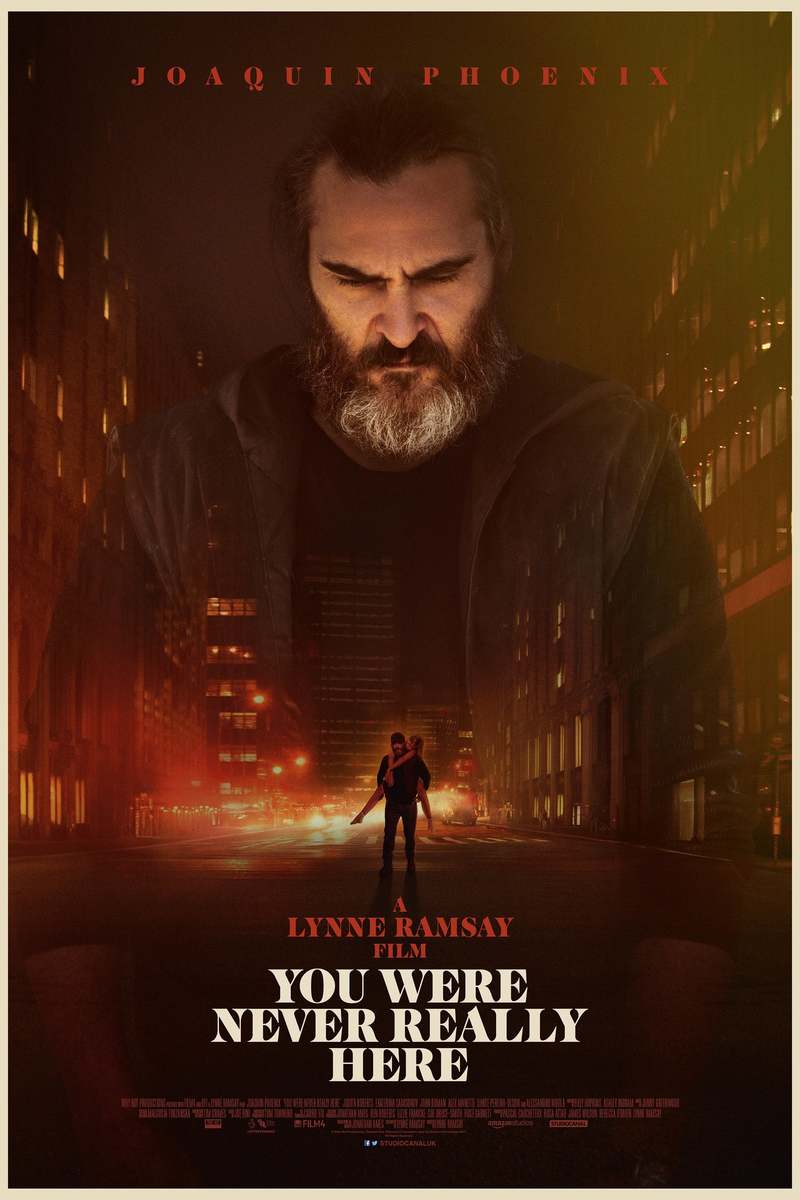
Another reason I adore Phoenix, and a reason that fits in directly with this film, is that he is an actor who seems to love being challenged, and Ramsay forces Phoenix into one of his most psychologically difficult characters to date. Joe is a simple man on the outside, but his complexities, while never really being overtly explored, are very notable. He plays a veteran with such brutal honesty, stripping away the troubling perception that a veteran has to be honorable and dignified, conveying the idea that for some, despite their bravery in fighting for their countries, society can often turn their back on these heroes. One can either find themselves broken by this rejection and turn to lives of sordid debauchery, or they could use it as fuel to do good in the same society that does not care for them. Joe is not a good person. But he is certainly not a person without morals or values, and he evades the blackening of his soul by trying to do good in whatever way he can. The concept of the suicidal, slightly-psychopathic veteran carrying the innocent but damaged young girl is a movingly powerful image. Phoenix is absolutely extraordinary in this film, and while the expressiveness of the young Samsonov is chilling, and the warm presence of the iconic Judith Roberts being very welcome, You Were Never Really Here belongs entirely to Phoenix, who does more with this character than the film would have you think.
You Were Never Really Here is not a warm film. It is cold and shocking, and there are unbearably uncomfortable moments that veer towards being profoundly terrifying throughout this film. Yet, the purpose of You Were Never Really Here is not to be shocking for the sake of shock value, but to be a crucial commentary on society. Joe lives in a broken world, and his only option is to help mend it, living in the fear that if he doesn’t, he will become a part of the multitudinous problems that plague society. You Were Never Really Here reminded me of two of the most moving films I have ever seen, Mike Leigh’s Naked and Orson Welles’ adaptation of Franz Kafka’s The Trial (not to mention some moments that evoked images of Winston Smith in George Orwell’s seminal social critique Nineteen Eighty-Four). Of course, it goes without saying that there are heavy shades of Taxi Driver (although I wish the connections weren’t so obvious, because I feel like You Were Never Really Here will forever be called a modern version of the Schrader/Scorsese masterpiece, and this film warrants an independent life of its own). All of these works are not only searing and terrifying portraits of society but also tales of the damaged individuals that reside within, existing in worlds so detached from decency, the only way for them to survive is through their own individual attempts at making some difference. Joe exists alongside Josef K, Travis Bickle, Winston Smith, Johnny and many other literary lone wolves who are imperfect and damaged but still retain the spark of humanity that the society around them lacks. You Were Never Really Here is a bleak and despair-filled film, so it is not surprising that the ending is the most jarring part of the entire story because it promises something impossible: hope.
Running at only ninety minutes, You Were Never Really Here is a lean and fast-paced film, and I accredit this to the fact that Ramsay is, in the words of another, a very economical filmmaker. There is not a single moment in You Were Never Really Here that was unnecessary. Ramsay does not waste any time on rudimentary exposition, or on contextualizing our protagonist in lengthy forays into the fast. Ramsay seems to have effectively compressed a story that could traditionally be told across an entire season of television into only ninety minutes, which is absolutely astonishing, as well as deeply impressive (and on a slight detour, You Were Never Really Here is a great companion piece to the television show Barry, which started out as a zany dark comedy about a veteran-turned-hitman, and promptly descends into similarly bleak territory as this). Everything in You Were Never Really Here is to the point and explicitly important, which results in an extreme viewing experience. It is a film in which you need to constantly reminds yourself to breathe because the tense and psychological overtures of this film are sometimes overpowering, and Ramsay refuses to allow for any comfort to pervade her bleak portrait of society here. However, there are two moments of astonishing beauty that stand apart from the chaotic and frantic energy that occur around them – the aforementioned ending (which is one of the most satisfying I have seen this year), and a moment of tranquility, which manages to be so stunningly beautiful but so unbearably sad, it may be the most scarring part of the entire film, and perhaps Ramsay’s finest moment. The oscillation between the sacred and the brutal in this film was extraordinary and proves that Ramsay is a fearless filmmaker.
You Were Never Really Here is a great film, but it is also one I will not be rushing to watch again very soon. It is an effectively terrifying thriller, brutally violent and beautifully intense. Joaquin Phoenix is at the top of his game here, playing a character who is a flawed man living in a darkened world. You Were Never Really Here makes an indelible impression through its relentlessly provocative style, as well as its narrative simplicity which allows this to be an energetic but exhaustingly complex social commentary, one that balances action with psychological nuances that create a stunning and profoundly moving film, the likes of which are rarely this effective. Lynne Ramsay is an astonishing filmmaker, and she continues her impressive streak of haunting but hypnotic cinematic visions of humanity, constructing a film that challenges the audience to place themselves in this broken, bleak world she presents to us, only to force us to realize she is not conveying fiction, but rather a representation of life as it, unfortunately, is for some people, and much like Joe realizes, one can live on as part of what makes society damaged, or do our own part, regardless of how small, to bring some change to this seemingly bleak and hopeless world, because even the darkest moments can result in what Nina, at the end of this film, states: “a beautiful day”.
 The Postmodern Pelican