 I think we can all remember where we were when we watched our first John Hughes film. Whether it was The Breakfast Club, Pretty in Pink or Ferris Bueller’s Day Off, John Hughes was a formative force in the cinematic education of many of us today. Despite being born just outside of his glorious reign over teen cinema, I have always gravitated towards his films as paragons of simple but meaningful entertainment, films that show the teenage angst through humor and pathos, the likes of which are very rarely seen. Therefore, the biggest surprise is that one of Hughes’ most remarkable achievements was also one of his most unconventional, a film that does not focus on the teenage experience or revolve around the machinations of romance, but rather on the simple importance of friendship. Planes, Trains and Automobiles may not have the generation-defining power of some of Hughes’ most significant contributions to cinema, but it is not any less charming or endearing. There are some days when I genuinely do believe that Planes, Trains and Automobiles is the best work Hughes has ever done, not only because it is undeniably his funniest film, but also his most unassuming and simple, which does certainly go a very long way when making a comedy, as some of the best comedies ever made will prove.
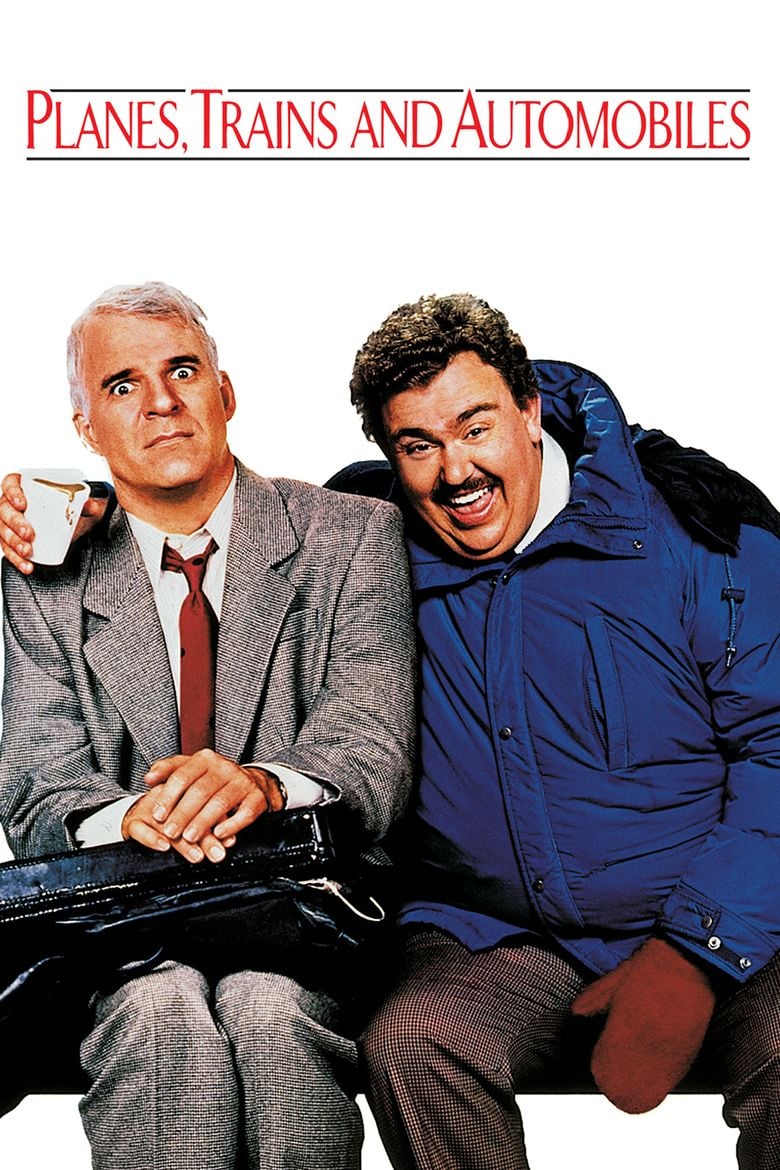
Neal Page (Steve Martin) is an uptight marketing executive trying to make his way back to Chicago to spend Thanksgiving with his wife and children. Unfortunately, he does not expect to encounter several inconveniences that come with traveling over the holidays – overcrowded airports, bustling cities and unpredictable weather mean that Neal’s perfect schedule for returning home is constantly being manipulated, with time growing more sparse as the problems arise. To make matters worse, Neal encounters the biggest inconvenience of all, a cheerful but obliviously troublesome goof named Del Griffith (John Candy), a salesman who makes his living selling shower curtain rings. The two strike up an unlikely friendship – Del, being the unconventionally charming and sociable urban dweller latching onto anyone who will hear him out, and Neal because he constantly abandons his own sound judgment and trusts this relative stranger to get him home, trusting his confident demeanor. Over the following days, the two go from complete strangers to close friends, but not without a couple of falling outs and arguments that call into question the humanity of each of our protagonists. However, in traditional Hollywood fashion, there is an obvious (but still heartwarming) happy ending, which makes Planes, Trains and Automobiles predictable but delightfully endearing in equal measure.
Steve Martin is certainly one of the most versatile comedic actors of his generation, and his diverse talents have made him an endearing figure for generations. There are few actors who can so believably oscillate between roles within a genre quite like Martin – for every The Jerk, there is Parenthood, and for every “Wild and Crazy Guy”, there is a Roxanne. He is able to express himself through broadly comedic slapstick, or wonderfully subtle emotional warmth, and he is entirely believable regardless of what the role demands of him. In a way, Planes, Trains and Automobiles did not demand anything from Martin that he was not entirely capable of – Neal Page is an archetypal Steve Martin character, someone serious and composed on the exterior, but able to convey his inner insecurities and neuroses through gloriously delirious humor. There are so many moments within Planes, Trains and Automobiles that allow Martin to run the gamut of comedic showcases. Standout moments include his now-iconic, expletive-laden breakdown at a rental car dealership or his stuck-up attempts at trying to appear more moral and sophisticated than his traveling companion. Martin is able to find the nuances in the character, being broadly comedic at times, but also balancing it with emotional gravitas where it counts. I truly believe that Martin, who is undeniably popular to this day, is known more for his iconic comedic antics rather than his more subtle work, and even hilarious films like Planes, Trains and Automobiles contain some terrific precision in terms of resonating on a purely emotional level.
Yet, as wonderful as Martin is, Planes, Trains and Automobiles would not have worked without John Candy. He was undeniably the heart and soul of this film, the cause of the biggest, heartiest laughs and the reason for the most touching, endearing moments. There was a quality to Candy that is almost impossible to find in anyone else, a warmth that is almost unparalleled. Candy was rarely the lead in many films, usually being the reliable supporting presence, and he was always great and consistent in these kinds of roles. However, his talents shone the brightest in films that placed him at the forefront of the story, with Uncle Buck (also a film by Hughes) being a delightful and heartfelt domestic masterpiece. Planes, Trains and Automobiles gives Candy one of his most hilarious roles, as well as one of the most melancholic of his entire career. Del Griffith is a simple man, someone who does not long for much other than a warm meal, a comfortable bed and perhaps a friend along the way. He is a buffoon, in all honesty, but he means well and he wishes the best for everyone he encounters. Candy truly was a wonderful actor, and Planes, Trains and Automobiles just proves his exceptional comedic talents as well as his deeply moving emotional warmth that lingers on long after this film has ended.
If there is one thing that can be said about Planes, Trains and Automobiles, it is that it is safe. Hughes clearly was not attempting to redefine comedy with this film, and rather depended on a set of reliable and well-worn conventions. The difference between the success of Planes, Trains and Automobiles and the failure of other films that take a similar approach is that while others use it poorly by relying too heavily on what is popular, Hughes’ utilizes what is popular to support the story he is trying to tell. The two conventional tropes of comedy present in Planes, Trains and Automobiles are the cross-country odyssey and the odd couple pairing, both of which have been exceptionally prevalent in comedy for a very long time, perhaps going back to the earliest days of comedic theatre. Planes, Trains and Automobiles works because of the effectiveness of the story in using these tropes to evoke familiar but meaningful feelings of comfort. This film belongs alongside many other films from my childhood that are sweet, funny and comforting, films that contain warmth and humor that feels often like a cinematic embrace. I do think Hughes is most remembered for his honest portrayal of teenage angst, but I personally found the unimpeachable warmth of his films to be the most defining feature of his films, and the factor that continuously drew me to revisit his films regularly.
Planes, Trains and Automobiles is not without cliches and taut conventions, but it uses them well, and the result is a delightful and meaningful comedy that may be predictable, but it is never dull. It is a film that elicits hearty, honest laughs, regardless of the number of times I have seen the same jokes and sequences. It is a sweet film that benefits from the terrific chemistry of the two leads and a fiery comedic passion, supported by the unhinged anarchy that befalls our two protagonists. Planes, Trains and Automobiles is a wonderfully frustrating, entertaining journey, and it is one of the most endearing comedies of the 1980s. There are not many films that are as warm, funny and brilliant as Planes, Trains and Automobiles, a film that has John Hughes at his most unconventional, Steve Martin and John Candy at their comedic peak, and the entire genre being utilized smartly by this trio of comedic maestros, who fashion together a memorable, relentlessly charming comedy film that is as hilarious as it is heartfelt.
 The Postmodern Pelican