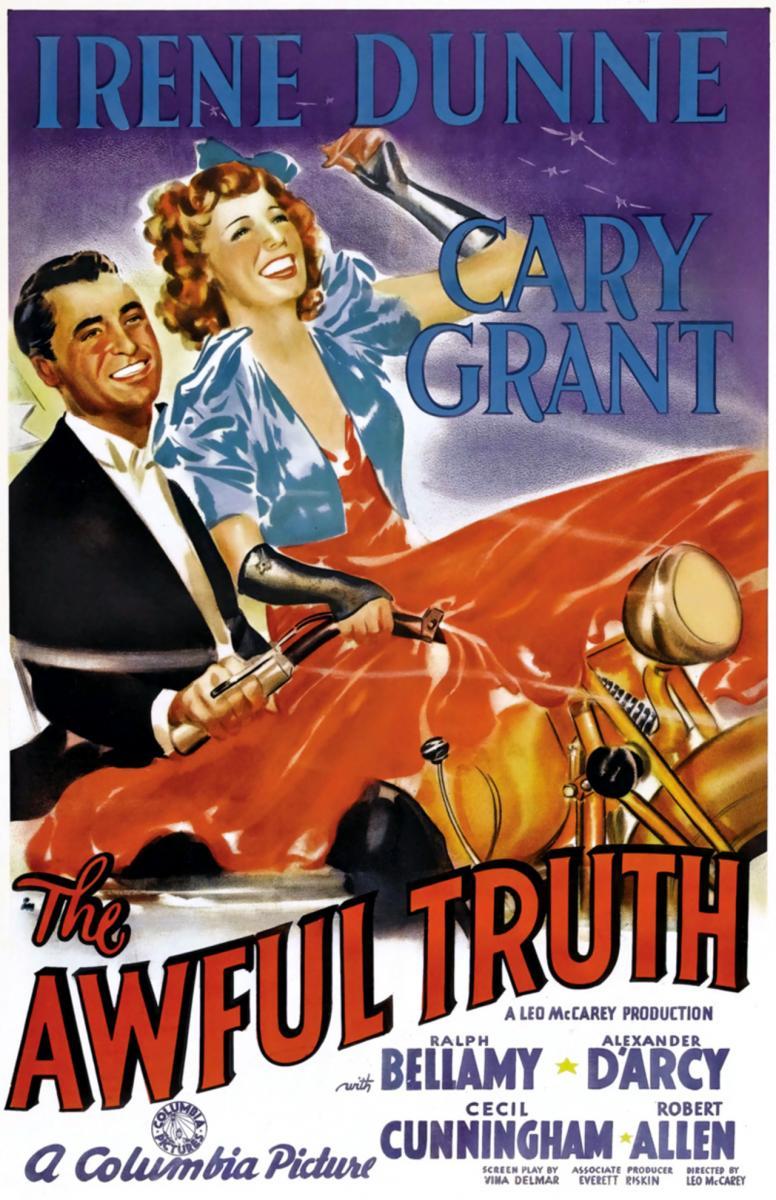
 They just don’t make films like The Awful Truth anymore, do they? A great comedy film driven by nothing more than sparkling dialogue, the tangible chemistry between the lead and a wonderful story that flows exceptionally well, supported by the incredible performances by a talented cast. The Awful Truth is the rare kind of film that just works in every way, and approaches being an almost despicably perfect film, a meditation on the human condition told through some of the most meaningful commentary on relationships ever put on screen. Leo McCarey, who in the same year also directed the beautiful and heartbreaking social-realist drama Make Way for Tomorrow (the polar opposite of The Awful Truth), made what I consider to be one of the finest screwball comedies of its era, a film that gives conventional classics such as Bringing Up Baby and It Happened One Night a true run for their money. In essence, The Awful Truth is absolutely marvelous, and I cannot overestimate how brilliant I found this film, loving every moment of it.
Jerry Warriner (Cary Grant) and his wife Lucy (Irene Dunne) are an upper-class married couple who have their share of suspicions in their relationship, with Jerry pretending to go on a trip to Florida at the outset of the film (his actual whereabouts are not clear), while Lucy has spent some time in the countryside home of her handsome music teacher, which is only one example of the untrusting nature of the couple’s relationship. At a whim, they decide to get divorced, and it is granted – although the decree only becomes official in sixty days, which puts both Jerry and Lucy in a period of relationship limbo – they are neither married nor are they single. However, this does not stop them from seeking out companions for their future, with Lucy becoming attached to the endearing Dan Leeson (Ralph Bellamy), a wealthy young man from Oklahoma looking for a wife to join him “where the West begins”, as Jerry puts it. Jerry himself goes through a few potential mistresses, including the bawdy Southern performer Dixie Belle Lee (Joyce Compton) and the socialite heiress, Barbara Vance (Molly Lamont), neither of which seems to be the perfect fit for him. However, both Jerry and Lucy keep finding themselves in each other’s lives, partially because Lucy has custody over the couple’s adorable dog, Mr. Smith (played by Skippy, who I insist on crediting, because he was arguably the highest-grossing star in this film, based in part on his iconic performance in the series of Thin Man films, but I digress), but also because they realize that their divorce was premature and hasty and that no one quite understands them like each other. However, these feelings are kept to themselves for the most part and manifest in petty and hilarious attempts to sabotage each other’s potential relationships, which results in some terrific moments where the audience is subjected to the odd nature of a thing called love.
The more I think about it, the more I consider Cary Grant to be one of the greatest actors of all time. There was not any doubt that he is considered one of the most iconic performers of his generation, a true star who used his dashing good looks and relentless charm to ascend to be one of the most endearing figures of the Golden Age of Hollywood. However, with performances like The Awful Truth and the seminal classics Bringing Up Baby and The Philadelphia Story, Grant proved himself to be a performer with exceptional comedic timing and an ability to imbue his performances with the right dose of humor and emotional gravitas. The Awful Truth, for better or worse, may be his finest comedic performance (not to discredit his marvelous work in countless other screwball comedies), mainly because his performance here felt more realistic than usual – he adds considerable nuance to a character that is much more than an archetypal charismatic screwball comedy protagonist, but a complex individual who feels out of place after the woman with whom he knew, deep down, that he was the most compatible with. The Awful Truth allows Grant to do a lot more than usual, while not taking him too far out of his element – it is a performance that allows him to be typically charismatic and wise-cracking, as well as extremely goofy, with some moments of exceptionally well-executed slapstick, the likes of which could only look so tremendously elegant coming from the debonair Grant, who manages to look elegant regardless of the situation he has found himself in. In all honesty, it is likely that I will praise the next Cary Grant film I see as being his finest performance, but that it not indicative of my own indecisive nature, but rather representational of Grant’s superb abilities as an actor, capable of such complexity and brilliance with what seems like almost flawless ease.
However, as tremendous as Grant is in this film, it is Irene Dunne who truly steals The Awful Truth. I cannot think of many actresses as unique as Dunne, a performer who is so wonderfully beguiling, and capable of such magnificent nuance in her performances. The Awful Truth gives her a character that showcases all of her talents as an actress. Lucy Warriner is an anomaly – a romantic heroine who pursues what she wants and is not afraid of seizing the moment and doing what may be difficult, but will ultimately result in her satisfaction, as well as a hilarious comedienne, adept at the physical aspect of this comedy that require her to be a lovably goofy individual. Perhaps this is why The Awful Truth works so well – both Grant and Dunne are capable of oscillating between different emotions, being able to convey the emotional fragility and delicate despair of these characters in the smaller, more intimate moments of reflection and introspection, while balancing the broadly comedic moments that require them to showcase their comic talents. The chemistry between the two leads is absolutely marvelous, and they clearly understood each other extremely well in order to perform so well against each other. This is not to mention their wonderful interactions with the rest of the cast, all of which are great in their own right, with highlights including Bellamy’s delightfully delusional cowboy, and the aforementioned Skippy, who is arguably the greatest canine performer in cinema history (and there have been some other great ones, so that really is saying something). The Awful Truth is a character-driven film, and it is helped along considerably by the cast, all of whom are excellent and serve their purpose perfectly.
The Awful Truth is a film that continues the theory that I have begun to develop, particularly in regards to romantic comedies. It is my belief that the romantic comedy genre was at its peak, both narratively and socially, during the 1930s and 1940s, and has only steadily regressed since then. Considering we are living in an era of progressive issues, the fact that most romantic comedies nowadays rely on the same archetypal representations of characters, particularly female characters, whether they be the needy-woman, the Manic Pixie Dream Girl or the lonely spinster (amongst others), they pale in comparison to films such as The Awful Truth and those of its ilk, and very few actually extend this towards the tricky and delicate subject of divorce. Consider some of the more contemporary comedies that tackle divorce – Mrs. Doubtfire, as sweet as it was, was just a showcase for Robin Williams. The iconic The First-Wives Club was marvelous but more about the post-divorce life rather than the process of divorce. It’s Complicated was a film that I felt brought out the worst in its talented cast, and Enough Said and The Squid and the Whale are terrific, but they were far too independent and underseen to be considered mainstream representations of divorce. Only the wonderful The War of the Roses can be considered akin to what I am referring to here. It is a contentious theory, and one I will go into more detail on once I have more coherent arguments towards, as well as supporting evidence.
Divorce is not a subject that cinema does not dare approach (of complex social issues, it is one of the easiest to make a comedy around), but only a film such as The Awful Truth (or the other great Cary Grant divorce comedy, His Girl Friday) can show these characters in a way that is meaningful but still entertaining. While not void of its problems (such as the cliched “happy ending”, as well as some narrative hiccups that don’t make logical sense), The Awful Truth is the quintessential unromantic comedy, a film that shows the other side of romance, while avoiding stereotype for the most part. Lucy Warriner is not a conventional vision of a woman, and she fits well into the category of other strong and willful screwball comedy heroines, someone who is independent and strong-willed, without being seen as bitter. I won’t suggest that The Awful Truth is a perfectly feminist film because there are overtures of the era that do trickle through within this film, but McCarey does well in showing these characters in a far more natural, realistic way than more contemporary films would tend to. In some ways, as I have alluded to above, The Awful Truth is not really that romantic at all, but there are cadences of true romance that underlie this film and culminate in a predictable but satisfying resolution.
I adored The Awful Truth. It could possibly even be my favorite screwball comedy film of all time now, mainly because of how all the components of this film just worked perfectly. The cast was great, the narrative was exceptional and the dialogue was emotionally-resonant and often utterly amusing and hilarious. It is a film that seems to be ahead of its time (as were many of its contemporaries), and somehow, eighty years later, it still speaks about relevant issues in a way that is not too dated and can still strike an emotional chord with many people. Grant and Dunne are fantastic as always, and the film as a whole is a towering success. Leo McCarey was certainly one of the most influential filmmakers of his generation, and in making The Awful Truth, the created something simple but effective, a film that can move and amuse in equal measure. It is a terrific film and something I will most certainly be revisiting regularly because when something is as nearly-perfect as The Awful Truth, just one viewing is not enough. Undeniably one of the great films of the 1930s, and one of the most entertaining comedies ever made. Filled with memorable moments (such as the dance scene midway through the film, or the encounter with the police), highly-quotable lines and amazing performances, The Awful Truth is something very special.
 The Postmodern Pelican