 Up until this past weekend, I believed that Blue Velvet was the greatest satire of the archetypal American suburban condition of the 1980s. As much as I am an ardent devotee to David Lynch, I have to admit that such a belief was nothing more than a misguided delusion. As effective and brilliant as Blue Velvet was, particularly in showing the corruption of the idyllic vision of suburbia which is often considered an American utopia of sorts. Suburbia is a subject many artists have attempted to create, ranging from the most harmless, toothless representations of the suburban tranquility of shows such as Leave It to Beaver and The Brady Bunch, to the most exquisitely wicked dark comedies that use the opportunity to make scathing social commentary. The film that I believe succeeds the most in representing the dark side of the suburban condition is The ‘Burbs, an underappreciated dark comedy from one of the most unheralded maestros of cinema, Joe Dante.
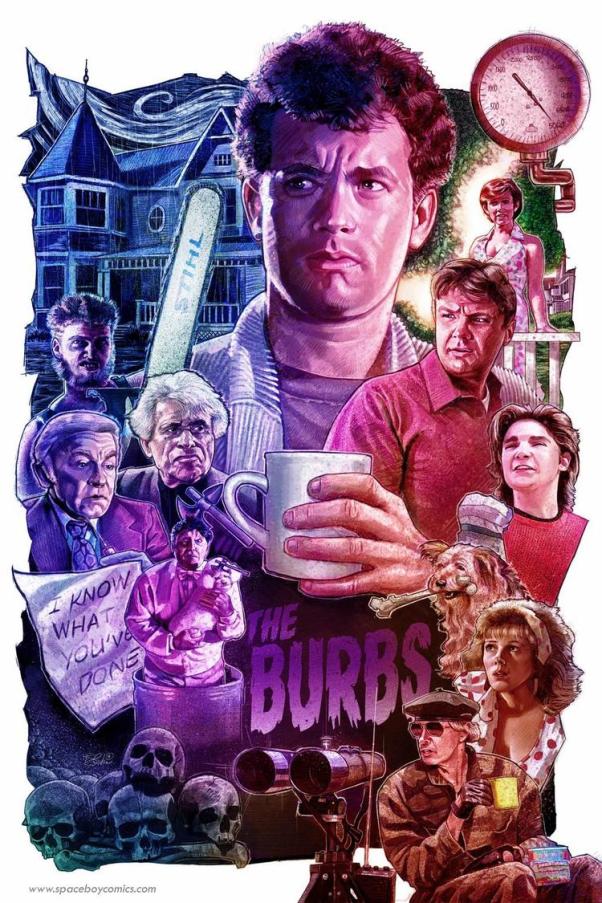
The ‘Burbs, as the title suggests, is set in a generic American suburb. The focus is on Ray Peterson (Tom Hanks), a mild-mannered family man, with a wife (Carrie Fisher) and a son, with whom he is looking forward to spending his week off from work with. His neighbor and best friend, Art Weingartner (Rick Ducommun) is constantly stirring trouble, with the latest victim of his enthusiastic paranoia being the Klopeks, a mysterious European family that moves into the house next door to Ray. The quiet and mysterious family, who are rarely seen, become the subject of conspiracy theories by the neighborhood, who believe the family to be involved in malicious activities, such as demon worshipping and ritual sacrifice. Ray finds his vacation from work occupied with attempts to uncover the mystery of these people, and along with Art and the eccentric and erratic Lt. Mark Rumsfeld (Bruce Dern), they set off a cataclysm of chaos, from which there is very little opportunity to walk away from. What starts as simple curiosity devolves into anarchy and pandemonium, which rocks the idyllic suburb and shocks the residents.
The ‘Burbs may just be the greatest suburban horror film ever made, perhaps even better than Halloween or A Nightmare on Elm Street (and there is a marvelously subversive reference to the latter franchise within this film, indicating that Dante knew exactly what he was aiming to do with this film). Arguably, The ‘Burbs is not a traditional horror, but it has many elements that draw make to the dread-filled, adrenaline-fueled horror films of the era. Suitably artificial and unbelievable to an almost psychotic degree, The ‘Burbs is successful merely because it has the element that made slasher horror films, and other similar thrillers of the 1980s so unforgettable and entertaining – it does not take itself too seriously, while still being able to be composed enough to avoid being a parody of familiar stereotypes. The ‘Burbs has one of the most absurd premises ever put on film, but through serendipitous collaboration between concept and execution, the film works spectacularly well, and the result is a thoroughly thrilling, absolutely hilarious vision of suburbia that is as darkly comical as it is utterly terrifying, with many of the most frightening moments of this film coming on behalf of masterful suspense and viciously vibrant shocks that prove that The ‘Burbs is anything but conventional.
Interestingly, The ‘Burbs was released in 1989, quite a watershed moment in the career of Tom Hanks, who was starting to grow into one of the most reliable stars of his generation, coming off acclaimed work in films such as Big, Splash and…some other highly forgettable film. While The ‘Burbs may not be the definitive moment in Hanks’ career, it was the first time he somewhat abandoned his perceived youthful, slightly rebellious image garnered in his work during the 1980s and embraced the everyman persona he would go on to define. The ‘Burbs was the first film in which Hanks played a father (which did seem slightly jarring for some reason, but in a very pleasant, unconventional way), and this film seems to be the perfect bridge between his earlier roles and his subsequent, more iconic performances, whereby it allows him to play an Average Joe, but one with an endearing rebellious streak and a tendency to indulge in juvenile acts of mischief. Hanks is terrific, but then again, he always is. The ‘Burbs gives him one of his most fascinating characters to work with, and like the film, Ray Peterson (even the name is the embodiment of ordinary and plain) is equal parts a faithful representation of a common social archetype, while still being a zany, eccentric and strange caricature of the targeted stereotype. The role did not require much from the actor, but Hanks is as great as he always is in the role. It is not the film that defined his career, but its a solid early effort from an actor who would go on to become an icon in his own right.
However, where The ‘Burbs succeeds most is in the supporting cast, with quite a few familiar figures occupying roles in this film. Rick Ducommun, who was a lesser-known stand-up comedian at the time, had the largest supporting role, playing Art, the needlessly annoying neighbor and best friend of Hanks’ character. What was certainly nothing short of one of the most unlikable neighbors in film history was made into an endearing, likable goofball, who occupied this insane, eccentric world with utter perfection. It is quite shocking that Ducommun never developed into a bigger name after the making of The ‘Burbs, considering his scene-stealing turn was absolutely astonishing, being the exact kind of breakthrough performance many comedians relish, as it builds their entire careers in most instances. Regardless of his subsequent work, Ducommun was marvelous in The ‘Burbs, and he threatens to steal the entire film away from the more established members of the cast, which is a remarkable feat considering the pedigree of cast in this film.
The only reason Ducommun doesn’t completely run away with this film as his own is because of the presence of someone else – Bruce Dern. Bruce Dern may just be the greatest actor of all time (which is in itself a falsehood, because Harry Dean Stanton existed). To give you an example of how great Dern was in this film, I will give you an example: I would quote his famous line from The ‘Burbs, “there go the goddamn brownies!” on a regular basis before I even knew about the existence of this film (that is most certainly a true story, and certainly not a way for me to support the claim that Bruce Dern is an undeniably brilliant actor). The ‘Burbs gives Dern the opportunity to flex his comedic talents, and while he has played his fair share of eccentric, scene-stealing, vaguely-sinister characters before. The ‘Burbs was one of the first films that allowed him to be so completely unhinged and unrestrained. Playing the demented veteran who finds himself falling victim to the raising paranoia, Dern is superb (as always), and that is because, like the entire cast, he commits entirely to the role, playing it without a hint of irony, and truly being captivated within the role. Dern has got a rare quality, which is often found in actors such as Leslie Nielsen and the aforementioned cinematic icon Harry Dean Stanton, whereby he plays the role with such conviction, believing in every movement his character makes. Of course, who would not be truly entertained by Bruce Dern, famously one of the only actors who killed John Wayne (on screen, of course), playing a grizzled, paranoid and twisted army veteran who likes nothing more than a healthy dose of suburban scandal with his morning coffee? There are good actors, there are great actors, and then there is Bruce Dern, who is an entire specimen of his own, and the cinematic landscape is all the better because of that.
I do not know why The ‘Burbs works so well. It finds the perfect balance between the sacred and the profane, the shocking and the placid, and it thus manages to be both a great suburban satire, as well as a legitimately thrilling urban horror film, filled with some genuinely shocking moments and fear-inducing moments of unrestrained anarchy and delightful catastrophe. Joe Dante may not be the most acclaimed of filmmakers, but he certainly could make twisted dark comedies that were well-formed, complex satires that could alternate between scathing social commentary and terrifying horror. The ‘Burbs is not quite a traditional horror, but it is structured in the same way, and as a result, many of the most memorable features of the genre are present in this film. The ‘Burbs is a highly-original, entertaining work of pure escapism, and I think I loved it more than I should have, but that is perfectly alright, considering it is one of the most captivating comedy films of the 1980s.
 The Postmodern Pelican