 I do love a good war film. However, there is an abundance of war films that are concerned with showing the actual warfare and often gloss over the journey towards the warfare, namely the preparation of soldiers. Very few films manage to convey the brutal training regimes soldiers were subjected to in order to prepare them for war, and even fewer do it right. Full Metal Jacket is one of Stanley Kubrick’s most disappointing films because the first half (which is about the training regime of soldiers during the Vietnam War) was utterly brilliant, but the goodwill gained throughout that first act is immediately lost with the misguided warfare scenes. There is a film that may have done what Full Metal Jacket was trying to do, and much for effectively (as sacrilegious as that is to say). The film is Biloxi Blues, a film that is not merely a quirky comedy about soldiers, but also a very serious statement on youthfulness and the dangers that lurk in coming of age in a treacherous era.
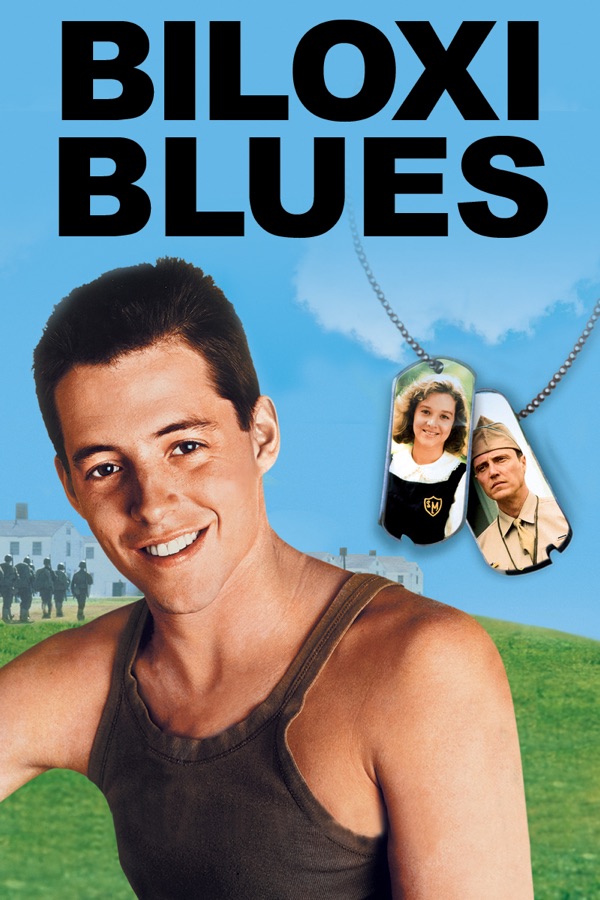
Biloxi Blues is based on the semi-autobiographical play of the same name by the extraordinary Neil Simon, and is centered on a young man named Eugene Jerome (Matthew Broderick) who represents the writer himself, and much like Simon, Eugene considers himself to be the great artist the mid-war era deserves, fashioning himself as a fish-out-of-water in the company of a group of vulgar brutes that make up his platoon, which is headed for the scorching army camp in Biloxi, Mississippi. The platoon, made up of colorful and eccentric characters, soon meets their platoon commander and de facto resident terror, Sergeant Merwin J. Toomey (Christopher Walken), who manages to oscillate from endearingly sarcastic to terrifyingly sinister without a moment’s notice. Over the next few weeks, the would-be troops are subjected to brutal physical labour and ridiculous punishments at the hand of their sergeant, who always seems to be relishing in their suffering to the point where it physically brings him joy. Eugene chronicles the trials and tribulations of his newly-found brethren as they endure the unique conditions of military training, with the spectre of warfare lurking just over the horizon, and even if this film does not explicitly show the war itself, it lingers on in omnipotence, always in the minds of the young men who know that not all of them will return intact, if they even return at all.
In a way, Biloxi Blues is a melancholic tragicomedy, a hilarious but nostalgic film about war that does not actually explicitly engage in the intricacies of warfare itself, but rather approaches the subject matter from the more social and psychological perspective, and naturally, considering the preoccupation with war films to show the brutality of war, it was refreshing to see a film that attempted to convey the inner emotions and overt turmoil many of these individuals who are preparing for war have to go through. Biloxi Blues is a film that is about training for war, but its also a film about being young, and all of the troops that we encounter throughout, particularly our protagonist, are young men holding onto the last spark of youthfulness they have, because it becomes increasingly clear that once the war is over, and they have seen the brutal and terrifying face of combat, they will no longer be able to relish in their childish, immature ways. This is precisely why Biloxi Blues is one of the most fascinating films on the subject of war to have ever been produced, because below the bawdy antics and vulgar childishness that sometimes overwhelms the narrative, Simon wrote something truly resonant, a film that is as poignant and melancholic as it is hilarious and entertaining.
Matthew Broderick was one of the most fascinating performers of the 1980s, and while his subsequent career across mediums has been anything but disappointing, with decades of remarkable work, it was his contributions in the 1980s that truly defined him as an actor. While Biloxi Blues may be a far cry from his star-making turn as the titular rebel in Ferris Bueller’s Day Off, but it feels like the natural remedy to that performance, with his sensitive and sensible writer being the perfect response to the rule-breaking, school-skipping, parade-serenading philosopher that defined his career. Eugene Jerome is a character without much that would naturally draw attention, and he serves to be a surrogate for the writer, and a messenger for the audience, the lens through which we see the story unfold. Broderick is fantastic in the role, and while the character may lack complexity, Broderick gives a special performance that supports the film without stealing any of the attention from the parts that deserve it. It is partially the result of a great script but massively credited towards Broderick’s nuanced and delicate performance that stands as one of his very best.
Let me be honest for a moment – the main reason I chose to watch Biloxi Blues is because Christopher Walken was in it, playing an eccentric drill sergeant. There are very few things in this world that perk my interest entirely, but Christopher Walken is one of them, and the opportunity to see him in a role that was not too unfamiliar for him, but also not entirely within his wheelhouse, was certainly something I was looking forward to. Walken did not disappoint, and it is my firm belief that this film alone is responsible for the endless impersonations of the actor, with nearly every one of his trademarks being present in this film. Walken occupies an odd position in this film – he plays a character that blends antagonistic archetypes, being able to toggle between being an arrogant, self-indulged jerk to a vainglorious, terrifying villain who is fully capable of murder without a second thought. Walken is both likable and utterly horrifying in this film, and he navigates the complexities of the character with remarkable finesse. Put under pressure, I would call Biloxi Blues one of Walken’s finest hours, and certainly one of his most memorable performances to date. The cast as a whole is wonderful, but it is Walken who truly does something magnificent in this performance.
Biloxi Blues is a great film. Mike Nichols continued his streak of reliable, entertaining and undeniably human stories with his film, and while it may not reach the impossible heights of some of his most notable works (The Graduate, Who’s Afraid of Virginia Woolf? and Angels in America being just some of his remarkable achievements), Biloxi Blues is a solid and meaningful film. It may not be a major film, and it may lack a bit of focus, but for the most part, it is a meaningful, poignant and hilarious exploration of the lives of a small group of young men who are fighting off the crippling anxiety that lurked over many individuals during the uncertain and horrifying years of the Second World War, and as a result, Biloxi Blues is a tremendous film that says a lot about society in a way that is utterly extraordinary.
 The Postmodern Pelican