 In his career that lasted nearly fifty years, Robert Altman directed over three dozen films, and while many of them have gone on to become iconic works of New Hollywood filmmaking, such a prolific career often leads to some films that are less than perfect, and sometimes even far too polarizing to stand alongside some of his classics, such as Nashville, M*A*S*H and Short Cuts. He had his fair share of failures, as well as some films that are just far too abstract and avant-garde to be considered great films. Yet, one of his most fascinating films is 3 Women, a film I was initially very reluctant on, with my first introduction to it a few years ago categorizing it as an outright failure from what I saw of it. However, revisiting the film properly recently has changed my perspective entirely, and 3 Women, a film I previously considered a grandiose misfire in the otherwise solid career of Altman, is one of a select group of his films that could be considered a true masterpiece, and undeniably one of the most extraordinary films of the 1970s.
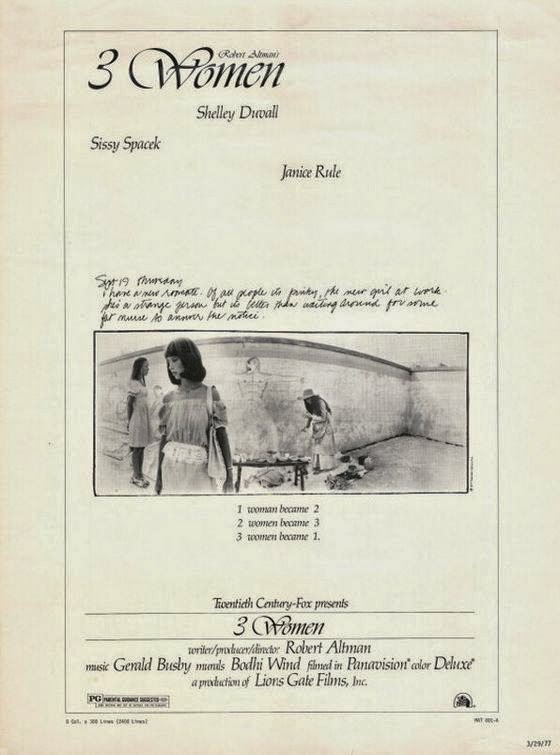
Millie (Shelley Duvall) is a young woman from Texas in an arid Californian town. She works at a spa facility for senior citizens, and she soon encounters Pinky (Sissy Spacek), an enthusiastic but quiet milquetoast of a girl who soon strikes up a friendship with Millie when she becomes her new roommate at a quaint apartment building owned by a couple who also run the local bar, where Millie and Pinky spend some evenings after a long day’s work. The two women grow apart when it becomes clear that Millie has excessive delusions, believing herself to be a desirable, irresistible siren who men simply cannot refuse, yet she constantly struggles to even get as much as a friendly greeting from many of the men who are the subject of her admiration. Pinky finds herself growing weary of Millie’s dismissive, condescending attitude and sheer nastiness, and a near-fatal attempt at her own life leaves Pinky an almost entirely new woman, which also forces Millie to reconsider her own actions, and perhaps even become a different person herself. Meanwhile, Willie (Janice Rule), the mysterious wife of the old man who pays Millie any attention, looms as a sinister spectre, creating unsettling murals that seem to strike some chord with Pinky, who finds herself drawn to the grotesque allure of the art and what it could represent.
3 Women is a great film, and on a purely surface level, it features two central performances by two extremely unconventional stars of the 1970s and 1980s, women who made careers out of perhaps the only two worthwhile Stephen King adaptations. To be perfectly frank, 3 Women terrified me far more than The Shining and or Carrie ever did. There is quite a bit to be said about this, but we’ll get to that later because it would be pertinent to just briefly discuss these two performances before attempting to consider the plethora of complex themes present throughout this film, the likes of which I am still struggling to understand. Duvall is unfortunately somewhat of a tragic figure, having given some truly extraordinary performances over the years, most notably in the aforementioned The Shining, a film that may be remembered for Jack Nicholson’s menacing performance, but it was Duvall who was the heart of that film, as well as a variety of other performances throughout the years which positioned her to be one of the most eccentric and brilliant actresses of her generation, yet whether it was her style of performance or her own personal life that caused it, she just never ascended to her true potential. Watching 3 Women just confirms the fact that Duvall was capable of some absolutely astonishing performances, and her raw naturalism was almost unmatched – her doe-like eyes being beacons of endless expressiveness, and her classical charms being juxtaposed with the cruel delusions of her character, only show that Duvall had capabilities very few of her contemporaries could ever come close to achieving. Her performance as Millie is complex, delightful and tremendously layered, and it is something quite unlike anything I’ve seen before in its unabashed honesty. Duvall was truly terrific in this film.
Sissy Spacek, on the other hand, has had a career trajectory that still persists consistently to this day, having given many iconic performances in some great films. 3 Women is a film that I am hesitant to call her best performance, but it is certainly one of her most fascinating, with her performance as Pinky being a great companion piece to that of the titular character in Carrie and as the world-weary young woman in Badlands. Spacek may have made a name for herself for these kinds of troubled, complex teenagers navigating vicious worlds that they have trouble understanding, and who possess a fiery intensity that is often concealed, but used when needed. Spacek essentially plays Pinky as two very different characters, and she becomes almost unrecognizable in personality between the two versions of the character. I was left suitably impressed by Spacek’s performance, and while it was obvious that she is a great actress capable of some truly extraordinary work, I was not expecting such a nuanced portrayal of a young woman trying to exist in a troubled world without changing herself, which unfortunately does happen as a result of the corruption she experiences.
It feels almost pointless to attempt to interpret 3 Women, as it is popularly known that the inspiration for this film came to Altman in a dream, and throughout the film, that dreamlike quality does persist, both in the surreal aesthetic as well as the abstract, bewildering story. For any film that clearly has some bigger meaning behind it, I usually like to narrow down the panoply of themes to one central concept that governs the film and to be perfectly honest, 3 Women is not an easy film to analyse. However, it seems that the thread that exists within this film is that of loneliness and isolation. Clearly taking its cue from the seminal work on the brewing tensions between women from Ingmar Bergman’s Persona (which also persisted into Alex Ross Perry’s Queen of Earth, a film that was clearly influenced by 3 Women as well, to my great surprise as I just reviewed Golden Exits yesterday), this film looks at the unique and unsettling interactions between identity and isolation, looking at these two women (in essence, three women, as an argument could be made for Rule being the third woman, rather than Spacek’s shifting persona being indicative of her being three different characters) and how one of them (Pinky) is a tabula rasa, and innocent soul who moves into the dreadful world of adulthood and is privy to corruption, and the other (Millie) who is steadfast in her own identity, which is an outright defiance of the identity others put upon her.
The third woman (Willie) is an amalgamation of both the themes, being isolated throughout the film, whether it is through her lonely painting of ghastly but mesmerizing murals, or her childbirth scene, where she is left alone to give birth to a stillborn son, as well as her identity being extremely mysterious, with very little information being given to her background. Despite Millie and Pinky being the central focus of this film, Altman keeps returning to Willie, implying that there is something far deeper to her character than the audience is lead to expect. In all honesty, I am still searching for this elusive clue to what her character possibly means, but there is something certainly very important about her character, and the connections that are implied between her and the younger woman, as well as the unshakable sense of the past interacting with the present in the pursuit of an uncertain future, show that Willie may be the key to this very puzzling film. Yet, much like Mulholland Drive, this film does not demand an explanation, and to even consider this film as having some simple meaning is reductive.
In terms of looking at what this film means, we need to look at what it represents. 3 Women is the latest film that will fall victim to my literary analysis, whereby I will look at this film from the perspective of Lyotard’s famous approach to postmodernism, constructing it as “incredulity towards metanarratives” – it is a film that has been inspired by many previous works, both cinematic and otherwise, as well as having deep roots in psychoanalysis. Some may try and look at this as a series of fragments, all working towards some elusive truthfulness about society and the human mind, but perhaps the most straightforward (and by extension, seemingly most reductive) is that 3 Women does not have an overarching meaning that serves to be Altman at his most metaphorically playful, trying to make some profound statement. It is a dreamy, sometimes incoherent story about a pair of unstable young women trying to exist in an unforgiving society, with the sense of dread that persists throughout this film being representative of the uncertainty that exists within the human mind. It is a film about questioning identity and facing isolation, with characters interacting with mirrors through which they garner their preferred identity rather than seeing themselves as they are, as well as becoming voyeurs, looking at others from behind curtains and through windows, seeing some redemption from their crippling loneliness in others who secretly feel the same. I am not entirely sure what Altman was trying to say when he made 3 Women, but its clear that what he was conveying was not some abstract exploration of profound philosophical problems, but rather a dream-like representation of individuality, and the ways in which our environments can influence us.
This all sounds very abstract and perhaps even somewhat like a scapegoat for looking at what this film actually tried to say. In all honesty, Altman made something very meaningful here, it’s just that the meaning he intended is not entirely clear. It will take some pondering, but there is certainly something much deeper lurking throughout this film, especially in the character of Willie. However, as a film, 3 Women is terrific. It is complex, unsettling and unbelievably disquieting. There are some truly disturbing moments, such as the dream sequence (of which I was not particularly fond, finding it to be too convoluted) and the undeniable sense of dread that lurks throughout this film. However, it is a nuanced character study and features some memorable performances that are as brilliant as they are hypnotic. A film about the search for identity in spite of isolation, it is a psychologically-complex film that leaves the viewer thoroughly disturbed, confused and absolutely enamored with the relentlessly voracious talents of Robert Altman, and while it may not be his most major work, 3 Women is the film that I have had the most trouble forgetting, and regardless of what this film was trying to say, it said it well. An unforgettable masterpiece of New Hollywood surrealism, and one of the most fascinating films of the 1970s.
 The Postmodern Pelican