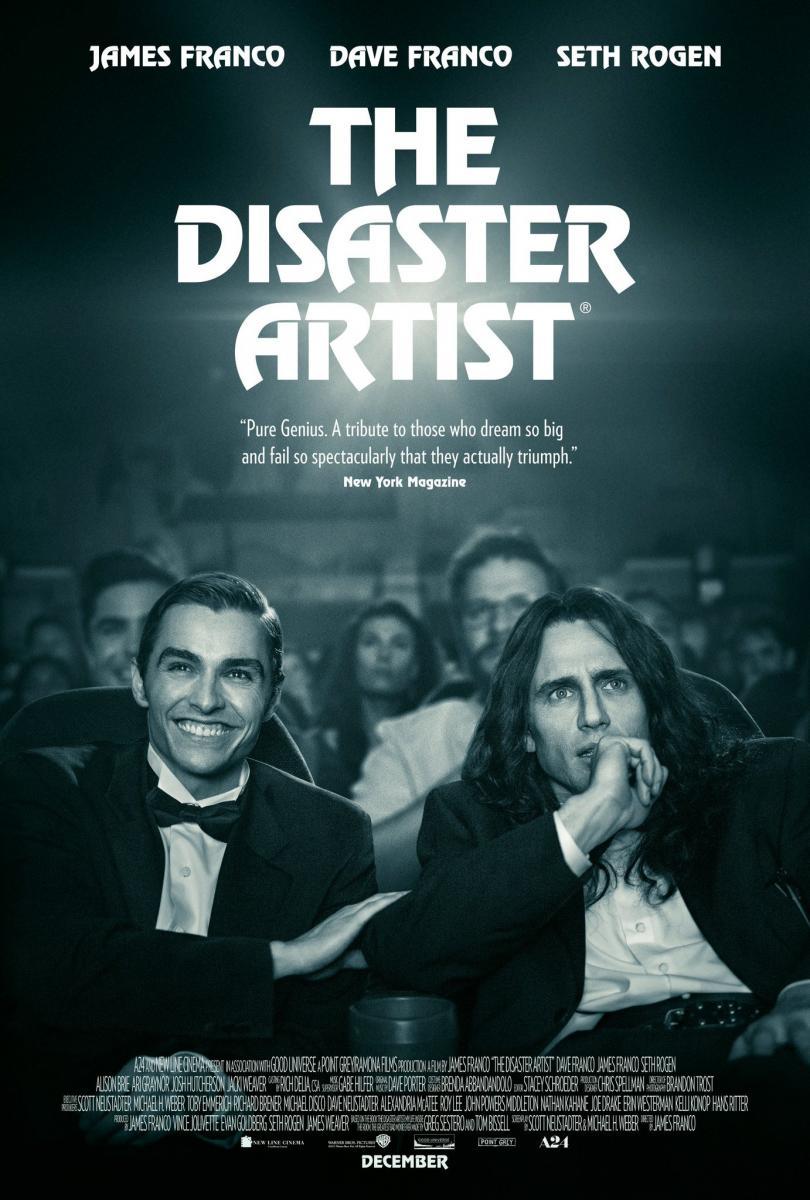
 I consider myself to have good taste in cinema, but there is one film that I adore more than even the most prestigious cinematic achievement: The Room, a film I never fail to praise relentlessly whenever I am given the opportunity. I wear my adoration for The Room proudly, considering it one of the most fascinating films ever made. It is a film that I have watched perhaps more times than any other film. It is a film of which I didn’t only write one review, but two. It is a film of which I have attended midnight screenings. It is a film that I introduce to all new friends and acquaintances (many of them despising me for putting them through the memorable ordeal of watching this film). It is a film that has been at the forefront of many passionate debates (and a few bitter arguments) with people who do not see the brilliance of this masterpiece. It is also an utterly terrible film, and one that has extremely low-values in terms of production and perhaps even morals and ethics, but it makes up for all its shortcomings in having endearing heart and soul, and it is the one film that I never grow weary of rewatching on multiple occasions. It only makes sense, therefore, that I would be beyond excited for The Disaster Artist, a film based on the non-fiction book of the same title that chronicles the making of The Room (one of the most fascinating books I have ever read, as it isn’t only an honest portrayal of the events surroundings the making of The Room, but also an explicit look at the struggles of being a young actor in the unforgiving Hollywood landscape). There was very little chance that I would not adore The Disaster Artist, but it managed to even surprise me in a number of ways.
Honestly, I will not deny that there is some element of bias towards The Disaster Artist on my part (as evident above), and my preconceived adoration of The Room did play a part in why I loved this film so much. However, looking at it objectively, The Disaster Artist is unlike anything I have seen before, an outrageous, hilarious satire of Hollywood as well as a touching and inspiring story about pursuing one’s dreams, achieving your ambitions regardless of the avenues in which it takes you. It is a film that I have been carefully monitoring its progress since it was announced in 2014, and having finally seen the result, I came away with a newfound appreciation for the story, and a heightened adoration of The Room, which I did not consider entirely possible. Looking at it completely objectively, The Disaster Artist is a subversive, memorable piece of cinema and undoubtedly one of the year’s best films, a film that has nearly as much commitment and dedication behind it as the source that inspired it.
This film is one that is inherently tricky for me to write about, because The Room extends far more than just being a piece of mindless entertainment – it has a story at its core in terms of the background of the film that resonates very deeply with me (and I assume for many others as well), and while The Room is undeniably a terrible film, it is also a film very close to my heart, and the story that inspired me is the subject of The Disaster Artist, and based on the execution of this story, this passion for the story clearly extends to those involved in this film, consisting of multiple people who have evidently felt unconventional impact of The Room in some way. Therefore, there is a certain duality occurring within this film, allowing it to serve as both a hilarious satire as well as containing a much deeper, far more meaningful message about humanity. I will be looking at both of these ideas throughout this review (basically, this just served to me a disclaimer to the fact that there will most definitely be personal commentary scattered throughout. I just love The Room so much). There are not many films like The Room, so the fact that it has risen to the status of qualifying to have a Hollywood film made about it is just complete poetic justice.
As I am sure everyone is well-aware, The Room was a 2003 independent film that was written, directed and produced by the main star, a mysterious (and vaguely vampiric) newcomer to filmmaking, Tommy Wiseau, who (in spite of his extreme European accent) insisted that he was the very definition of a cinematic hero that represented American values, along the lines of James Dean and Marlon Brando (both of which are heavily mentioned as influences to the main characters throughout this film). Wiseau’s perception of himself was grotesque in grandiosity, and he lacked most qualities that his idols possessed – good-looks, great talents and self-awareness. However, Wiseau did have one key quality that set him up for the warped success he would fall into after a few years – he had passion, and a breed of confidence rarely seen by anyone, even the most talented artists. Wiseau decided to make a film, something he saw as the next great Tennessee Williams drama, in which he played the lead role of the dashing, charismatic Johnny, regardless of the fact that Wiseau has, as one character notes, a “malevolent presence” far more suited for villain roles. Relentless in his vision, Tommy and his best friend, the young, handsome but deeply insecure Greg Sestero (who actually does represent the kind of heroic leading man Tommy sees himself as) make The Room, a film that they both believe in without any sense of hesitation, but one that results in nothing less than horrific reviews, such as the notion that it could be the worst film ever made (and I vehemently disagree with this idea, because how can something as endearing as The Room possibly be that bad?). What began as a passion project resulted in one of the most spectacular failures in entertainment history, but like any triumphant story, Wiseau rose from the ashes of failure like some overly-confident phoenix, and transformed this dismal failure into one of the biggest cult sensations in cinematic history, the likes of which the entertainment industry has never seen.
The Disaster Artist was a book written by Sestero as an account for the tumultuous and controversial period in which he worked on the film. It is an absolutely riveting read (as mentioned previously, not only does it shed considerable light on the making of The Room, but is also an honest and frank portrayal of the life of an unsuccessful actor pursuing the seemingly-impossible dream of success). It made sense that The Disaster Artist would eventually be optioned into a film, but it was difficult to see it actually happening because it is not inconceivable that there may not have been much of an audience for this film, other than ardent fans of the original. Of course, there was only one person ambitious (or perhaps, just completely insane) who could have done this film justice. James Franco is the embodiment of the over-ambitious, vaguely-arrogant overachiever who is relentless in his search for acclaim, and while I do respect him as an actor based on some of his bold and daring choices of performance, his directorial efforts have been middling (to put it kindly, and I sometimes believe he gave Tommy Wiseau a run for his money with some of his films). The Disaster Artist was an ambitious project, and Franco has had his fair share of fascinating failures that were the results of over-ambition and perhaps a small dose of unhealthy arrogance, so at the very least, his adaptation would be memorable, regardless of its quality. Franco, to the great surprise of many, managed to make a great film – not a film that is good by his usual standards, but rather a wonderful, touching and hilarious film. Perhaps mirroring the protagonist of the true-life story on which The Disaster Artist was based, Franco takes on the role of Wiseau in more ways than one, being the director of both this film, as well as the film-within-the-film (this panders to my endless adoration of meta-cinema to a staggering degree), as well as portraying the man himself. What surprised me the most about The Disaster Artist is that even if it was an unremarkable film, it would, at the very least, be an entertaining experience. Luckily, as has been reiterated several times before, it came through as one of the most impressive films of the year, and a notoriously high point in Franco’s career, both as an actor and as a director.
I want to talk about James Franco as an actor. He is undeniably an actor of notability in some regards, but not always for the most positive reasons, and he has shown himself to lack consistency in many of his professional decisions. He is capable of some towering performances, such as his remarkable work in 127 Hours, as well as showing a keen sense of comedic timing in films that allow him to exercise his more naturally light-hearted side, such as Pineapple Express and This is the End, both great films in which Franco is marvellous. In all honesty, I often saw Franco as a bit of an elitist, a performer and artist who held himself in esteem that could only be described as celestial, only occasionally qualifying for such acclaim (but when he did hit all the right notes, the results were fantastic). Many of Franco’s ambitions as an artist do not correlate with his actual talents, and as a result, there are many examples of subpar films in his career, particularly those in which he served as the director. As an actor, Franco is often very good, but his prolific directorial output has lacked anything remarkably admirable, even if the effort was clearly there. The Disaster Artist may just be the first great success in Franco’s career as a director, and there is some strong kindred spirituality between Franco and Wiseau, both artists who have self-perceptions that outweigh their actual capacities, but who still pursue their own self-indulgent ambitions without any hesitation. The Disaster Artist was one of the few instances in which I was entirely impressed by Franco and actually awe-struck by what he was able to do, and the limits to which he stretched his abilities, both as a performer and as a filmmaker (please note that I do not think Franco is a bad actor at all, and he has done some fantastic work in the past, but rather his work as a director has not always been the most consistent). Franco’s work in The Disaster Artist is absolutely astonishing, and he gives the performance of his career as Wiseau.
David Ehrlich, in his review for The Disaster Artist jokingly stated that Franco’s performance was so remarkable, Daniel Day-Lewis had to retire out of shame. This thought is far less absurd than it appears, because Franco, in spite of all his previous weaknesses as of late, truly goes further with this performance than he has ever done before, embodying the spirit of Tommy Wiseau with such awkward grace and oddly-poignant emotional resonance. Many have accused Franco of being an actor of excess, someone who does not display restraint in many of his performances, particularly those that require a notable sense of subtle nuance. Franco’s performance here is almost contradictory to what we have seen him do before – rather than be the dashing, charismatic leading man who is inherently heroic in some way, here he plays a sleazy but still oddly charming iconoclast of cinema, someone who embraced his own unique oddities to becomes a counterculture cinematic icon, the true manifestation of passion. Franco adds a great deal of complexity to the role of Wiseau, humanizing him and detaching from the popular conception that he was some alien-like figure without any traces of humanity, while still conveying the fact that Wiseau is nothing short of a case-study in absurdity, a larger-than-life artistic figure who lacked any self-awareness or any ability to monitor his own behaviour and coming to the conclusion that the way he sees himself is radically different from how the rest of the world sees him. Franco is magnificent in the film, and he gives the performance that best matches his unique set of talents, portraying Tommy as a three-dimensional, fascinating individual, rather than just a malevolent, mysterious outsider. The role of Tommy Wiseau was seemingly tailor-made for Franco, and the seamless way he blends pathos and absurdity in this performance was something to behold. What I thought would be an entertaining but meaningless caricature of a figure who is almost unimitable turned out to be something unbelievably complex and exceptionally poignant.
However, its not enough to just note Franco’s performance, because it extends much further than just a great portrayal of Tommy Wiseau. I really appreciated the amount of effort Franco put into the making of this film. Reshooting almost the entire film, shot-for-shot, to give it far more accuracy (as well as to delight fans of the original film), Franco committed fully to bringing this film and story to life through what he made in The Disaster Artist. It was one instance of his love of prestigious excess to work as an asset, because his attention to detail is beyond admirable, and he creates a film that serves two purposes: it is a hilarious account of the true-life story, as well as being an ode to the film and the culture that has developed around it. Franco includes all of the film’s most iconic scenes, as well as including hidden jokes that only the most ardent fans of The Room may notice, in an effort to show that despite showing the slightly darker side of this story (The Disaster Artist is anything but a film that portrays Tommy Wiseau as a completely decent, moral individual, showing many of his flaws that make him somewhat of a villain in his own story), there is a genuine fondness for The Room that is evident here. He pays homage to a film in a way that is delicate but not sensitive or ignorant of the bigger issues at hand, and he crafts a film that manages to be an entertaining comedy as well as a wonderful tribute to one of the greatest cult sensations of all time.
While James Franco has had his considerable share of prestige films, and forays into higher-profile work, the same cannot be said for his brother. Dave Franco sometimes seems to be trapped in a perpetual cycle of subpar motion pictures, very few actually give him the platform to display much talent or range. Usually the comedic relief or the lovably idiotic leading man, Franco has rarely been given the opportunity to do something meaningful. Therefore, this is precisely why his leading role in The Disaster Artist was so unexpectedly wonderful – being the default focal point of the film (as the story is told through his eyes), Franco imbues the role of Greg Sestero with such emotional warmth and insecure fear, as he pursues a career of an actor relentlessly, going to any lengths to become known. Some may call it nepotism for Franco to have cast his brother in this film (however, this is their very first collaboration, so there are some clear implications that they pursued different projects precisely for this reason), but he was perfect for the role, finding the warmth in the character, playing someone who is almost completely different from Tommy, but still sharing the same passion and lust for fame. The Disaster Artist is a triumph for both James and Dave Franco, and they give arguably their finest performances, and while James Franco consistently squanders talents that he has clearly been shown to have on several occasions, Dave Franco is finally given the chance to prove that he is equally as talented as his brother, and an actor who has a distinctly different set of talents compared to his brother. It also helps that the brothers have extraordinary chemistry, which helped in conveying the deep friendship between Tommy and Greg. Serving as the emotional core of his film, and anchoring it with powerful gravitas, Franco is the best he’s ever been, and one can only hope The Disaster Artist launches him into better projects, because based on his performance here, he certainly deserves it.
The Disaster Artist moves beyond its two leads and has a great supporting cast, with many familiar faces showing up for only one or two scenes, but making an indelible impact on the film as a whole. Films about Hollywood are often populated with actors playing their real-life counterparts, and there are some memorable ones here, such as the bevy of comedians who give their testimony to the values of The Room at the outset of the film, to someone like Bryan Cranston, who has a pivotal but extremely small role as himself, serving as a major plot device in driving the story forward and indirectly contributing to the central tensions. Then there are the cameos of notable performers playing figures involved in The Room – Seth Rogen, one of the original fans of The Room, has a hilarious role as Sandy, the script supervisor who takes over as de facto director of the film when Tommy proves to be incapable. Josh Hutcherson, Zac Efron, Ari Graynor and Jacki Weaver all play significant castmembers of The Room, and while they are not developed to be anything more than devices used to tell the story (lacking much characterization), they are all great. Iconic actresses Melanie Griffith and Sharon Stone but have single-scene performances in the film, and despite their limited screen time, they are welcome additions to a cast brimming with talented performers. A film like The Disaster Artist thrives on its cast, and the result is something truly terrific. There’s also a great cameo is the post-credits scene that should not be missed.
You can say quite a bit about The Disaster Artist and its multitude of themes. There are questions about what drove the making of this film, and whether it was simply a story that the filmmakers found irresistible, or perhaps it was the chance for the Franco Brothers to collaborate on something enjoyable and entertaining. However, there is something else that drove this film, and it is the main theme: passion. The reason why I adore The Room is because not only is it an absurdly entertaining film, and the source of many laughter-filled evenings, but because it is a palpable embodiment of passion, a manifesto to the virtues of hard work. Looking beyond its historically-significant problems and countless flaws, there is a story that is as inspiring as it is surreal. Tommy Wiseau and Greg Sestero set out to make a film, because Hollywood was nothing more than a long series of closed doors for them, and the only way for them to make names for themselves is to do it themselves. The results may have not been exactly what they were expecting, but it doubtlessly gave them what they desired the most: recognition. They became worldwide sensations and their names will be remembered for eras to come – and while they did achieve it in a very roundabout, unexpected way, the vigour and dedication most certainly paid off, and the result was something incredible. This was the core of The Disaster Artist. It was not a film to show the behind-the-scenes scandals and the shady dealings that went on during the making of The Room (but these issues aren’t left out, they just don’t take the foreground), but it was a film that showed the raw tenacity that went into the making of a film that may be considered one of the worst films ever made, but if The Disaster Artist proves anything, it is that The Room is a part of cinematic history. As it was so accurately stated towards the beginning of the film, nearly two decades later, people are still extremely enamored with The Room, and the film continues to be in the popular zeitgeist, gaining new admirers at a startling pace (and I suspect The Disaster Artist will only help the rabid base of fans to grow exponentially), and is going to be remembered for eons longer than any traditionally-acclaimed film. We can say a great deal about The Disaster Artist and the film which it is centered around, but in the end, the only theme that matters in this film is that of the commitment of Tommy and Greg evident throughout, and the film brings it out in full-swing, making a profound statement about the troublesome nature of trying to become a star, only to fail. Sometimes you fade into obscurity and pursue other professions, or you could enter the history books as a part of counterculture cinematic rebellion, and it proves that with a great dose of passion, anything is possible (except for perhaps making a great film, but that’s beside the point). The Disaster Artist is one of the most unexpectedly profound portrayals of the American Dream, and it casts an inspiring but not unrealistic gaze upon the values of pursuing even the most wild of ambitions.
The book on which The Disaster Artist, as said previously, is a great text on the pursuit of fame and an explicit and honest account of Hollywood and the way it operates. The book also reads as a surreal, absurdist comedy, filled with quirky characters and episodic events that are almost too bizarre to be true (but when you are dealing with Tommy Wiseau, nothing is too bizarre to be true). The film retains much of the same, and has some gloriously hilarious and lovingly-twisted moments, but it also has genuine heart and soul. It is far more dramatic than one would expect, and there are strong undercurrents of despair and desperation pulsating throughout this film. The emotional resonance of The Disaster Artist should not be ignored – there are some oddly touching moments scattered throughout, particularly in the two major storylines, namely the making of The Room and how Tommy sees this as his masterpiece and pursues it with a brand of tenacity that very few individuals are able to possess, and the central friendship between Tommy and Greg. The entire first act is dedicated solely to the duo’s fruitless attempts to break into Hollywood, and it takes the form of one of the most touching films about the power of friendship. Often a grotesquely-malformed odd couple comedy (with the couple consisting of a blonde, all-American young boy-next-door and a vampiric, middle-aged European who insists that he is the embodiment of everything America stands for), and the strengths of this film do not lie in the outrageous story of how the film was made, but in the poignant and subtle moments of friendship shared between the two main characters. The Disaster Artist: come for the absurd Hollywood drama, stay for the beautifully touching ode to friendship.
The Disaster Artist met every expectation I had, and still exceeded them tremendously. It is a film that does absolute justice to the source material, to the point where it is a brilliant companion piece to the original film (for some more of my rambling, passionate thoughts about The Room, read my review). I may be biased, but I absolutely adored this film. It focuses on the more touching nuances of the story without failing to be a hilarious retelling of one of the strangest sagas in cinema history. James Franco has made an astonishing film, one in which he gives arguably his greatest performance yet, as well as showing his extreme prowess as a filmmaker, capable of meaningful storytelling that has a firm grasp of its message, whatever that may be. The Disaster Artist is a film about passion, about following your dreams regardless of the effort one needs to put in, and the ultimate price someone has to pay in order to reach the potential they believe they are capable of. The combination of a keen sense of comedy, a fantastic cast and strong emotional-resonance and poetic nostalgia, The Disaster Artist is a glowing success and one of the most wonderful films of the year. While I believe having seen The Room amplifies the experience of watching The Disaster Artist massively, it is a great film regardless of whether one is aware of the source material. A solid, extremely touching film that pays tribute to something truly special, James Franco and everyone involved in this film worked on something incredible, and it now officially allows The Room to take its place in the pantheon of great cinematic events. Regardless of my bias, I adored The Disaster Artist (and so did the audience I watched it with, with it being one of the most energetic screenings of any film I have ever attended), and this film succeeds on a number of levels. It is truly a tremendous experience, and something undeniably memorable. This is a film almost as special as the cinematic achievement that inspired it, and that is definitely saying something.
 The Postmodern Pelican