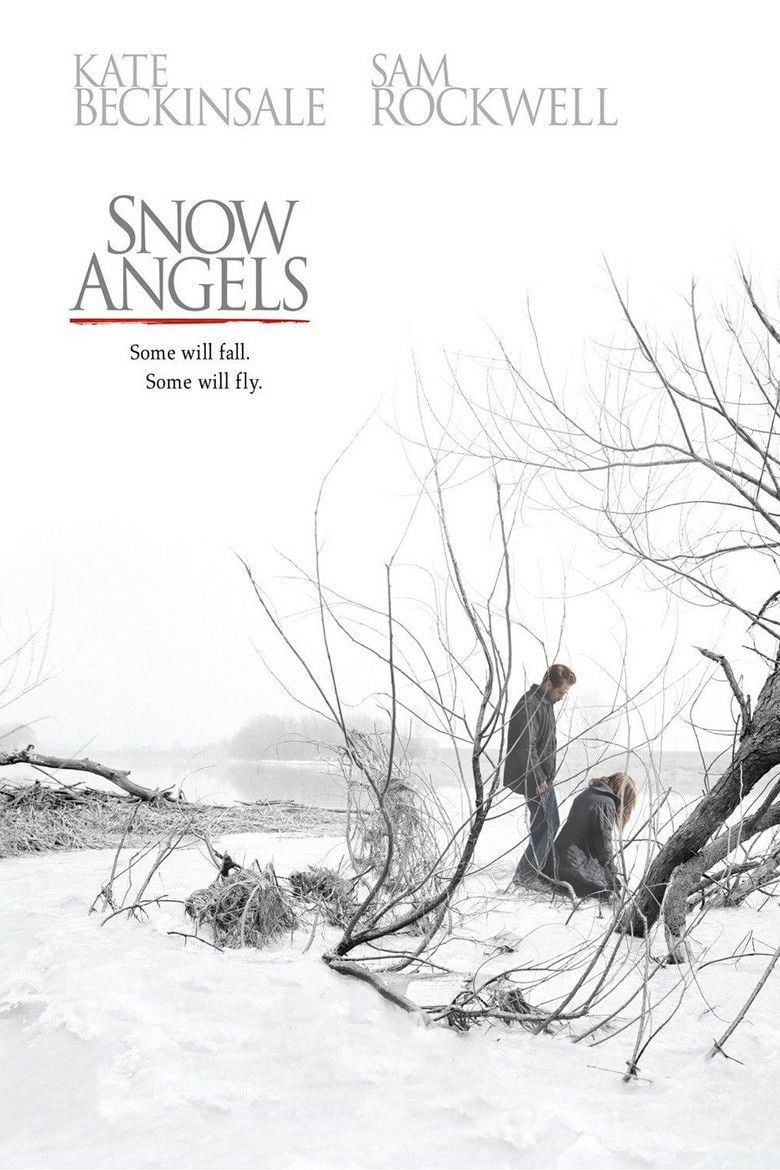
 I have had a very complicated cinematic relationship with David Gordon Green. He has made such cinematic misfires as Your Highness and The Sitter, as well as the funny (albeit entirely lacking in cultural significance) stoner film Pineapple Express. I enjoyed the latter, but have nothing but utter disdain for the former. Yet, for every one of these, there is a film like George Washington, All the Real Girls and Undertow. He has made quite a significant return to form recently (such as with his marvellous and emotionally-moving film Stronger), but not enough to reach the same tremendous heights he did in the early stages of his career. One of his most notable earlier films is Snow Angels, a small-town drama that continued Green’s streak of beautifully-complex character-driven films that have an important message lurking underneath the sometimes bitterly harsh and tremendously complex exterior. The combination of a great cast giving memorable performances, a strong story and a narrative that tends towards outright social realism all make Snow Angels one of the most distinctive films in David Gordon Green’s career, and one of the most fascinating independent films of the twenty-first century.
Snow Angels is set in a conventional, remarkably unremarkable small town in what is apparently in Pennsylvania (according to the novel of the same name by Stewart O’Nan, from which Green adapted this film). The film follows a small group of characters that inhabit that town in the days leading up to some horrific events. Amongst these characters are Annie (Kate Beckinsale), a waitress who has recently gotten divorced from her husband, Glenn (Sam Rockwell), a suicidal alcoholic who has decided to become a born-again Christian in order to prove his capabilities as a father to the daughter he and Annie share, Tara (Gracie Hudson). Another major character in the story is Arthur (Michael Angarano), a quiet high school student who starts a relationship with a smart and alluring girl in his class, Lila (Olivia Thirlby). Arthur’s own parents (Jeanetta Arnette and Griffin Dunne) are going through their own divorce, which positions Arthur as even more of an outcast, this time being ignored by his family as they go through their own problems, leaving him as a silent observer. The small community is shaken when a tragic event happens, which sets off a chain reaction of anarchy that affects all the characters, with their inter-related connections being shown to be far deeper than what the audience sees at first, and the effects the aftermath of a tragedy can have on such a tight-knit community that is clearly not accustomed to such events.
I never quite understood why Kate Beckinsale did not achieve bigger things throughout her career. She has established herself as a reliable and fascinating actress, capable of giving incredible performances across a wide variety of films (I still believe her performance in Love & Friendship is one of the seminal comedic performances of the current decade). Yet, she has failed to receive the praise and acclaim she deserves. Snow Angels is amongst her very best performances, and it stands as one of her most distinctive achievements because of how simple it was. The role of Annie is nothing more than a standard working-class woman who is trying to balance her career and her family, especially in the face of a heartbreaking divorce from her high-school sweetheart. Beckinsale is terrific at evoking the most authentic, truthful emotions and conveys the inner-turmoil of the character with unbelievable grace and magnificent honesty. The entirety of Snow Angels is without much cinematic fanfare or trickery but rather tells its story through simple narrative progression, and Beckinsale’s performance anchors the film through the same straightforward, honest depiction of a character who is not extraordinarily special or notable in any other instance, but through the empathetic performance Beckinsale gives, she illuminates the screen and gives one of her finest performances yet. It helps that she has assistance from some wonderful scene-partners, such as the extremely talented Michael Angarano (whose storyline in this film was unnecessary for the most part, but he was still great regardless of the flaws following his character’s arc), and Amy Sedaris, who gives a notably against-type performance as Barb, Annie’s best friend who has to suffer with her own earth-shattering revelation that changes her whole perspective. As a whole, the cast of Snow Angels is excellent, and are able to bring about the truthful tragedy of this story with effortless grace and extraordinary ease.
Yet, there is one person in the cast who was quite simple exceptional: Sam Rockwell. I am so pleased that at the present moment, we are living in an age where Sam Rockwell, perhaps the most unheralded actor of his generation, is finally receiving the acclaim that he deserves. Critics have adored him for decades, and he’s been a consistent presence in cinema for a while. He has taken brief forays into the world of mainstream cinema (such as his scene-stealing turn in Iron Man 2, or Cowboys & Aliens or any of the other films that took advantage of Rockwell’s extraordinary talents, even if it was just his astonishing dancing skills), but his home has always been independent cinema, and every time I see a new independent film starring Rockwell, it feels like I am becoming almost a born-again fan, finding something new in his performance to admire. Snow Angels may just be his most remarkable performance yet. Playing Glenn, a man who loses everything he values and finds himself on the brink of suicide all too often while still trying to improve himself is utterly devastating. Rockwell gives one of the most emotionally-complex performances of his career in this film, delivering a portrayal of a man so broken and beaten by the forces of reality, he has no choice but to move on – whether that is to move on to better himself (which he initially does do by finding solace in religion), or towards a more sinister region of human nature, remains to be seen. It is one of the most singularly heartbreaking performances I’ve ever seen, a performance so raw and naturalistic in its suffering, it becomes all too real. Rockwell has always been considered a terrific actor capable of a wide variety of performances, but Snow Angels proved that he is capable of more than anyone could have imagined. I truly did not think Rockwell had this in him, and I am still absolutely astonished at the performance he gave here.
It would be easy to mistake Snow Angels for something that it is not based on what the audience is introduced to. From the outset, we are privy to life in a small town in Pennsylvania, being introduced to its unique and perhaps even quirky residents who live their own lives in the small town. Snow Angels has a much deeper meaning (which I will discuss later on), but there is something else about the film that struck me as being wholly fascinating, the bilateral nature of the narrative. Snow Angels serves two distinct purposes relating to its role as a piece of social realism: firstly as a commentary on a small town, how lives intersect and how connections are formed in such a small community, contradictory to films set in larger cities, as well as being a representation of small-town mentalities. Green does not waste the opportunity to look at the lives of these characters through a lens of tender criticism, commenting on how they have grown too accustomed to the peculiarities of a small community, the idea of a bigger crisis, such as crime, is almost foreign to the residents, who were clearly not prepared for the traumatic event, and thus do not know how to react (if there is a proper way to react to trauma, which I will talk about later on). This is precisely why Snow Angels, despite its seemingly warm and welcoming presence, is one of the most cold and depressing films of its kind, because to see the social fabric being torn apart in the way that it is here is utterly heartbreaking.
Be warned: Snow Angels is not an easy film to watch. It may appear like the archetypal “slice of life” narrative of a small town, but there is something far more complex in this film, and in all honesty, it is one of the most harrowing films I have ever seen. It is a film that leaves you drained because of how explicitly honest it is, creating the same narrative discomfort as films such as Ken Park and Detachment – films so brutally truthful in the expression of emotion, it becomes a film that challenges the boundaries of emotional manipulation in its representation of tragedy (some would even refer to this film as being “misery porn”, and it certainly is a film that does not conceal its intention to be almost unbearably sad). However, this is not a liability towards this film in any way, nor is it even close to a flaw: rather, it is a terrific asset, as Snow Angels finds its success precisely in how it is able to change the audience’s perception. The film begins, as I’ve mentioned before, as a quaint and charming commentary on life in a small town, showing the trials and tribulations of the various characters as they deal with their own problems and crises of identity. It proceeds this way until the end of the second act, where the film descends into relentless sadness, showing the destructive nature of trauma and the aftermath.
Trauma is represented extremely well in Snow Angels, particularly reflected in the characters directly related to the tragedy. I have mentioned it before in previous reviews, but we can look towards trauma theory in understanding what Green was trying to convey here, because at its core, Snow Angels is nothing more than a character study of the effects of a traumatic incident, and as many trauma theorists have pointed out previously, there are two stages of trauma “acting out” (bouts of anger and depression, and an inability to move on from the trauma) and “working through” (the ability to finally come to terms with the trauma and move on in such a way that the trauma isn’t forgotten, but also not an impinging factor on the victim experiencing the trauma). These are purely psychological concepts used in real-life instances of grieving individuals, but they are also extremely effective in looking at works of art that represent traumatic events and display the varying ways in which individuals react to the trauma, and Snow Angels is one of the most overt examples of both stages, but rather than showing the stages as neat, orderly and inevitable phenomena (as something like Extremely Loud and Incredible Loud does), Snow Angels shows grieving as excruciatingly bitter, extremely unreal and entirely tangled and chaotic, perhaps even somewhat violent in same instances. In all honesty, Snow Angels is a deeply moving film, but in a way that is profoundly unsettling and complex, through its relentlessly provocative representation of a traumatic event and the aftermath, which leaves the audience truly shaken.
Snow Angels is quite a film. It is utterly heartbreaking and singularly brilliant, with a vision to convey truthfulness that can only be admired, and performances from an extremely talented cast. David Gordon Green has (or at least used to) have an uncanny ability to represent human nature in a way that is brutally honest and deeply meaningful. Snow Angels does not make any soaring commentary, nor does it say anything that we don’t already know. Rather, it seems to be a film that follows the structure of traditional Victorian realist novels, telling the story of a small town and the intersecting lives of the residents as they go about their own affairs, being brought together by a particularly notable event that shows the deep connections formed in a small community. Utterly harrowing, deeply meaningful and unbelievably fascinating, Snow Angels is a film that will not be easily forgotten, and it deserves much wider visibility because it truly is an extraordinary piece of cinematic tragedy that represents humanity in its most honest, flawed light. It is a fantastic film, and truly an unheralded cinematic gem.
 The Postmodern Pelican