 In the late 1960s, Martin Scorsese – at that point working as a director for hire, only having directed Who’s That Knocking at My Door, a deeply personal film, two years before – was relieved of his responsibilities from helming The Honeymoon Killers, based on the true story of Martha Beck and Raymond Fernandez, and replaced by Leonard Kastle, the screenwriter of the film who took over the duties as director. What I expected to be a generic, pulpy true-crime thriller about an infamous pair of real-life murderers actually turned out to be something entirely different, a film with a certain poignant depth and bleak disposition that exceeded its genre, and positions it as one of the most audacious crime films of the generation in which it was made, and considering The Honeymoon Killers was a film that helped inaugurate the 1970s, a decade known for its inspired and unique crime thrillers, that is quite an achievement. I haven’t seen something as brutally hypnotic as The Honeymoon Killers in quite some time, and in all honesty, it shocked me and left me utterly exhilarated. What Kastle did with this film, through his own meticulous attention to detail through careful research as well as the cinematic style in which he conveys the events of the film, is wonderful (and considering he had a background only in opera and theatre, the fact that he managed to make something so deeply-assured in terms of cinematic flair is beyond impressive). The Honeymoon Killers is something akin to a twisted John Waters fantasy, and a nightmarish vision of the capacity of the human spirit to be corrupt and purely malevolent in the pursuit of our own selfish ideals and to achieve what we believe has been promised to us.
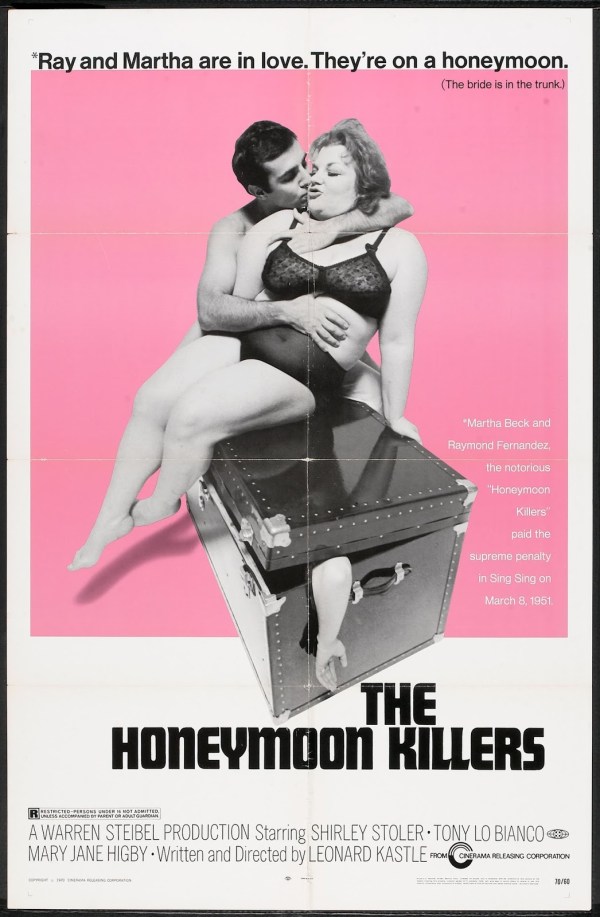
Martha Beck (Shirley Stoler) is a middle-aged nurse in Mobile, Alabama who has grown jaded and bitter over her loneliness after being unable to find someone to spend her life with. She lives with her elderly mother (Dortha Duckworth), who grows more senile by the day and is taken care of by Martha’s friend and neighbor Bunny (Doris Roberts), who also plans to play matchmaker of sorts to Martha, submitting her name to a “friendship club” which is merely a lonely hearts society where desperate spinsters and lonely widows can meet men who will supposedly take away their loneliness, and with whom they can spend the rest of their lives. It does not take long for Martha to receive a letter, but unfortunately, she has been chosen by Raymond Fernandez (Tony Lo Bianco), a con man who marries wealthy women and then abandons them not long after acquiring large sums of their money. He manages to swindle Martha out of a large portion of money, but when he abandons her, she finds him again and learns about his activities, and is eager to join him on the conquest to manipulate lonely women for financial gain. Tagging along on all of Ray’s adventures from then on, Martha presents herself as Ray’s sister, and the duo finds and con several women who blindly accept the pair into their lives, thinking they are positive forces. The couple preys on innocent, desperate women and exploits them for their own financial gain. As the tensions between the couple arise, so does the violence, and they very soon find themselves murdering their victims, either to keep them quiet or out of jealousy. Their crimes become increasingly twisted and disturbing and eventually results in a bitterly satisfying ending for both Martha and Ray, where they finally are given the sentence that they deserve.
The cast of The Honeymoon Killers is populated by, at that point, virtual unknowns. This is always a very effective method of true-crime or horror films because it lends a great deal of realistic gravitas and almost documentary-style sensibilities to the film. There is a certain realism that exists with obscure newcomers that would otherwise be distracting from the story if these roles had been played by established actors. Tony Lo Bianco, not entirely a newcomer, only had small roles on television soap operas and crime procedurals, as well as appearing in only one film before The Honeymoon Killers in the capacity of supporting. His performance in The Honeymoon Killers is nothing short of a tour-de-force of sleazy charisma and despicable allure, using the tough-guy persona he carefully honed over the course of his career to play a character that is unbelievably malicious but from whom the audience cannot resist being seduced by in much the same way that Martha is. Ray is a subversion of the archetypal macho leading man and is rather a coldhearted, malevolent villain who undergoes his own existential crises as tensions arise. Acting across from Lo Bianco is Shirley Stoler, who made her film debut with The Honeymoon Killers, is astonishing as Martha, the frumpish nurse who gets a new lease on life when she meets the mysterious Ray. Her performance is wonderful, and her growth as a character, from a reluctant and lonely nurse to a cold-blooded killer, was wonderful. The fact that the two leads of the film were relatively unknown only allows their actions to be even more shocking, as the audience grows to see these individuals not as characters performed by actors, but as true-life individuals who committed some truly heinous crimes.
The Honeymoon Killers never tries to conceal its inherent truth, and through being a low-budget exploitation film, it manages to be extraordinarily dark and violent. There are many ways to tell a true-crime story, as we have seen over the years (if there is something that the collective public adores unequivocally for some reason, it is tales of gruesome and macabre activities that are based on fact), but none are quite as disturbing as the approach The Honeymoon Killers takes to its subject matter, showing the actions of Beck and Fernandez in as gruesome and explicit detail as possible, not hiding any of their graphic actions, being extremely brutal and relentlessly honest. There is something admirable about this approach, as it does not glamorize the actions of the subjects, and rather presents their reign of terror in the demented spotlight it deserves, hideous and disturbing and utterly unforgettable. This film begins with a startling statement noting the true absurdity of what the “lonely hearts killers” did, and very rarely as a prologue to a film been so accurate. The events that transpire over the course of The Honeymoon Killers is nothing short of horrifying and leaves the audience truly shaken, particularly the third act of the film, where the seemingly tranquil and somewhat banal nature of the film descends into unadulterated anarchy and pure chaos as Martha and Ray realize that they have gone too far, and the only way to escape is to go further and become even more malicious and murderous. There is a moment towards the climax of the film where Martha drowns the daughter of Ray’s latest victim, and while we do not see the actual murder, we see Ray as he waits outside the bloody chamber, listening with horror and apprehension as Martha murders an innocent child, showing Ray’s realization that the woman he had manipulated had now eclipsed him in criminal desire and has evolved into a cold-hearted, bitter murderer. This is just one of several moments of gritty realism that lends The Honeymoon Killers its distinctive terror-filled atmosphere and makes it something entirely unique, mainly because of how realistic the actions of these characters are.
There is something quite fascinating about The Honeymoon Killers that may seem contradictory to the execution of the film: it is a beautifully American film, which goes against the brutal nature of the story. Much like The Great Gatsby and every other uncontestably American romance, it is about the American Dream, and the corruption thereof. The characters in The Honeymoon Killers are outsiders to the idealistic view of America – Ray is a foreigner, and Martha is a lonely, seemingly-unattractive nurse who has failed to find a husband. Even the victims of the couple fit this profile, being lonely widows or bitter spinsters who yearn for the happiness that the Rockwell-esque portrayal of the nuclear family promised, and which had been written and lamented about since the earliest days of American society. There is something noble in the way the events of this film are conveyed (not the actions of Ray and Martha, but rather the events surrounding them) that evoke images of the corrupted dream. The combination of the bitter jealousy of Martha at not having achieved what others have as per traditional heteronormative standards, and Ray’s greed and belief in exploiting lonely women to make his own fortune in the Land of the Free makes The Honeymoon Killers a strangely patriotic film, unrelenting in its portrayal of the factual nature of the perceived happiness that exists in a capitalist society. The Honeymoon Killers never makes any bold statements towards the strongly American value-centric nuances of the story (and I may just be grasping at straws), and what I loved the most about The Honeymoon Killers is that while it might be a challenging film and one that is unbelievably difficult to watch, it is a brutally honest reflection of reality. These characters may not be particularly likable and are entirely despicable and horrifyingly malicious, but they are truthful representations of the cliché of the American Dream going horribly wrong, causing people to act in ways that are less than ideal.
In all honesty, as much as I admired The Honeymoon Killers, I wouldn’t say that I particularly liked it. It is an effective film rather than a particularly great film because it is so difficult to endure. I mentioned previously how The Honeymoon Killers was clearly made with a shoestring budget, and while I am a champion of independent films, it sometimes can lead to some truly bleak storytelling when a film is made to be as gritty and naturalistic as this one was. Shot in grainy black-and-white, and taking place usually in extremely tight close-up shots that show every disturbing detail of the crimes. Perhaps what disturbed me the most about The Honeymoon Killers is how deeply authentic it was, how so much of the film takes place in recognizable locations – the tranquil countryside, the bustling city and most disturbing of all, the suburbs, supposedly the very definition of American idealism and exceptionalism, a location of wholesome, innocent comforts and soaring patriotism, which is entirely subverted by the introduction of the malicious actions of Martha and Ray in an environment that is supposed to be welcoming, warm and endearing. The Honeymoon Killers is not afraid to be straightforward, and it manages to be one of the most singularly disturbing pieces of true-crime cinema ever committed to screen. It is a deeply horrific reflection on normative societal values, and the way in which Kastle twists and subverts expectations is truly incredible.
Moreover, despite being relatively unheralded and occupying the position of a cult film rather than a beloved mainstream crime film, The Honeymoon Killers clearly influenced several other films that would go on to cover similar themes. It is clear that The Honeymoon Killers is a forerunner to Blue Velvet in terms of its uncomfortably bleak portrayal of suburbia and the despicable activities that can occur behind the white picket fence, and it is difficult to imagine David Lynch not being inspired by this film in some capacity. Much like the seminal Belgian black comedy Man Bites Dog (another film I feel was directly inspired by The Honeymoon Killers), of which the original title C’est arrivé près de chez vous roughly translates to “It Happened Near Your Home”, The Honeymoon Killers takes a gritty, cold-hearted approach to showing the brutality of the crimes, locating them in places that the audience will uncomfortably recognize, presenting the stories in a way almost documentarian in its realism. Finally, as mentioned previously, it is extremely obvious that John Waters saw this film and was deeply inspired by it, particularly in his infamous masterpiece, Pink Flamingoes, which features Divine doing his best Shirley Stoler impression, as well as featuring a particularly dastardly couple committing gruesome and horrendous crimes in the pursuit of being the most despicable individuals alive. The Honeymoon Killers is the rare film that is difficult to watch, but in a way that is inspiring rather than repulsive, and while remaining relatively lower in profile, it has clearly been a seminal work of gritty, naturalistic and brutally honest crime cinema and has inspired countless other films in some capacity, even if it isn’t glaringly obvious.
I thought The Honeymoon Killers was a terrific film, even if I did not find it particularly pleasing to watch, and often felt extremely uncomfortable and disturbed throughout. It is a deranged but deeply honest portrayal of the American Dream being corrupted, and how broken promises of capitalism can lead to relentlessly demented acts from seemingly normal, conventional individuals who are attempting to pursue their own idea of happiness, even if it means delving into the realm of the criminal. Shirley Stoler and Tony Lo Bianco were fantastic as the leads, and sold this film on their dedicated performances and their incredible chemistry, with their ability to play off each other being notable highlights of an otherwise excruciatingly bleak film. The Honeymoon Killers is a masterpiece of true crime storytelling, as well as one of the most effective exploitation films I have ever seen. It is shocking, deranged and deeply disturbing, and a film that very few will actually enjoy, but rather many will respect. I won’t be hurrying out to see The Honeymoon Killers anytime soon, but that does not mean this isn’t a great film. It takes a certain amount of courage to present reality in as unglamorous and demented a light as Kastle did here, and the result is an abominable, horrifying reflection on the reality that both repulses and seduces the audience, resulting in an entirely unforgettable but unbelievably frightful cinematic experience.
 The Postmodern Pelican