 There are some actors who have shown to be adept at directing, and then there are those that just cannot convincingly bring a film together in a way that is satisfactory. Many in the latter category only try once or twice, but then there is that occasional rambunctious spirit who just keeps on trying to be a serious director, regardless of the fact that his films are not particularly good or notable. George Clooney, as much of a beloved actor as he is, falls squarely into this category. A few months ago, I reviewed Suburbicon, a film I had extraordinarily high expectations for (a 1950s social satire, with a talented cast and based on a screenplay by Joel and Ethan Coen), and like much of the audience who had to endure that film, I was left utterly disappointed. I was hoping it would be the film that brought out something new in Clooney, especially considering he had the safety net of a screenplay written by a pair of the most audacious filmmakers of their generation. In all honesty, I was hoping that at least Clooney’s directorial debut, Confessions of a Dangerous Mind, would be somewhat better (especially because it was written by Charlie Kaufman, a true genius) – and to cut to the chase, as hard as Clooney tried to make something great here, it just did not work out, with Confessions of a Dangerous Mind being a contrived, unstable mess of a film that only has a few redeeming qualities scattered throughout.
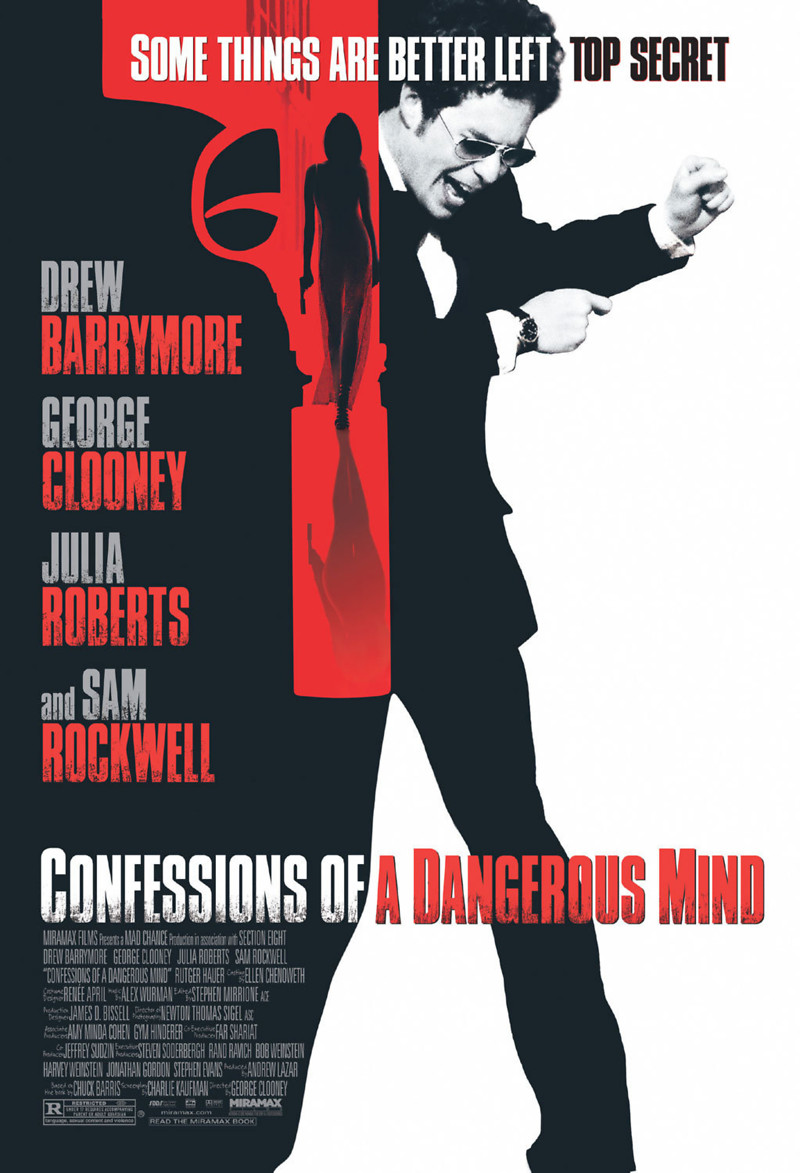
Confessions of a Dangerous Mind is based on the “unauthorized autobiography” of Chuck Barris (Sam Rockwell), a television producer and game show host known for such iconic (but low-brow) works as The Dating Game, The Newlywed Game, and The Gong Show. However, this is not a straightforward, simple entertainment biopic (one of this film’s most glaring mistakes is not focusing on the entertainment aspect that much), as Barris claimed (whether it is true or false, most likely the latter) to be a CIA agent who was responsible for murdering dozens of enemies of the state in an attempt to aid the USA in the spread of capitalism through the suppressing of communism. Confessions of a Dangerous Mind tracks Barris’ double life, showing him as an innovative (but highly divisive) television personality, responsible for creating shows that were entertaining but did not contribute anything artistic to American culture, as well as his concealed life as a contract killer, who hops around the world, killing people as ordered by his mysterious recruiter, Jim Byrd (George Clooney) and a mysterious fellow agent who he starts to develop an attraction to named Patricia (Julia Roberts), while his longtime girlfriend Penny Pacino (Drew Barrymore) waits at home, blissfully unaware of what her beau is up to when he sets off on a chaperoning trip to Berlin or Austria or Mexico, or any of the exotic locations that Confessions of a Dangerous Mind so flawlessly fails to focus on.
I’ll start with one of the few redeeming qualities of this film – Sam Rockwell. I have never hidden my appreciation for Rockwell as an actor, finding him charming and endearing, regardless of the role. Confessions of a Dangerous Mind was one of his first notable leading roles, and it was relatively early in his career. Rockwell is one of the few actors who is able to elevate the material and make it watchable, in spite of all its issues, and Confessions of a Dangerous Mind is not an exception. Rockwell commits to this role splendidly, being able to effortlessly display both sides of Barris’ life, as a charismatic television entrepreneur, and as a cold-blooded killer, who is able to use his milquetoast demeanor to gain the trust of his victims. Rockwell is fantastic in Confessions of a Dangerous Mind, and his quirky charms work well within the context of the film, and one of the climactic scenes where he breaks down into a manic paranoia was masterfully-executed, as were several other moments that proved that Rockwell deserved better than what he was given. I would not say that this film defined Rockwell’s career, but it certainly did jump-start a wave of attention towards what he is capable of and helped him gain some exposure. The problem with Rockwell’s performance is that under the odd direction of this film, no actor could possibly overcome the tonal and structural hurdles that plague it, and Rockwell can only be so good before falling victim to the inconsistency of this film. Rockwell manages to do something with the role, but he’s been far better when the material actually supports him, and not the other way around.
Here is one massive issue I had with Confessions of a Dangerous Mind – Clooney is obviously a beloved figure (if not a particularly inspiring actor), and he clearly has many friends in the industry. It only makes sense that his directorial debut will involve the assistance of many of his famous friends and colleagues raring to work with Clooney on what seemed to be a promising film. I have never been adverse to films that make use of a large cast of famous performers, as long as the characters are well-developed and actually meaningfully-constructed, and enough to give the actors something to do to warrant their involvement. Confessions of a Dangerous Mind was brimming with notable actors, and not a single one of them was particularly good. One only needs to look at Clooney himself, who shoehorns himself into the film in a role that is supposed to be an ambiguous, omnipresent CIA agent tasked with mentoring Barris and making him a cold-blooded killer and a representative of the relentless patriotic capitalist project of the United States of America. What could have been a fascinating, mysterious character was simply George Clooney in an awful mustache, speaking slightly above a whisper and coming off as the most unstable insurance salesman that side of the Mississippi. Clooney is not the most versatile actor, but he has his charms, none of which are on display here, leaving us with one of the most laughably strange performances in Clooney’s career – if only the director of this film had worked to develop the performance more. Also, how is it possible that Clooney casts the great Rutger Hauer in this film and makes him do absolutely nothing? Let’s also not mention the astonishingly terrible cameos from Brad Pitt and Matt Damon.
Moreover, both Drew Barrymore and Julia Roberts (who, at the time of Confessions of a Dangerous Mind, were at the very peak of their popularity, and deservedly so) are both in this film, and both of them are atrociously wasted. Barrymore does nothing except play the blindly supportive girlfriend who appears throughout the film to serve as a plot device, and while she is undeniably charming as always, she just isn’t given anything interesting to do, and just falls victim to an underdeveloped character. Roberts, on the other hand, had absolutely nothing to do in this film, playing someone that is supposed to be smooth, seductive and mysterious, but is actually just Julia Roberts giving the same confident, straightforward, no-nonsense intellectual act that she was known for around the time. I am not entirely sure what is more distressing: the fact that Roberts was hired to play a character that was inferior to her capabilities, or that the filmmakers actually retained this character that has very little consequential effect on the plot. The twist regarding her character could be seen from space, and it was laughable the extent to which this film tried to imply her importance to the story, while seemingly also forgetting about her altogether at multiple points. Either Confessions of a Dangerous Mind was completely ignorant of the capabilities of its talented cast, or it was self-delusional in believing that it was an appropriate showcase for the actors that appeared in the film. It struck me that it was entirely possible that many of these actors in this film had the charitable nature to appear in Confessions of a Dangerous Mind as a favor to Clooney in his directorial debut, rather than because they thought this was a good career move. Clooney, for all of his charisma and endearing personality traits, just does not know how to direct actors.
I cannot recall ever seeing a film as inconsistent in tone as Confessions of a Dangerous Mind. It was part entertainment satire, part spy film, and part biographical drama, and fully a failure in all these regards. It was not scathing enough to be a satire on the entertainment industry, not well-developed enough to tackle the real-life subject matter and pay his fascinating (if not entirely untruthful) life the respect it deserves, and not nearly thrilling enough to be a good spy film. The problem wasn’t that Clooney was trying to juggle all three of these genre conventions, but that he clearly did not know how to develop a single one of them. The film, as I mentioned previously, was based on a screenplay by Charlie Kaufman, and I say that it was based on the screenplay, rather than that it was written by him, because of behind-the-scenes stories are to be believed, Clooney completely bastardized Kaufman’s original screenplay to the point where it was unrecognizable to the writer, and considering Kaufman is the writer of such esteemed works as Being John Malkovich, Adaptation and Eternal Sunshine of the Spotless Mind, I can believe that his original script for Confessions of a Dangerous Mind was most certainly more superior and far less dull than the final product. Clooney’s two most relatively-successful directorial efforts (by that I mean that they were not complete failures) were The Ides of March and Goodnight and Good Luck, both of which stuck to a particular genre and did not deviate.
There is absolutely nothing wrong with a film oscillating between genres and conventions, granted the director knows what he or she is doing. Clooney just failed to have a control on any of them here, and the result is that Confessions of a Dangerous Mind is an uneasy, misshapen, contrived muddle of genres. It doesn’t help that it features some of the most atrocious cinematography I’ve ever seen (the lighting was offensively bad, and the photography of Barris’ “assignments” was consistently awful, trying to appear natural and gritty, but just coming off as desperate and dull) – but what do you expect from a cinematographer who is best known for Bryan Singer’s X-Men films, as well as the hilariously bad Cop Rock television show. Perhaps my main gripe with Confessions of a Dangerous Mind is that of feeling offended by how Clooney corrupted what was very likely a subversive, well-develop screenplay into something as dull and lifeless as the final product, whereas in the hands of a more capable filmmaker, it could have resulted in something truly special. I know it seems like I am relentless in my criticism of this film, but it is just simply annoying the extent to which this film managed to surprise me with its utter dullness.
I wanted to love Confessions of a Dangerous Mind. It seemed like a dark comedy about the entertainment industry, particularly a figure who was larger-than-life and gloriously ludicrous. Sam Rockwell does his very best to elevate the poor decisions made by the director, and it tries so hard to be edgy and hilarious and fails tremendously on both counts. It is not an entirely awful film, and there are some good moments (the second act is relatively strong, but is preceded and succeeded by poorly-developed characters and a narrative that is inconsistent). I just wanted to love this film more than I did, and rather than feeling muted respect for it, I found it to be awfully contrived and quite simply a disappointing disaster. The tone was startlingly inconsistent, and the film as a whole just does not know what it wants to be. Confessions of a Dangerous Mind was not the explosive directorial debut Clooney had clearly hoped it would be, and I just found myself bitterly upset at how this film had all the elements to be a success but wasted them in a way that was slightly disrespectful, and discouragingly bad.
 The Postmodern Pelican