 Family is a subject that cinema loves, and there is absolutely no shortage of films that tackle the difficult but relatable topic of family dynamics. It is a subject that independent cinema is particularly enamored with, whereby several films take a critical (and often extremely hilarious) gander at the complex relationship between family members. One of the most memorable recent films that succeeds in being a meditation on family dynamics is Tamara Jenkins’ brilliant The Savages, a film that is hilarious, bitterly acidic and often unbearably heartbreaking, and beneath its quintessential independent comedy sheen, there is a far more deep and profound story of loss and dealing with situations that most people have to endure at some point. It is not a groundbreaking film, but it makes some fascinating statements on its subject matter, delivered through its effortlessly talented pair of leads and a story that may not be a definitive account of family and the tensions that exist within, but certainly is a scathingly honest and brutally hilarious portrayal of a family in crisis, and how such a crisis can lead to unexpected effects. If anything, The Savages is subversive in how it subtly attacks the notion of traditional family behavior in a manner that is so nuanced and bitterly hilarious, allowing it to metaphorically pack a truly memorable emotional blow to the audience, who are surely not expecting such a bleak portrayal of the relationship between relatives.
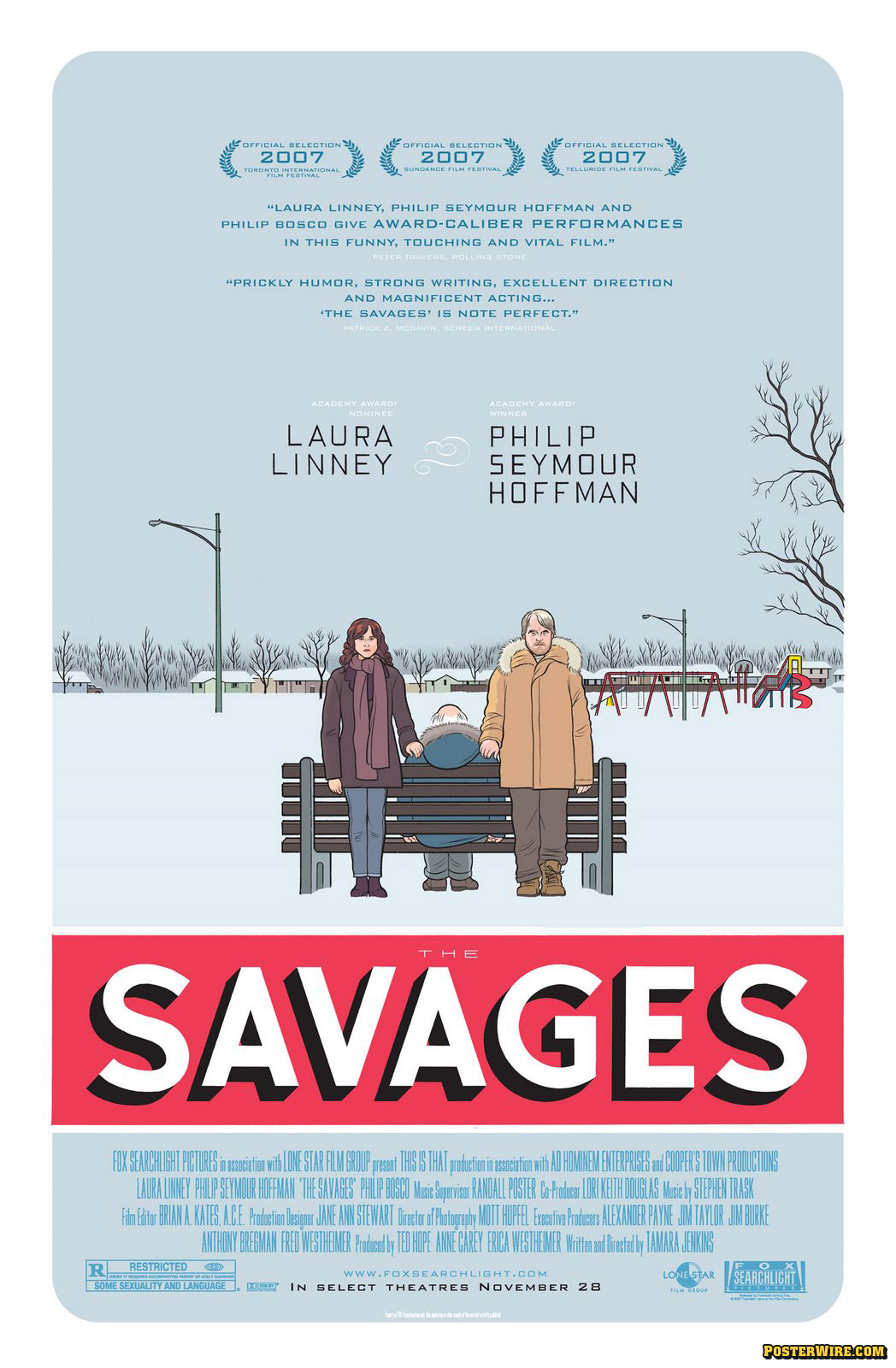
The Savages is centered on two individuals – Wendy Savage (Laura Linney) is an aspiring playwright who makes her living by doing temp work. Her brother, Jon (Philip Seymour Hoffman) is a mildly-successful and relatively-renowned academic known for his work on theatre, particularly the work of Bertolt Brecht. Their father, Leonard (Philip Bosco) is diagnosed with dementia after the death of his longtime girlfriend, and for the first time in their lives, the siblings have to work together to help take care of their father, which is all an elaborate way of distracting from the fact that he does not have much time left, and Jon and Wendy need to come to terms with the fact that their father is running out of time. Along the way, tensions between the siblings heighten as they compete for dominance, both in terms of asserting their superior intellects, as well as trying to take charge of the wellbeing of their father, which proves to both drive Jon and Wendy apart, as well as bringing them even closer together as they navigate through their respective emotions and reactions to the imminent death of their father. Tensions are high, and the vitriolic jealousy between the two siblings is truly palpable, and believe me when I state my belief that the decision to title this film The Savages most certainly was not only made to refer to the last name of the main characters, but also to the type of individuals they are and the ways in which they conduct themselves.
Tamara Jenkins constructed her film out of a very simple premise, and while it could easily be misconstrued as being void of any real storyline, it is actually an attempt to display broken bonds between families, and how individuals within those families can react differently to various forms of events and pre-traumatic conditions that force them to encounter one another and address their own personal quandaries while being in the presence of the people who are simultaneously capable of both emotional destruction as well as a rebuilding of soulfulness. The Savages is a film that directly comments on the inherent awkwardness of family, how it is far different from the archetypal Norman Rockwell paintings of the perfect family, void of any tension or conflict. The Savages is an attempt to look critically at this idea of family, to deconstruct normative notions of what constitutes a “traditional” familial unit, and present it in a way that is both darkly hilarious, able to make scathing commentary on family as a whole, as well as being bleak and heartbreaking, noting how tragedy can cause people to act in unexpected ways, for better and for worse. While The Savages may not be the most original film about family tensions, it is certainly one of the most brutally honest, and there is something very special and unique lurking underneath the relatively quirky and idiosyncratic independent dramedy appearance of this film.
Independent comedies such as The Savages thrive almost entirely on the performances, as the story is conveyed almost exclusively through the development of the characters. In a film such as The Savages, it is imperative that the actors selected to occupy these roles are able to make the characters their own, and develop them from beyond the script and imbue them with a certain degree of realism, in order for the audience to legitimately believe that they are privy to the events of this film. Tamara Jenkins spared not expense in getting two of the finest performers of their generations to play the titular characters. I assume watching a film such as The Savages is a melancholy experience for many viewers, as it contains one of the finest performances from Philip Seymour Hoffman, an actor taken from us far too soon. While it is important for me to not use this review as just another platform to mourn the immense loss cinema felt when the iconoclastic Philip Seymour Hoffman died, it would be wrong to not briefly note his legacy. I can think of very few actors that had careers that were on par with Hoffman’s, particularly between the mid-2000s, right up until his untimely death in 2014. He was a recognizable, beloved and unique actor and found his way into the mainstream on a variety of occasions. However, it was always his ability to command the screen in small independent films that I admired him so much for. The Savages is one of his finest performances, perhaps because it showcases everything that Hoffman was capable of – undeniable wit, scathingly hilarious sarcasm and the ability to convey authentic emotional gravitas into the story, creating a character that is undeniably his own in many ways. It is not a performance that defined Hoffman’s career in the same way as Capote, The Master or Synecdoche, New York, but rather serves to be an example of Hoffman’s enduring legacy, his flawless control of the character, and his uncanny sense for displaying the true, authentic humanism of his characters. Perhaps one could consider it a minor work in his career, but it is certainly one of his most endearing and truthful performances.
The other half of the titular pair of characters (which is a bit of dishonesty on my part, for reasons I will explain later on) is Laura Linney’s Wendy Savage, a viciously hilarious and unique creation, and a departure from the usually very stoic and willful characters Linney is known to play. As Wendy, Linney is able to play a conflicted and broken character, searching for some meaning to her life and struggling to find a purpose and a way to realize her dream, much in the same way that her brother has seemingly carved himself a niche of acclaim and respect, even if he himself feels like a failure for his inability to be as world-renowned and respected as he believes himself to be. Linney does not merely convey the inherent insecurities of her character – she engages directly with them, showing Wendy as a truly misplaced individual, trying to live an artistic, fulfilling life, yet the external forces she experiences are in constant interplay with her inner turmoil, and prevent her from reaching the potential she believes herself to be capable of achieving. Linney is extraordinary in The Savages, and she manages to display a vulnerability very rarely displayed by an actress who is nothing short of consistently excellent, and strangely underrated. The Savages is quite simply just another terrific performance by Linney, who has incredible chemistry with Hoffman, playing siblings doing their best in the anticipation of tragedy.
The Savages is not only about Jon and Wendy, a fact that I have misleading alluded to. It is as much about the tension between the siblings as it is about their troubled relationship with their aging father, a man who both siblings openly admit was not the most dedicated of parental figures, but still a good enough father that his offspring will temporarily leave their lives behind to care for him and give him the best quality of life possible as he heads to his inevitable, rapidly-approaching demise (which he seems to be strangely at peace with). The Savages never explores Leonard as fully as it does Jon and Wendy, because, despite this film being about his relationship with his children, it is not necessarily about him as a character. Yet, Phillip Bosco is still fantastic, managing to convey the central struggle of his character – whether as a man growing senile and acting out in ways that are hilariously vulgar as well as heartbreakingly tragic, or in his tranquil moments of peaceful acceptance, and most notably, his despair at seeing his children fighting over the most inconsequential, insignificant matters. For the most part, Leonard is a silent observer, often remaining in the background and not being the focus most of the time, but rather something akin to a plot device. However, if the viewer simply directs their gaze towards Bosco in any scene he is in, it is possible to assuage the pure emotional power present in Bosco’s emotive expressiveness, always being a vital but not focal part of this film. Bosco is far better than one expects, and he is as good (if not occasionally better) than the two leads of this film. It is as much his film as it is that of Hoffman and Linney, and it is important to not understate his own powerful and impactful performance in The Savages
The Savages is a tremendous film. It is hilarious and a scathing satire of family and the tensions between siblings. However, it is far from mean-spirited, and is genuinely moving. It is a complex account of family relationships, and the way in which individuals deal with trauma, and how the interactions with other people experiencing their own battles with whatever personal problems that they have can lead to conflict, but also very possibly satisfying, soulful resolution. The Savages is a quirky and idiosyncratic independent dramedy, and while it is not a particularly major work, it is still wonderful and features Philip Seymour Hoffman and Laura Linney at peak brilliance, and allows them to develop characters that are original and realistic. The Savages is a fantastic film, and deserves all the acclaim it can get. Independent cinema often forces the audience to be confronted with difficult subject matter and it challenges issues that are not often explored in mainstream films. The Savages is not any different, and it is a beautifully-constructed piece of modern cinema, and a truly lovely film, but one that is not afraid to subvert its heartfelt subject matter in the pursuit of some bitterly acidic, vitriolic commentary on the sacred matter of family. The Savages may not be the definitive account of familial relationships (does such a film that could qualify for this title even exist?), but it is certainly one of the most brutally honest and deeply hilarious, and manages to be a truly memorable film that I was not expecting to be this emotionally-resonant. A truly terrific film.
 The Postmodern Pelican