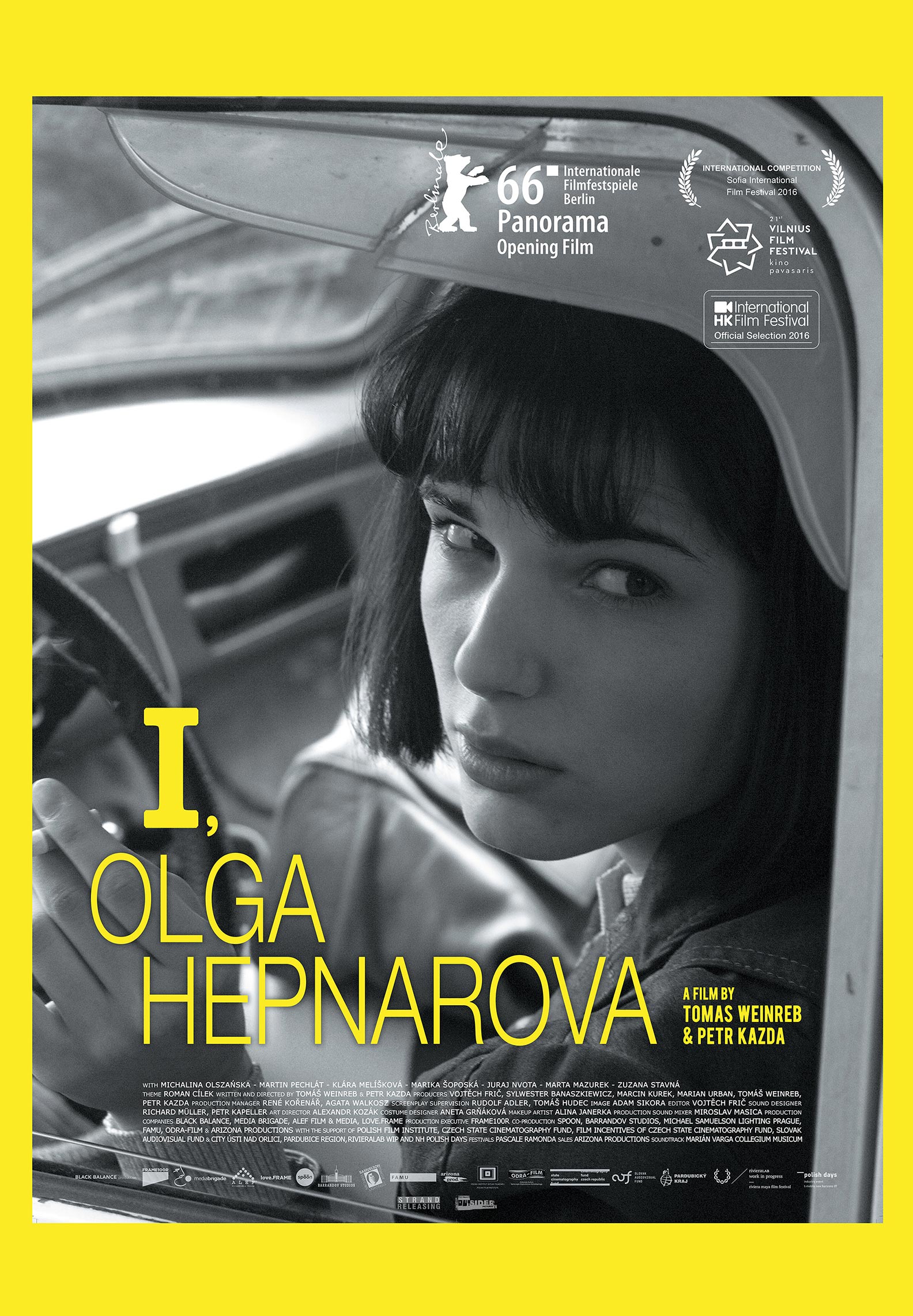
 “One day you’ll pay for your laughter and my tears” – these are words spoken by the main character in I, Olga Hepnarová (Czech: Já, Olga Hepnarová), a shocking and brilliant film hailing from Tomáš Weinreb and Petr Kazda, both making their feature-length film debut with this chillingly socially-relevant psychological thriller that is based on one of the most infamous stories in twentieth-century Czechoslovakian history. A film that packs a proverbial emotional punch in conveying the deeply disturbing story of the last woman executed in Czechoslovakia through gorgeous cinematography, a hauntingly bleak story and one of the best performances of the current century. Through this despicably brilliant character study, we are introduced to a story that has the ability to terrify us, not only because of its unbelievably cruel truthfulness but because of how socially-relevant it is, which is a horrifying concept. I, Olga Hepnarová is a film that has remained relatively obscure since its released only a year ago (or this year, depending on one’s region), but in spite of its lack of wide-viewership, it manages to be one of the most extraordinary films the Czech Republic has produced in a long time.
I, Olga Hepnarová is based on the true story of the titular character, Olga Hepnarová (Michalina Olszańska), a young woman who works as a truck driver. To call her mentally-unstable is an understatement, as she is clearly very disturbed, and in a strange inversion of expectations, she often practically begs to be placed in an asylum to allow her to “have a rest” – and through being the victim of bullying and discrimination, Hepnarová starts to develop a deeply hostile attitude to the world around her, and starts to have suicidal thoughts – and when taking her life does not succeed, she decides that her own death will do nothing to change the mindset of those who have apparently wronged her, and she needs to take revenge on humanity in some excruciatingly violent form. In an action that is unfortunately far too realistic considering recent acts of horrific violence throughout the world, Hepnarová hits a group of civilians with her company’s truck, killing eight people and injuring several others. Her own demented nature not only displays her lack of remorse, but results in her pleading for the death sentence, which results in her history-making fate as being the last woman executed in Czechoslovakian history. Her grisly death at the end of the hangman’s noose is exactly the kind of result that she had hoped for, and through her own disturbed actions and desire to take revenge on humanity, Hepnarová was granted her wish, but at the cost of being remembered as one of the most infamously deranged serial killers in European history, with motives that were deeply ambiguous, and reasons for committing the murders that are almost impossible to feel sympathetic towards.
I, Olga Hepnarová is an extraordinarily layered film, and one that approaches its titular subject in a number of ways. It is actually daunting to consider the vast amount of themes this film attempts to convey, and even though it sometimes may become slightly muddled in the process of the unfolding of the true-crime narrative, it succeeds in the execution of the story (no pun intended). Of course, the most prominent theme present in I, Olga Hepnarová is that of the mental illness of the main character. It is a film that foregrounds the titular figure as someone that struggled with mental instability, and shows the challenges she faced on a day-to-day basis as she attempted to navigate a harsh society in which she felt like a complete outsider (and not only as someone that suffered from mental illness, but also as a lesbian in a society in which homosexuality was not illegal, having been decriminalized only a few years before, but one that was clearly still hostile to the idea of homosexuality in terms of attitude – the heteronormative agenda does not play a very large role in the central tension of I, Olga Hepnarová, but it is certainly a presence throughout). Moreover, she feels like a pariah in her own family, struggling with the belief that the man that she has been told is her father is not actually her father, and that her mother is a cold, clinical figure that does not care so much for her working-class daughter as she does for her status as a prominent medical practitioner.
I, Olga Hepnarová never tries to justify Hepnarová’s actions through attempting to create sympathy for her suffering from mental illness, nor does it try and show her as a misunderstood, tragically-flawed heroine who only committed the dreadful crime of killing and injuring innocent people as a result of her own struggles in an unforgiving, hateful society. However, the film also does not present Hepnarová as a cold-blooded, sadistic individual who just killed a group of individuals for the sake of making history, being void of any motivation or reasoning behind such an action. This film navigates the extraordinarily fine line between these two extremes in conveying the events surrounding Hepnarová’s crime, and manages to explore the central challenges Hepnarová faced throughout her early adult years that led to her horrific exertion of her inner rage without actually creating the sense of pathos or pity towards the character. It is an attempt to understand, but not in any way validate or condone, what she did, and to portray a truly disturbed individual that believed herself to be a victim to what she believed a particularly awful society, and exerted her cold-blooded revenge on innocent people to warrant her own mental instability.
Admittedly, I have been known to make some hyperbolic statements from time to time, and very often, they are just ramblings as a result of overt enthusiasm and hindsight usually informs me of the problems with my excessive praise of some films or performances. However, I can say with absolute sincerity that I, Olga Hepnarová features one of the most brilliant and moving performances I have seen in years. Michalina Olszańska, who plays Olga Hepnarová, is absolutely astonishing – the way she carries herself, with her dead-eyed gaze of pure malice and diabolic scheming being used in conjunction with her awkward and rigid stance only emphasizes how much of an outsider Hepnarová actually was. Olszańska’s performance is so nuanced, with her moments of vulnerability being particularly searing, such as in the brief forays into romance with other girls, as well as the heartbreak she feels after the love affairs disintegrate as a result of her own insecurities and feelings of unworthiness. I cannot recall many performances quite like Olszańska’s in I, Olga Hepnarová, where she is able to bring out so much characterization through the sheer physicality of emotion and gesture of her performance, with her complex expressiveness working alongside the more traditional dialogue-driven aspect of the role. The transformative aspect of the role – whereby Olszańska oscillates between being awkward and vengeful, to romantic and vulnerable, is utterly staggering.
I, Olga Hepnarová gives Olszańska plenty to do, and she navigates a character that is obviously despicable, but in a manner that shows her as being more than just a murderous psychopath – it portrays her as a murderous psychopath with depth and motives – and I cannot possibly emphasize the point enough that I, Olga Hepnarová never attempts to justify the actions of Hepnarová, and it is actually remarkable the extent to which this film knowingly avoids showing her as sympathetic in any way. In her interactions with other characters as well as in her moments of silent reflection, where her inner-thoughts are conveyed through chilling voice-over soliloquies, Olszańska is astoundingly brilliant. It takes remarkable ability from an actress with considerable talent to portray such a terrible individual in a way that presents her as being undeniably human and flawed, yet not in a way that can be considered an apologia for her decisions. Olszańska gives a truly career-defining, star-making turn as Hepnarová, which only makes this film’s somewhat meager viewership even more disappointing, as she is exquisitely tremendous in the film, and her performance is deeply impressive and filled with unexpected nuance and depth.
It is obvious that I, Olga Hepnarová is an undeniably bleak film based purely on its true-life subject matter. However, Tomáš Weinreb and Petr Kazda emphasized the haunting nature of the story through the way the film was made, with the technical and creative aspects of the film working alongside the narrative to create truly remarkable viewing. The most distinctive quality about I, Olga Hepnarová is that it is filmed in black and white, and while many modern films use monochrome to appear superficially unique and artistically-resonant, the same cannot be said for this film, which uses the monochrome aesthetic extremely well. The cinematography of this film is simultaneously gorgeous as well as being deeply unsettling – I, Olga Hepnarová is a very cold film, and the despairing sense of detachment and isolation that the titular character feels is highlighted by the lack of warmth and color in the film. The thematic desolation of the central story I, Olga Hepnarová is supported by the stark and disconcerting beauty of this film’s aesthetics, where cinematography, which is not limited to the monochrome visuals, but also to the beautifully haunting long-shots that linger just long enough to create the sense of unease, is used to underscore the hopelessly gloomy truthfulness of the story.
I, Olga Hepnarová is a haunting film and one that has remained in my mind since I saw it. There is something so uncomfortably beautiful about this story, how it manages to rummage through the seemingly impenetrable mind of an infamous historical figure, taking the viewer along in this film’s often difficult investigation of the murderer and her background, attempting to probe into the reasons behind her actions without actually showing any signs of pity towards her. It is a complex portrait of a controversial individual that made one decision that altered the course of her life and resulted in her desire to make history being satisfied, albeit in a way far different from what she considered to be heroic, noble motives, where she became reviled and notable only as a fascinating statistic, with her deluded intentions going entirely ignored. If anything, I, Olga Hepnarová presents Hepnarová as someone who was clearly mentally unhinged, but was steadfast in her conviction that her actions were noble and somehow an attempt to prevent similar actions from happening, choosing to use herself as an example to bring about some social change.
Obviously, this approach is quite different (but not any less horrifying) than the motives that go into the unspeakable terrorist attacks that are shockingly too commonplace in the modern world, which are usually inciteful acts of revenge and warning. Hepnarová’s motives were somehow intended to be preventative, but obviously were not, and simply conveyed her as the deluded, deranged individual that she was. Beneath the true-life horrors this film represents, there is some form of virtue, perhaps not on the part of Hepnarová herself, but on the part of the filmmakers, who attempted to show the ability of an individual to commit unutterable acts as a result of their own belief that they have been wronged, whether by an individual or society as a whole, but when in actuality, it seems that the only person to blame for such actions is the perpetrator themselves. It is a contentious issue (and a subject on which I am not an authority in any way), and there are some sporadically deceptive moments where the audience is almost persuaded into feeling pity for Hepnarová, as she is often shown to be hurt by her experiences and the lack of acceptance she feels, but it is deftly avoided, and she is shown to be a complex but no less despicable character that meets the demise that she both desired and deserved.
I, Olga Hepnarová is a truly wonderful and subversive film. It may seem like a conventional monochromatic, modern European social drama, but it is far more complex than that, tackling a subject that is more obscure than more notable perpetrators of violent acts of murder, but not any less worthy of such a cinematic investigation into the motives behind the crime, and the person who chose to commit such an action. Michalina Olszańska is unthinkably magnificent, and gives a truly mesmerizing performance, and one that has lingered on my mind consistently, with her nuanced but unsettling performance as a cold-blooded but complicated criminal instantly entering the canon of exceptional cinematic representations of malevolence. The gorgeous aesthetic of the film underlines the bleak nature of the story, and creates the sense of haunting uneasiness. All these factors come together to create a film that is hypnotic and mesmerizing, and fails to fade away, and rather lingers on in one’s mind. It is a slow-burner of a film, with the often frustratingly-slow development of the titular character being paramount to conveying the shocking and gruesome climax, where the horrific terrorist act is shown explicitly and with sheer brutality. I, Olga Hepnarová is an intricate character study of a vile and malicious individual, and while it may be often unbearably tense and uncomfortable to watch, it is ultimately a magnificently-made masterpiece of modern European cinema, with one of the strongest lead performances in years, and a story that is relentlessly somber and wretched, and utterly unforgettable.
 The Postmodern Pelican