 Documentary films are such an underappreciated cinematic form, mainly because around-the-clock news programming and micro-documentaries presented on television and over social media have made the idea of the innovative, long-form documentary somewhat redundant. However, the form still manages to live on despite the fact that it panders to an extremely niche audience. I am a proud member of that niche audience, and I find the more abstract and odd the subject of the documentary is, the better. This is the exact mentality that has drawn me to the work of people such as Werner Herzog and Errol Morris, two filmmakers that make unconventional documentary films about unique subjects that challenge the boundaries of what a documentary film actually can possibly be through their manipulation of form and content, where the subjects speak for themselves and construct their own story, and the filmmaker does not intervene in the stream of the story in any way that is not necessary. I can see two sources of inspiration for this kind of documentary filmmaking: Shirley Clarke’s fascinating character studies (most notably, the remarkable Portrait of Jason) and The Maysles Brothers’ canon of great documentary films, namely Grey Gardens and Salesman, where they helped define the style that has come to be known as cinéma vérité, and has been a singular influence on much of documentary filmmaking, and even aided in giving birth to the parodic mockumentary film and television show industry (as well as reality television in a way, but let’s not get into that).
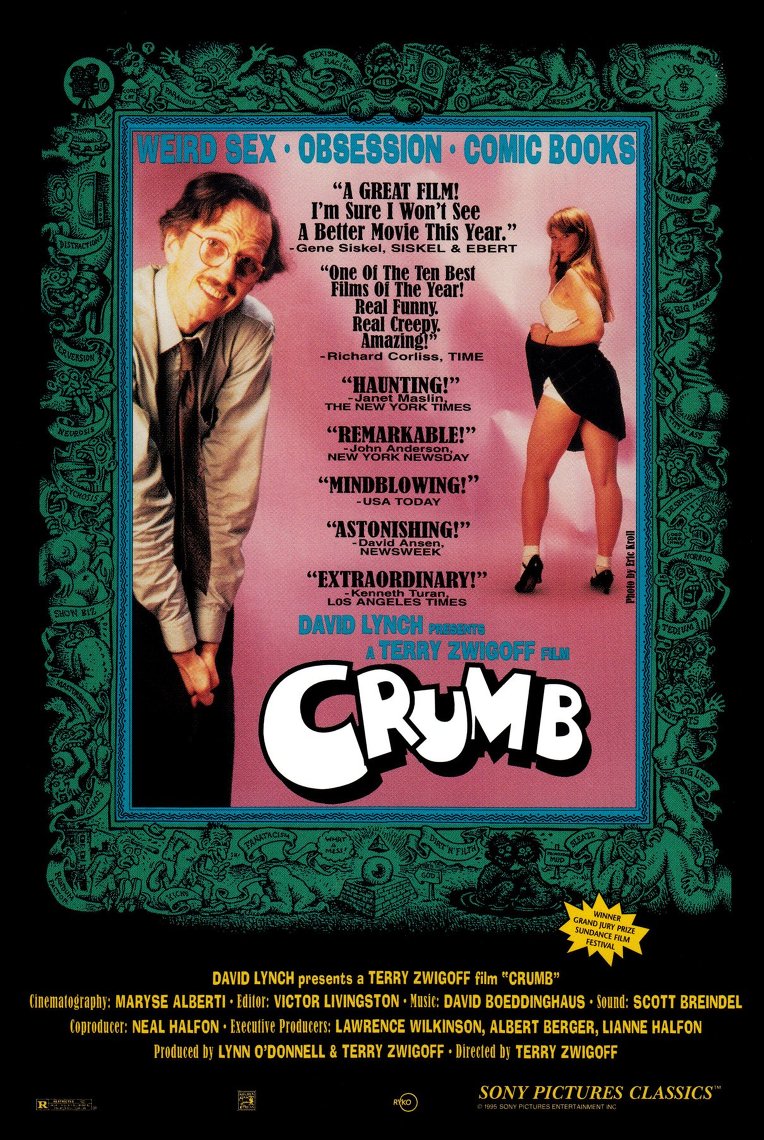
This has all been a very roundabout way to introduce Crumb, a unique and brilliant documentary film hailing from Terry Zwigoff (the talented director behind such masterpieces as Ghost World and Bad Santa), about one of the most fascinating artists of the twentieth century, Robert Crumb (or simple R. Crumb, as he is known in much of his professional work). The reason to introduce this review with an overview of early documentary filmmaking is important, because while Zwigoff intended to construct a film centered around a man that was his friend as well as a cult, counter-culture artistic icon of late-twentieth century satire, Crumb is as much about the man as it is about the form of documentary filmmaking as well, and the more one looks into the wide and labyrynthine world of documentaries, you come to realize that there are very few genres of film that are as clearly influenced by other filmmakers and film movements as the documentary – and while some may see Crumb as being a portrayal of a very odd but highly influential man, there is something far more profoundly deep in this film in terms of what it is trying to say, as well as how it says it. It paints a singular image of a unique artist, as well as the various people in his life, past and present, that have inspired him and influenced his work in some way, and the way in which Zwigoff explores the life of the titular individual (if it is only about Robert Crumb is most certainly a contentious issue) is wonderfully profound and very often, bitterly hilarious.
Robert Crumb is an extraordinarily odd person, and I have been fascinated by his work for years now, finding his creations to be awkward, uncomfortable and deeply brilliant in so many ways – one only needs to look at his demented and sardonically funny satire Fritz the Cat to understand that Crumb is anything but conventional, and he often pushes the boundaries a tad too far but is restrained enough to not be entirely exploitative or overly vulgar. He paved the way for many graphic novelists to experiment and create unconventional and seductively unique works of art, and his influence is overt when looking at the work of underground graphic novelists such as Daniel Clowes (whose graphic novels Ghost World and Art School Confidential would go on to be notable later works in the career of Terry Zwigoff), Alison Bechdel and Art Spiegelman, all of whom owe much of their careers in some way to the work Crumb did, as he proved that comic books were not restricted to be the realm of superheros and cute, adorable characters – they could be crass, crude and extremely provactive, and more than that, startlingly realistic. Robert Crumb essentially revolutionized comic books in his own way, and while it is easy to dismiss comics as being insignificant works of populist media designed to pander to the general public’s fascination with crime-fighting superheroes and anthropomorphic animals tossing off cliched words of wisdom, the alluring and shocking work of Crumb shows that this form of art can be truly controversial and utterly incredible when it hails from a truly creative, and perhaps slightly disturbed, mind. Crumb shows two very different sides to Crumb, showing him as both an artist, and as a man, as well as the interplay between the two – and Zwigoff ensures frequent and meaningful oscillation between these two personas in this deeply personal focus on one of the most endearing artistic oddballs to ever live.
There is just something so oddly fascinating about Robert Crumb and the way he is portrayed in this film. His eccentric suits, distinctive eye-glasses and the several quaint hats that he wears throughout the film (most notable a straw basher) evokes an image of another artistic genius, James Joyce, who was similarly provocative in his work, and helped redefine a particular artistic movement of his own (for Joyce, it was his involvement in the Modernist movement of writing, and for Crumb it was his work in bringing about the underground comic book movement, or “comix”) – and I could list many other similarities between Crumb and Joyce, but at the risk of losing sight and honestly not making much sense, I’ll just say that the way Zwigoff frames Crumb is nothing short of being entirely akin to the way Joyce frames himself in his work – perhaps we could even conjure up an apter alternative title for this film by calling it “A Portrait of the Artist as Very Strange Man”. If there is one aspect of this film that drives it and makes it utterly scintillating viewing, it is the fact that Robert Crumb seems to be exactly the kind of person one would expect him to be based on his comic books – odd, quirky and the best possible amount of deranged and demented. He possesses a rare artistic genius that exists only within the most bizarre individuals. There is just something so endearing about watching Crumb in his day-to-day life, as well as watching as this film attempts to chronicle his career throughout the years, from childhood fascination to obscurity and then suddenly to underground fame that put Crumb squarely on the path to become the most influential graphic novelist of all time. Zwigoff has attempted to allow the audience a glimpse into the mind of Robert Crumb, and it succeeds beautifully, conjuring up a deeply moving and often very hilarious image of a truly great artist.
I alluded to it previously, but I came across a concept while watching this film that was confirmed while doing research about it – I suspected the very straightforward title of Crumb was intentionally simple and ambiguous, mainly because this film does not only focus on Robert Crumb, but also on his family, most notably his brothers Charles and Maxon, who play significant roles in this film, and are given very sympathetic, predominant focus throughout the film. Zwigoff intends to convey their own backgrounds and artistic inspirations in an attempt to show their influence on Robert, as well as how their shared upbringing influenced them in different ways. Crumb attempts to contrast Robert with his brothers, showing how the brothers share many remarkable similarities (such as a prominent artistic spirit, which is usually very provocative and personal, as well as a certain misanthropic view of humanity), as well as how they differ in a variety of ways.
There isn’t any way to deny that the Crumb brothers were not conventional individuals, and they had their own personal demons that they fought – and despite this film being relatively pleasant and upholds a keen sense of humor throughout, there are moments where the upbringing and personal lives of the brothers are shown, and it can be unbelievably difficult to watch – abuse, poverty, and inner-turmoil were all huge influences on the brothers. While it may be a bit controversial, it seemed that this film intended to show the arrested development of Robert, Charles and Maxon Crumb, and how they were influenced in different ways by innumerable sources, where one become a world-renowned artist, another a panhandler and another a reclusive, mentally-ill misanthrope who committed suicide before the film was released. Crumb is a film that can be extremely difficult to watch at times, and despite its predominantly upbeat nature, it is also capable of being unbelievably tragic and bleak, but this is necessary to an extent, as it allows the audience to take a glimpse into the origins of the artist and his family, which sheds a significant amount of light on the iconic cartoonist’s career.
Admittedly, Crumb is a relentlessly honest portrayal of Robert Crumb, and with that dedication to portraying him as realistically as possible, one comes to the conclusion that this is not in any way a sympathetic character study. Terry Zwigoff did not intend to show Robert Crumb as an endearing, lovable and inspirational figure in an uplifting documentary. Quite to the contrary – if anything, Crumb proves what an oddball Crumb actually is – there are many moments of sheer misanthropic ramblings on the part of Crumb, as he criticizes society and the world around him, showing his relentless disdain for a great many normally-accepted aspects of our culture. This film, to me, proved two vital facts about Robert Crumb: that he is an absolutely extraordinary, influential artist, and that he is not a particularly pleasant individual. Yet, we never truly hate Crumb, nor do we grow weary of his scornful attitude towards others. If anything, the fact that this film is an unsympathetic portrayal of Crumb only accentuates both the brilliance of the film and the provocative nature of the cartoonist himself. How many people would use the platform of a feature-length documentary focused almost solely on being a day-to-day account of their lives as a way to deride society and position oneself up as bitter and sardonic to existence? There is something so endearing about the fact that Crumb openly went about his day as a good-spirited but still highly-unsympathetic social critic, and it only emphasizes the fact that in addition to being one of the greatest cartoonists of all time, Crumb is also one of the most profoundly visionary social critics living today. There are very few films that are able to make such a cold and unlikable character so charismatic and magnetic, and this alone sets Crumb apart from several other documentary films.
In terms of the form itself, Crumb is a very unconventional documentary film that may not attempt to be entirely groundbreaking, and it has its roots firmly set within the pre-existing canon of documentary films, while still attempting to be a subversive act of cinematic defiance in its own way. Running a few beats longer than usual (clocking in at exactly two hours – not exactly unheard of, but for an independent documentary film about one person, it does some somewhat unconventional), it has a bilateral chronology that has many intersections but are distinctive enough to create a startlingly profound oscillation between them. As mentioned before, Crumb looks at both the professional life and personal background of Crumb, with the one looking at how his work evolved and how he rose to fame, and the other looking at his background and his family, and rather than being a straightforward chronology of his life, where we track his development from his family life to his life as a famous artist, the two parts of the film work alongside each other, with Zwigoff switching between wildly-different testimonies to emphasize certain points. There is something about the juxtaposition of Crumb’s personal life and his professional career that does not seem entirely groundbreaking, but the manner in which Zwigoff constructed this film created stark parallels that are almost indescribably unique.
Moreover, the integration of Crumb’s artistic work in this film is great – there are many extended sequences focused solely on looking at Crumb’s work throughout the years – whether they are montages of his drawings, or a fellow artist or Crumb himself reading one of his works. One particular scene, where Crumb reads one of his more shocking comics, is fascinating, as it allows him the opportunity to account for the inspiration behind it, and give some background to his own feelings towards that particular piece, but not over-explain it to the point where it loses its artistic merit. As a whole, Crumb is a tremendously satisfying look at the career of a great artist, told mostly through his own thoughts and in his interactions with his colleagues and family members. Very few documentary films take such an honest and open approach to their subjects as Crumb did, which proves it to be a great achievement.
As a whole, Crumb approaches its subject with a keen sense of attempting to show who he truly is and to convey his virtues and attitude towards himself and the world around him. The innovative documentary style, which is a combination of talking-head interviews and cinéma vérité interactions between Crumb and other people, make Crumb absolutely extraordinary viewing. It is a documentary that will be of interest to any viewer – whether one is a devotee to the underground “comix” movement, or a fan of Crumb’s work itself, or even someone just generally interested in the world of alternative cartooning, then Crumb is an absolutely brilliant film. It is subversive, often hilarious and sometimes even moving portrait of one of the most singularly odd artistic minds of the twentieth century. It is a film that lingers with you for a while, because it is far from being straightforward, and features a panoply of emotions, ranging from joyfully hilarious, to hauntingly bleak. It is often very awkward and uncomfortable, and there are some truly disconcerting moments in this film. However, it is a truly fantastic film that places an artistic iconoclast at the forefront, and through careful exploration of both his personal life and background and how it heavily influenced his acclaimed and iconic professional, artistic life.
Crumb is an innovative, fascinating documentary that never attempts to be falsely sentimental or to portray Robert Crumb in any way that was entirely not truthful. I love films that look at outsiders or unconventional individuals, as they often challenge generally-accepted societal structures – and if it wasn’t clear through his work, Robert Crumb does not challenge society – he deconstructs it and portrays it as a grotesque, hideous caricature of itself, where his unhinged disdain for society intermingles with his dark sense of humor and his own troubled background. In no uncertain terms, Crumb is quite simply extraordinary, and its truthful nature and unabashed originality make it a definitive piece of non-fiction filmmaking and one of the greatest films on the subject of art to have ever been made. It is an astonishing, unique and brilliant film and the exact kind of cinematic representation that Robert Crumb and his work deserved.
 The Postmodern Pelican