 Ever seen a film so great, that it makes you wonder whether or not you’ll ever see a better film? There are quite a few cinematic experiences whereby I have been absolutely in awe of the mastery and brilliance behind the filmmaking, where my adoration for cinema is confirmed so completely and fully, and every other film just seems to pale in comparison. There are just some films destined to help define cinematic history, and it is not particularly often that these films burst into one’s life with such magnificent resonance. Of course, this is just a very long-winded and convoluted way of me introducing Good Time, a film so utterly captivating and deeply unsettling in how brilliant it is. Make no mistake: Good Time is an absolute masterpiece, and I have yet to find anyone who thinks any less of this artistic masterwork.
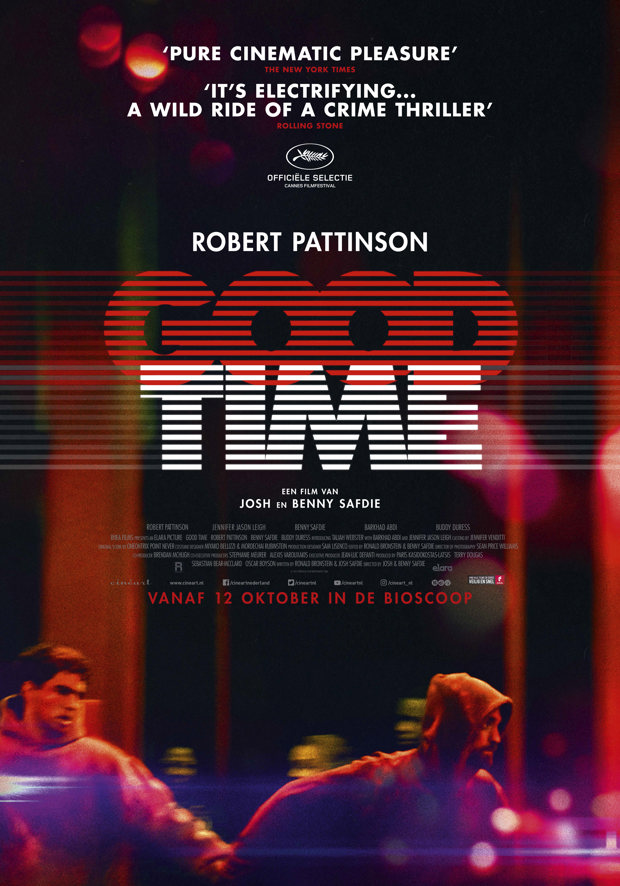
Good Time is about two brothers Connie Nikas (Robert Pattinson) and his mentally-challenged brother Nick (Ben Safdie) who pull off a seemingly-successful bank robbery, only to have it sabotaged by a conveniently-located dye-pack. After an attempted escape, Nick is sent to prison while Connie is on the run – and Connie does the right thing by trying to help his innocent brother, who was merely an accomplice, get out of the hospital that Nick has been sent to after a brawl in the prison. However, it becomes slightly more complicated when Connie mistakes another man (Buddy Duress) for his brother – and what follows is a night-time odyssey through the mean streets of New York City, as Connie tries to find the money to get his brother out on bail, while avoiding the myriad of obstacles that he encounters throughout that one night.
In the credits to Good Time, the first name Josh and Ben Safdie express their gratitude to is Martin Scorsese. Now I am almost entirely sure any modern filmmaker working today, especially those in independent cinema, owe something towards Scorsese because he essentially helped define American independent film in the 1970s. However, there is far more to this expression of gratitude towards Scorsese than just merely thanking him – Good Time is a film that is so analogous to the work of Scorsese, it borders on being a direct homage to films such as Mean Streets and Taxi Driver, in a multitude of ways. Good Time is a film that is made with its influences clearly shown throughout, and rather than being a poorly-constructed pastiche, it soars on its own unique and innovative merits, while still taking inspiration from its iconic predecessors that helped allow films like Good Time to be made – in a way, it seems to be Joshua and Ben Safdie paying tribute to the entire institution of New Hollywood independent cinema that paved the way for them to have the acclaimed career they have amassed in under a decade.
Now onto the one aspect of this film that I really want to focus on – Robert Pattison, who is one of the finest young actors of his generation. It actually shocks me that only a few years ago, such a statement wouldn’t only be the subject of radical disagreement from many logical people, I would probably lose all credibility as someone with a well-formed perspective of cinema. Yet, the actor he has grown up to be is truly remarkable, and along with Kristen Stewart, he’s managed to free himself of the shackles of Twilight to become a truly extraordinary actor who is building a very steady career as a favorite of auteurs, and a darling of arthouse cinema. I don’t mean to insult the legacy of the widely-beloved franchise, but how is it possible that the major stars of other, far more acclaimed and iconic franchise films haven’t been able to follow those films with equally as acclaimed performances, whereas the two stars of the critically maligned Twilight films have become two of the brightest stars in world cinema? It isn’t to say one group is more talented than the other, rather that sometimes life can provide unexpected surprises, and seeing Pattinson and Stewart rise to this status of endlessly acclaimed performers is gratifying in the least.
However, to get back to Good Time – I won’t pretend like this was the first time that Pattinson impressed me as an actor. Even this year, he managed to surprise me with his nuanced and mature work in James Gray’s The Lost City of Z. However, Good Time is something entirely different – it represents a turning point in Pattinson’s career, a performance that shows that Pattinson is not merely an example of a former teenage icon becoming a very talented performer. It is a revelation towards Pattinson’s deep and idiosyncratic talents. He plays the role of Connie Nikas with such feverish intensity and complex fury, it rivals the career-defining performances of the likes of Robert DeNiro in Mean Streets and Taxi Driver, Al Pacino in Dog Day Afternoon and Serpico and Dustin Hoffman in Lenny and Midnight Cowboy. If this seems like ridiculously high praise towards Pattinson, it is an understatement. His performance simmers with the intensity of those early 1970s performances, filled with quiet rage and sleazy heroism, and even if you don’t find Pattinson’s performance comparable in terms of quality and brilliance as those I’ve mentioned previously, you’ll find (at the very least) that Pattinson’s performance seems to be a belated performance that belongs in the era of New Hollywood.
I’ve admired Joshua and Ben Safdie, as well as their regular collaborator Ronald Bronstein, for their audacious use of casting in their films. Their films have a truly genuine sense of authenticity, and perhaps that comes from their decision to cast non-professional actors in roles that are vaguely autobiography. Buddy Duress (who played a drug dealer in the brothers’ previous film, Heaven Knows What) returns in this film, playing a recently-released convict forced to go on the run after a painful misunderstanding on the part of Connie. I was captivated by Duress’ heartfelt and genuine performance, which I soon learned was a result of him actually being a real-life ex-convict, similar to his character in this film. I won’t say that Good Time is going to launch Duress’ to worldwide fame and acclaim, and he isn’t likely to get a part in future tentpole blockbusters (despite being a very talented actor), but it is one of those performances that are the gloriously wonderful results of an audacious decision. Independent cinema has become a home for faded stars to get a second chance, as well as novice performers and character actors to get exposure that they wouldn’t normally get in mainstream films – yet independent cinema is also the place where non-actors can actually thrive, and while it is sometimes risky, it can result in spectacular performances. It takes quite a bit of courage to take such a leap (especially when there are many other actors who would have done very well in this performance), but the authenticity of Duress’ performance was astonishing. Beyond his performance, Ben Safdie is great as Nick, as are Jennifer Jason Leigh and Barkhad Abdi in smaller but very vital roles that may be limited in terms of screentime, but are still valuable contributions from some well-established but tragically underrated actors.
Good Time owes so much of its visual flair to previous films. I cannot remember a film made in the last decade that was as committed to representing the gritty realism of small-time crime quite like this film. This is a film that is so deeply frantic and fast-paced and filled to the brim with bitterly bleak adrenaline. It is a crime film that places far more emphasis on the chase rather than the crime itself, and the combination of the rapid cinematography, jarringly perfect colour and the pumping score (composed by Oneohtrix Point Never, someone who I am starting to consider to be a true musical genius) make this a thrilling but heart-wrenching example of modern crime cinema. The score, in particular, is extremely powerful and contributes perfectly to the disordered, unsettling and exciting world that this film constructs. The change in tone of the score can be considered jarring at first, but once you realize that the score is used as a character in its own right, to progress the plot and drive the narrative forward (and often complicate it) for the viewer, you realize how this extends far more than just being music to amplify a scene – it is a tool to create the distinctive atmosphere of the film and shape it to be as extraordinary as it turned out to be. Also, the film ends with an original song by Iggy Pop, so what is there not to love about this film?
This would also be a good time to mention Sean Price Williams, the cinematographer (I know I mentioned the cinematography only a few sentences ago, but if you’ve read some of my other reviews, you’ll know my adoration of cinematographers that borders on a fetishization of the craft, if we’re being entirely honest here) – if there is someone who a filmmaker wants to hire to create a film that has the genuine look of the films of a bygone era, particularly those from the 1970s, then Williams is most certainly the preferred option. While he is relatively underrated and low in profile, he has lensed some of the most tremendously brilliant films that are designed to be pastiches of previous decades. Films such as Alex Ross Perry’s Impolex, The Color Wheel, Listen Up Philip and Queen of Earth, Bob Byington’s Somebody Up There Likes Me and previous films by Joshua and Ben Safdie such as Frownland and Heaven Knows What are all the result of Williams’ spectacular ability to visually construct films that are far from mere imitation of previous eras, but authentic recreation of the style. If this doesn’t make much sense, then just consider how masterfully-constructed the aesthetic of Good Time was in representing the New York City of Sidney Lumet, Martin Scorsese and maybe even Woody Allen. If you love films that are throwbacks to previous decades, Good Time is certainly one of the best.
More than anything else, Good Time is a love-letter of a film. It is a glorious praising of the New York City that defined the 1970s, as well as a film that places emphasis on the character-driven aspects of these kinds of films that are sadly overlooked in modern crime cinema. A film that takes place over a condensed period of time (in this case one night, very similar to Scorsese’s wonderful After Hours), the actual crime aspects of this film are far more exciting when relegated verbally through testimony and character development rather than in the actual scenes (with scenes of criminal activity only being notable as bookends to this narrative), and the focus is on showing the interactions between the desperate lead character and those that unfortunately are forced into his life, as he uses his cunning manipulation to take advantage of others in his own attempts to evade capture (and this bears relevance to the central concept my favorite film of all time Mike Leigh’s Naked, a similarly dark and bleak film about a single character using others to reach his goals, albeit not with the same familial integrity as in Good Time). It is a film that places the focus on the character, and through brilliant characterization, we come to understand these characters and their motivations.
Good Time was a supremely intense film, and I often found myself exhilarated and short of breath after several of the high-intensity chases or escape scenes. It is an extraordinary film, and I would be betraying my own good judgment if I didn’t proclaim this as one of the very best films of the year. Robert Pattinson has never been this good, and I challenge him to ever give a better performance (and judging from his career trajectory, I don’t doubt that he will). Smaller performances from the supporting cast allow Good Time to be a wonderfully-developed character-driven crime film that owes so much to its independent cinema roots. It is an absolutely incredible film, and most certainly a film that I think contributes heavily to the notion that independent cinema is a force to be reckoned with when it is done well, and for every self-indulgent, metafictional mumblecore comedy or shockingly twisted horror, there is a masterpiece of Good Time that is just absolutely exquisite. What an electrifying, captivating masterpiece of a film.
 The Postmodern Pelican