 Oh boy. Where do I even start?
Honestly, I don’t know where to begin when talking about Malatesta’s Carnival of Blood. I cannot honestly remember the last time a film made me this unbelievably angry. How it manages to be one of the most frustratingly odd films I have ever seen is beyond me, and I am not entirely sure what to feel other than unrequited anger towards this film and everyone involved in it. There was just something about this film that pushed all the wrong buttons and left me at a complete loss for words, and I am truly unsure of what to say about this film other than the fact that it is one of the most bizarre films I have ever seen, and one that can only be described by one word: questionable.
However, I did actually find myself strangely loving the film, for some reason that is completely foreign to me. As angry as Malatesta’s Carnival of Blood made me, there were some moments of genuine audacity and true ambition that made up for every single moment of failure within this film, and each flaw that existed in this film (and trust me, there were beyond countless problems that exist within Malatesta’s Carnival of Blood), there was something so unique and remarkable, it was impossible to not actually enjoy it. Yet, I wouldn’t call it a good film at all. It is a film that actually left me questioning not only the story of this film, or the intentions of the filmmakers but rather my own sanity. Something about this film just left me wondering about the world around me, and how something so…abnormal as Malatesta’s Carnival of Blood can actually exist.
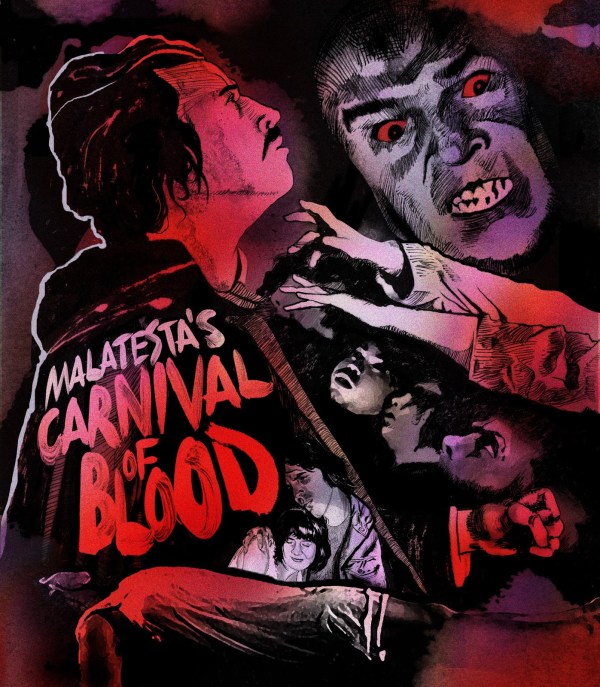
As I’m writing this, I am still trying to come to terms with what this film actually was (if it was indeed a film, because it often resembled a terrifying nightmare of which there isn’t any escape – a feature that may actually have worked towards the benefit of this film if we look at its strengths, but we’ll discuss that later). With any film of this ilk, there is a need to make sense of it and try and align everything to understand what this film was saying. I am still not entirely sure on how to come to terms with Malatesta’s Carnival of Blood, but let’s approach it like any conventional film, by looking at the story: essentially, the Norris family are hired to work as carnies at a run-down carnival, which they use to hide the fact that they are looking for their son who went missing a while before. What the family doesn’t realize is that the carnival is run by the mysterious Malatesta and his co-manager Mr. Blood, who turns out to be – big surprise – a vampire! Yes, I truly did not see that coming, did you?
Even worse (because apparently having a dilapidated carnival run by a vampire isn’t enough), there is a population of cannibals that feast on the flesh of visitors that fall victim to the deadly consequences of being in the wrong place at the wrong time – furthermore, there is also a resident choir of cannibals that sing the most hauntingly (but strangely well-composed) disturbing hymns. These cannibals must have had a vocal trainer or two fall victim to them, or how else can you explain their absolutely impeccable pitch? I know I cannot, but I do digress because while I am sure I can write an entire thesis on the cannibal choir, there is far more to be discussed. Although I wouldn’t mind a spin-off featuring Malatesta’s Man-Eating Minstrels – and if this isn’t the name of their demented vicious vocal ensemble (or is it a gut-consuming glee club, I’m not sure. But I digress), then I am not entirely sure what I believe anymore.
Added to this (because there is clearly absolutely no end in sight to the monstrous figures lurking around this carnival. Why can’t monsters like this go to my local carnival?), there is also a menacing handyman that runs around the carnival poking people to death (no wonder they need to hire so many new carnival workers, there is absolutely no job security), who is so elegantly and unsuspectingly named “Sticker” (I assume Poker and Billy Bob the Stabbing Boy were on vacation, also because Sticker was pretty bad at this job – I am guessing they only hired him because of his name, as it was always in his destiny, just like Mr. Bookman on Seinfeld. But I digress). That’s essentially what I understood this film to be about, with this plot covering perhaps 15 minutes in total (if we’re being generous). The rest of the film is a surreal, off-the-wall psychedelic trip to a world no one actually wants to visit, not even in their deepest, darkest nightmares.
So here’s what worries me – I genuinely have no idea if Malatesta’s Carnival of Blood is a good film or a bad film. Going by my own traditional standards, a good film is one that achieves what it sets out to do. Honestly, the most primal criterion for a film to be considered successful in my eyes is simply to have an aim and to take the necessary steps to achieve that aim in such a way. The problem I’ve run into here is I am not entirely sure what Malatesta’s Carnival of Blood actually set out to do, which prevents me from making this vital judgment as to whether or not it is a good film. All I can say as a humble film-viewer is that Malatesta’s Carnival of Blood is a confusing, violent and utterly nonsensical mind-bending film that raises more questions than it answers – if the intention behind this film was to make it such, then it deserves an endless standing ovation, because out of all the baffling films I have seen in my life, Malatesta’s Carnival of Blood certainly stands above the rest, and this isn’t necessarily a good thing at all, intentional or not.
Let’s talk about surrealism. There seems to be this notion that surrealism simply consists of the postmodern approach of “weirdness for the sake of being weird”, which is certainly true to a large extent. Surreal art, cinema, in particular, prides itself on being puzzling, complex and impenetrably strange. I am not adverse to surreal cinema at all – if you know my taste, you’ll know how I praise David Lynch, Alejandro Jodorowsky, and Luis Buñuel as definitive gods of cinema, and I can speak endlessly about their iconoclastic work in redefining the limits of what is possible in cinema. What people don’t realize is that these filmmakers, as well as other surrealist artists, don’t set out to just create baffling works to just confuse audiences – absolutely anyone can create something without structure or coherent plot and label it as “surrealist” when nothing can be further from reality. Surrealism does ultimately take form for and have some sense of structure, and even the most absurd works of surrealist art are the result of endless stretches of meticulous planning and execution.
This is precisely where Malatesta’s Carnival of Blood fails so dismally – it decides to be a surreal film, and hopes to achieve it through inserting peculiar images to the majority of this film and allow the audience to draw their own conclusions and make sense of the story in their own way through exposure to these moments of genuine weirdness. Unfortunately, as enjoyable as it is to create something just so bizarre, it also just comes off as poor cinema if your film just doesn’t have the structure to account for the uncanny elements. In all honesty, Malatesta’s Carnival of Blood comes off as an amateurish attempt to create something horrifying and surreal, and while I do agree that it does achieve this to an extent, it is not by way of anything intentional, or rather clearly attempted.
Performances, let’s talk about performances. Mainly because I am getting unapologetically angry with this film, and I need to regain some sense of normality if I am going to actually try and make sense of this film at all. I understand horror cinema isn’t normally known for its devotion to well-developed characters, nor to any regular attempt to bring out great performances from its cast. However, while it may be unfair and unconventional to do this, we need to compare it to two other films, namely The Premonition and The Witch Who Came from the Sea, films that appeared in the American Horror Project boxset alongside Malatesta’s Carnival of Blood. Those two films (both of which I have already reviewed and given quite glowing words of enthusiasm) featured some of the best horror film performances in the history of the genre – and thus I was expecting at least the same level, or a similar level, of performance from the cast in this film. To my absolute surprise (can you detect the sarcasm?) I found Malatesta’s Carnival of Blood to have some performances so absolutely dreadful, it bordered on unwatchable. The worst culprit? Betsy Henn, who apparently only existed in this film to screech about how the family needed to leave their (apparently very safe) caravan or to warn her husband or daughter to not go into the path of danger, only to have her concerns brutally ignored. If only they listened to her, we would’ve had a vastly shorter film and I wouldn’t have had to spend 74 minutes of my life watching this film (but I didn’t regret a single minute of it. Actually, to be fair there were about seven minutes scattered throughout the film where I regretted watching it, but for the most part, I did endure without too much pain).
However, this isn’t to say all the performances were bad (unfortunately, it’s just the vast majority), as there are at least two great performances in the film, courtesy of Jerome Dempsey who plays the titular (?) Mr. Blood. His commitment to this performance was worth the price of admission in the least, and being the character actor who was so obscure, he probably didn’t even exist (even though I vaguely remember being charmed for a moment with him in Network, believe it or not – I think I have a problem), he is tremendously good as the vampiric Mr. Blood (I really still can’t get over the naming of characters in this film. It was truly delightful to see the amount of imagination put into naming these characters). Yet, it isn’t even the fact that he is a vampire that disturbed me the most, rather the fact that he was such an awful manager for a carnival that was apparently highly successful, and I found it almost entirely unfeasible that someone as utterly useless as Mr. Blood was in charge of that carnival, especially if the actual person in charge has nothing better to do than to skulk around like a tertiary villain in a poorly-directed community theatre production of Hamlet, showing off classic horror films to his hordes of cannibalistic cinephiles (could they even truly appreciate the movies Mr. Malatesta was so generous in showing them? Those cannibals truly have it made – hot dinner every night and movies from their charismatic host. Most hotels don’t even offer that service without some exorbitant fees, added to that, you get free dinner entertainment from Malatesta’s Man-Eating Minstrels, so that’s even more of a reason to plan your next family trip to Mr. Blood’s Family Steakhouse: “where you can eat with your family or eat your family!”).
Yet, pedantic overanalysis aside, Dempsey was very good, if for nothing more than the fact that he was just entertaining to watch. The other great performance is Paul Hostetler, who plays Mr. Norris. His performance wasn’t good by the traditional standard, I just found him to be enjoyable to watch because his performance had a certain sense of realism and genuine authenticity to it – and by that I mean he just seemed like a normal father pulled off the side of the road and put into this film and told what to say five seconds before he had to say it. The word “amateur” actually implies some effort was put in. So no, this was not amateur cinema. This was getting your friends to stand in front of a camera as they say words written down on paper (or by the looks of it based on this film, greasy, ketchup-stained napkins). There is something so endearing about these amateur performers because it makes it clear that absolutely anyone can be an actor – they may not be a particularly good actor, and they may be given a useless, shrill character that tries to warn everyone to just use their heads and not go clearly into the path of mortal danger. Or you get a character named Mr. Blood or Sticker.
Putting this all aside, there was actually a lot to like about Malatesta’s Carnival of Blood. To be perfectly fair, this was a film that set out to be a nightmarish horror, and it honestly did manage to do that, without any sense of sarcasm, I readily admit that there were some genuinely good moments of horror in this film, and this film didn’t hit the highs it wanted to as often as it intended to, but when it did, it worked splendidly and managed to be very effective and often genuinely terrifying. There were some really great moments of sheer terror, and the descent into nightmare territory was really very effective. It may have lacked structure or proper direction that would have defined it as something truly special, but there isn’t any denying that the filmmakers were attempting to create a strange and unsettling portrayal of our primal fears and desires (anything involving cannibals will always, without the shadow of a doubt, draw upon overt subtexts of sexual desire and lust, and Malatesta’s Carnival of Blood is not an exception. The singing cannibal choir, to its credit, is also one of the most disturbing images out of any horror film I’ve seen). It is for this pure reason that the filmmakers actually did succeed in making something as terrifyingly haunting and bizarre as Malatesta’s Carnival of Blood, with some images lingering in your mind long afterward, that I have been very generous with scoring Malatesta’s Carnival of Blood. In the end, this is a film that actually did what it wanted to do, and whether it was intentional or not, it deserves to be seen and praised for the film that it is rather than the film that it wanted to be.
Moreover, I feel the need to say that I do feel a tad guilty for being so tough on Malatesta’s Carnival of Blood, when in actual fact I am one of the most ardent supporters of independent cinema, and speaking both of Malatesta’s Carnival of Blood and the aforementioned American Horror Story boxset as a whole to an extent, independent cinema is always a risk. Often your film has all the ingredients to be a popular underdog hit, but most of the time, independent filmmakers see their films either become small-time cult classics (in the best case scenario) or fade away into complete obscurity (in the worst case scenario). Malatesta’s Carnival of Blood is well-known as a revenant of a film, coming back after three decades of seemingly being considered lost, and while I am so tempted to say that it should have stayed a lost film, the independent film fan in me actually appreciates the audacity behind this film, and in some strange way I do want to champion it to be seen by a wider audience and become a cult classic, or better even, a notable piece of surreal horror. It may not be a very good film, but that is beyond the point because, despite all its faults and everything that is absent from it, Malatesta’s Carnival of Blood has something far more valuable behind it – ambition. It may be a problematic, often laughably ridiculous film with countless flaws, but the fact that someone actually succeeded in making this film, and in such a way that it actually is unforgettable (for better or worse) is a monumental achievement. Just don’t think I have suddenly completely turned my opinion around and changed my mind – I still stand behind absolutely everything I’ve said, and Malatesta’s Carnival of Blood is not really a good film at all, but it certainly is a film and a truly zealous one at that. The fact that it is very stylistic, with a lot of technical and creative effort put into the making of this film just proves that there was quite a bit of work put in, particularly through the distinctive style and oddly beautiful cinematography that makes it quite a unique film as a whole, far from similarly low-budget horror films of the era.
It is such a pity. I truly wanted to openly adore Malatesta’s Carnival of Blood. I loved the other two films in the boxset, and it was a bit of a low point to end it on this film. However, I am really in two minds about Malatesta’s Carnival of Blood, because the logical cinephile who enjoys reason and structure in me just sees the endless faults within this film and finds it almost unforgivable that these flaws compose nearly the entire film, whereas the dedicated film geek who sees the best in everything and can find merit in even the worst films just sees the pure, unadulterated passion and ambition that went into the making of this film (why else would I be such a huge, unrelenting champion of The Room?). It is a tense battle between the two sides, but I am actually surprised and very pleased to say that, looking at Malatesta’s Carnival of Blood in retrospect, there is far more to love about this film than there is to hate or criticize. If we can say nothing more about this film, at least there isn’t a single moment where you’ll be bored or uninterested. It is a film with many problems, but it actually overcomes that problems by being an honest, audacious independent horror film that has passion surging through its veins and will remain on your mind. As far as experiences go, Malatesta’s Carnival of Blood is one of the most unique you could possibly hope to have.
 The Postmodern Pelican