 Since I started this blog years ago, I have reviewed nearly every film I’ve seen in that period. Its brought me so much joy and helped me discover new and exciting films and filmmakers and have my thoughts on them articulated. However, it has also allowed me the opportunity to write about films that I genuinely adore, many of them being films I have watched countless times. One such film that I absolutely love is also a film that is somehow reviled by the masses, both in its time of release and today, with many considering it a messy, deeply flawed and completely failed attempt at comedy. That film is obviously The Cable Guy, which I genuinely believe is one of the most brilliant dark comedy films ever made, and perhaps my favorite comedy of the 1990s, narrowly beating out The Birdcage. There is just something so deeply intriguing about The Cable Guy that just keeps me coming back every single time.
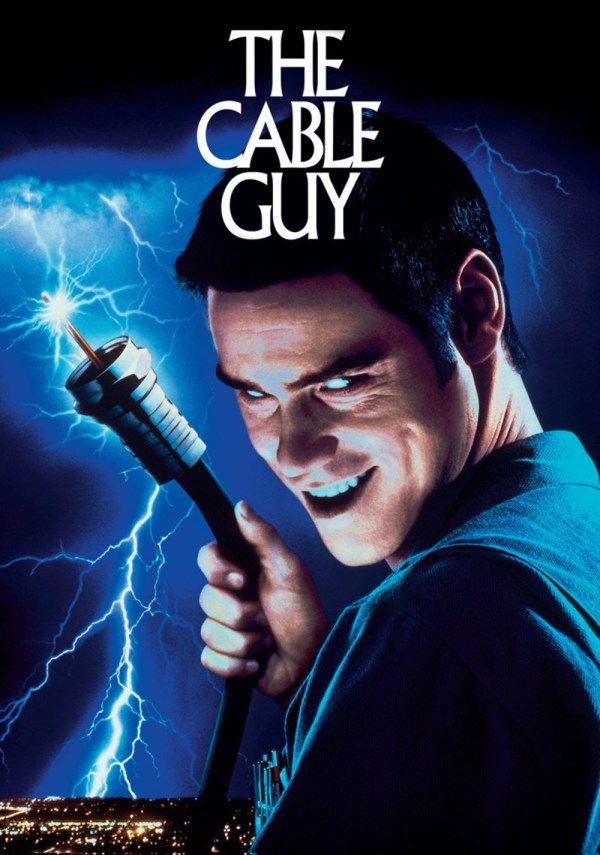
I don’t need to go into what this film is about, right? Regardless, if I can convince even just one individual to watch The Cable Guy for the first time, or perhaps even persuade someone to give it another chance, then my work is done. Essentially, The Cable Guy is designed in the style of a pulpy thriller featuring a psychopathic loner worming his or her way into the lives of innocent people and using their manipulative tricks and lack of restraint to relentlessly terrorize some people who are usually flawed, but good-natured and peaceful at the heart. In The Cable Guy, our victim is Steven (Matthew Broderick), an architect who is currently on a break from his girlfriend Robin (Leslie Mann). When he needs cable installed in his new apartment, the cable company sends over a man calling himself Ernie “Chip” Douglas (Jim Carrey). Steven is a very private person, but no amount of personal space can prevent Chip from forcing his way into Steven’s life, simply searching for some spark of friendship between them. However, his attempts at friendship are constantly thrown away by Steven, and therefore Chip (which is obviously not his real name) is left to simply take petty revenge on someone who just didn’t value his friendship. Psychological terror and insanity follows as Chip makes sure Steven regrets rejecting his unconditional friendship.
Folks, I would not be wrong in saying that The Cable Guy is one of the darkest films of the 1990s, which is odd considering the man behind the camera is Ben Stiller, who is not someone known for making intentionally dark films. I just want to take this opportunity to talk about an issue I’ve been meaning to get to for years now and provide an opinion that may be entirely unpopular to say the least – I really love Ben Stiller as a director. While he may not be an auteur or a completely remarkable and historically-significant filmmaker, but he is beyond competent behind the camera and each of his six films that he has served on as director have been actually pretty great films (except for Zoolander 2, that was a huge mistake), which is something very difficult to deny. I expect to explore each one individually in time, but from Reality Bites to The Secret Life of Walter Mitty, it is very clear that Stiller is capable as a director. However, I do think it is The Cable Guy that is Stiller’s best work, and while it may be a case that he was a bit of a “director-for-hire”, with the core of this film laying in the hands of the actors and the script (of which Stiller was an uncredited writer), his touch is clearly present throughout this film, specifically his very endearing trait of complete and utter absurdity. It is such a perfectly constructed blend of broad comedy and wacky surrealism that has made some of Stiller’s more audacious projects pretty entertaining as a whole.
I can say a little bit about Matthew Broderick, essentially that he is the ultimate charismatic milquetoast, and he is a 1980s icon for his role in Ferris Bueller’s Day Off, and he’s given some wonderfully remarkable performances in films, on television, and on stage. The Cable Guy is absolutely not an exception, and he is great in it, balancing the terror of the film with his zanily introverted but terrified performance. However, to dwell too much on Broderick (or any of the other cast members for that matter), would be pointless because The Cable Guy is completely, unequivocally a film that belongs entirely to Jim Carrey. This may just be my favorite performance Jim Carrey has ever given (and trust me, I am far more a huge fan of the esteemed comedic thespian than one could notably attest to be), mainly because this is unlike anything Jim Carrey has ever done before – he has played off-the-wall and eccentric characters many times before (building his career almost entirely on these kinds of odd characters), but never before has he been so…deranged. His performance is completely demented and so unhinged, and it is an absolute joy to watch Carrey construct a character that is seemingly without limits. He consistently tests these limits, taking this character to some truly dark and disturbing places internally, but rather than becoming an unbearable performance, it allows the character to grow to be far more complex than just a typical terrorizing villain. Hilarious, demented and often very touching, Carrey is fantastic in The Cable Guy, and the emotional resonance of his character is only buttressed by his splendid commitment to the role.
Let’s talk about genre because it’s a topic I love. Art is hybridity, and there is no such thing as something completely original, with each piece of art adopting elements of countless others that came before it (for more on this thought, please refer to the dozen other times I’ve mentioned this in previous reviews, and the multitude of future reviews where I will probably mention it again. I just love this kind of postmodernist discussion). The Cable Guy is a film that has been somewhat misattributed to the wave of highly popular and iconic, yet not exactly artistically-sound Jim Carrey comedies of the 1990s, and the fact that Ben Stiller was attached as director isn’t entirely helpful towards its case. Watching this film through that lens shows it as being mediocre – it lands very few genuine laughs in the way we’d expect, and it often is unbearably uncomfortable and far too disturbing for the taste of many movie-goers, and on a side-note, I genuinely believe that this is the root of the muted audience and critical enthusiasm surrounding The Cable Guy, because I’d assume most people went to watch this film with the expectation that it would be a broad, zany Jim Carrey comedy, whereas it is something almost bleak in how dark it is. Blending elements of dark comedy, romance and psychological thriller bring out the unique nature of The Cable Guy, and it excels at showing how these three major genre-themes work in tandem to create a highly-unforgettable and delightfully dark and complex comedy that subverts expectations and rather serves to be a deeply unsettling piece of black comedy.
I alluded to the idea earlier, but The Cable Guy is clearly a pastiche to the highly-popular sub-genre of privacy-invasion thrillers of the 1980s and 1990s – and while they were very often the very definition of trash, I highly enjoy them on occasion, if for nothing more than their despicably entertaining camp value and the genuinely shocking thrills that lurk in this films. However, it is not a parody at all, and like any great homage, it is able to stand alongside all the films that inspired it and enter into the canon of great psychological thrillers. The Cable Guy is nothing less than a wonderfully subversive example of taking comedy into the realm of the psychological, where one’s deepest fears and insecurities are not only displayed but assaulted and manipulated to the point where it blurs reality and fiction. It is a film that could have very easily been far lighter and less reliant on its gradual decline into a state of cathartic horror, which would have made it a crowd-pleasing, warmly-received comedy that would entertain without having much below the surface. I am pretty sure it wouldn’t have been a bad film, but I doubt it would have left the impact that it did here. Ben Stiller was faced with two options when he took on this film – make it lighter and please the crowds, or keep it dark and remain true to the underlying spirit of this film. The fact that the risk was taken to make this very dark and disturbing film even bleaker than it already needed to be was actually an excellent choice, and I applaud everyone involved for taking The Cable Guy to where it ended up. We’re very easy to heap criticism on this film, but the fact that it was actually a risky film to make considering the audience-loving pedigree attached to Carrey makes it something worth noting and giving another chance. It does what it sets out to do, and that’s always worthy of some degree of praise in my eyes.
I know I have made The Cable Guy out to be a dark and disturbing film that preys upon the natural psychological state of the audience. Yet, The Cable Guy is also a really funny film. Carrey’s performance is pure comedic gold, and while this film may not offer broad laughs, there are a range of different ways The Cable Guy creates comedy – the awkwardness of the interactions between characters is one way, as well as the chemistry between Broderick and Carrey that position them as being somewhat in The Odd Couple by way of Dante Alighieri (that is quite an allegory, and it is probably grasping at straws, but I like the comparison). However, the most suitable way The Cable Guy extracts comedy from its subject matter is by being a scathing social commentary. While not entirely evident from the surface, there are deeper satirical elements to this film – the yuppie revolution, the dependence on television to feel truly connected as well as other smaller comments on capitalism and consumerism that are so insignificant, I won’t bear them a further thought, let alone elaborating on them. Just understand that The Cable Guy is a very dark comedy that finds its most notable humor in the moments of genuinely unsettling social satire that positions it as one of the true great non-political satires of the 1990s.
Honestly, and perhaps I truly am an army of one on this idea, but I love The Cable Guy. I don’t love it in the same way I love something like The Room, which is a combination of fond memories of watching it with friends, the laughably entertaining filmmaking and the fact that it is hip to go against the grain of what everyone else likes. Rather, I like The Cable Guy because I truly believe that it is a great film and one of the most underrated comedic gems that have somehow gotten muted (but far from forgotten) due to audiences and critics expecting something and get something else entirely. It has a fantastic performance from Jim Carrey at the core, and the story is complex but hilarious, and every time I rewatch it (which has been a few too many times over the years), I just love it even more, finding subtle nuances throughout that I never noticed before. I know The Cable Guy is a bit of a cult classic and it has its fans, but it is still viewed as being a bit of a failure for reasons I can’t quite comprehend, other than the fact that it is a soaring, hilarious example of wonderful satire and a film that dares to do something different. I implore anyone who hasn’t seen this film to watch it, as well as those that have watched it and not particularly loved it – watch it through the lens of it being a dark comedy and social satire rather than just a broad Jim Carrey comedy. Hopefully, by doing this you’ll see exactly what I see, which is a wonderfully odd psychological thriller that is hilarious, surreal and just a delight that deserves a far better reputation than it has.
 The Postmodern Pelican