 I love cinema (this is brand new information, isn’t it?), and perhaps what I find most alluring about cinema is how it is formed out of the creative need to simply tell stories. Perhaps one can accuse blockbuster tentpole films and franchises of simply seeking out the solace of the almighty dollar, which is an opinion I do tend to agree with, even if I am usually the first person in line when there is a new, exciting superhero film released. However, we can see that the independent film industry is built on this primal need to just tell a story, and usually, from the perspective of someone who has an interesting, often very personal story to tell. One film that I found absolutely brilliant in how it approached its themes – not only its major theme but a plethora of smaller themes, is the recent Korean-American drama film, Spa Night, a small and intimate independent film that covers issues far grander than its humble execution would suggest on the surface.
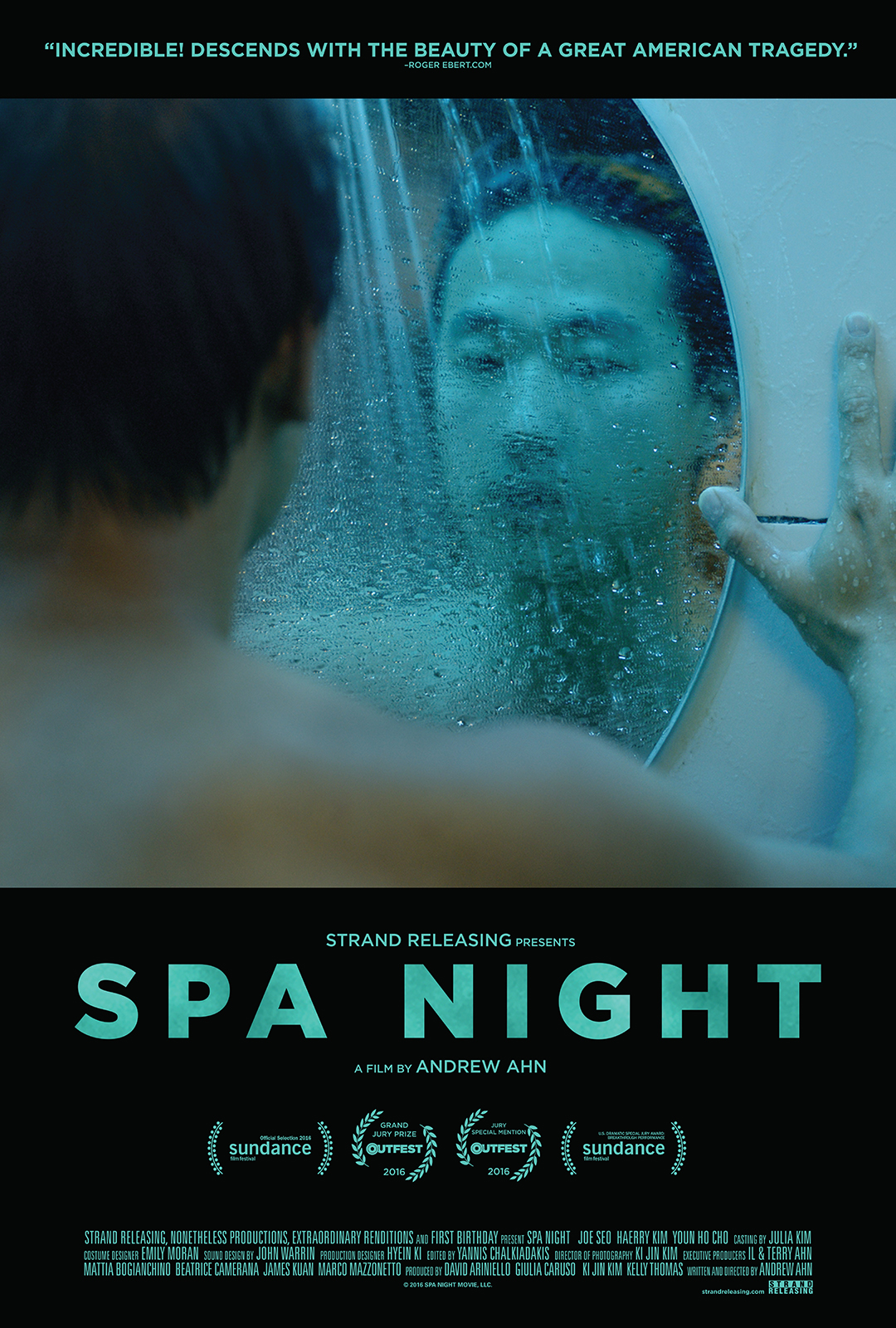
Spa Night is set in contemporary Los Angeles. David (Joe Seo) is a first-generation, Korean-American who grapples with sexuality. He lives with his loving parents Jin (Youn Ho Cho) and Soyoung (Haerry Kim), who work in their family-owned restaurant to support themselves and their son. However, after a tragic dry-spell, they are forced to close their business, and the family needs to find alternative methods to making money and earning a living. Soyoung gets a job at a friend’s restaurant as a waitress, and Jin tries a variety of jobs but fails at each of them and ends up sinking into a deep void of alcoholism. David is attempting to get into the University of Southern California, but he needs to take some very expensive SAT courses to prepare. In order to support his family and himself, David secretly takes up a job at a Korean spa, where he discovers a hidden underworld of homosexual encounters between the patrons. This forces the deeply-closeted David to confront his own burgeoning sexuality, as this environment both terrifies and fascinates him. However, how long can someone possibly hide their desires before it starts to take a toll on them and others?
2016 was a great year for cinema, in particular, LGBTQIA+ cinema, which had a triumphant year when Moonlight was shown to be the most acclaimed film of the year. In addition to Moonlight, films such as Carol and this year’s Call Me By Your Name (as well as a multitude of other LGBTQIA-themed films released over the past few years) shows that cinema is currently in a renaissance of queer cinema, where these stories are being told (often by members of the community themselves) in manners far different from how they have been represented before. Not only are we being given films that feature original and audacious queer-themed narratives, they are being shown to wider audiences, whereby these stories are no longer the fodder for obscure arthouse cinemas. The entire concept of queer theory is to go against the normalization of heteronormativity, and this outburst of exciting queer cinema challenges what is perceived as being normal. Quite frankly, it is a wonderful moment cinema is having nowadays, where these stories are being made and distributed to the mass-markets where stereotypes and perceptions of the LGBTQIA+ community are not only being subverted but entirely dismissed to make way for some incredibly complex and unique films.
A few years ago, I watched an obscure Greek film entitled Xenia, which also happened to be a sadly unheralded film about a young gay man trying to find his way in an unforgiving world. I remember marveling at the central performance, given by newcomer Kostas Nikouli. There was just something so raw and emotional about his performance, where we saw the true primal nature of desire and insecurity shining through so perfectly. Spa Night has a performance that surprised me just as much, in the form of Joe Seo, who plays the lead role of David in the film. His performance defied my expectations and proved to be one of the most explosively brilliant mainstream film debuts a young actor could possibly hope for. His performance was nuanced, emotional and absolutely astounding. Seo played the character with such delicate simplicity, where his quiet and reserved manner contributed to the subtle cadences required of the role. If this is not a star-making turn, then I am not entirely sure what is. However, I cannot logically forget to praise Haerry Kim and Youn Ho Cho, who give equally impressive performances as David’s parents, who are fighting their own proverbial demons and coming to terms with their own failures in achieving what the problematically metaphorical American Dream promised they would. Beautifully nuanced and deeply heartbreaking, their performances are absolute marvels.
There are a variety of themes shown throughout Spa Night, and I have already alluded to the main focus of this film, the coming-of-age story of our protagonist who is trying to come to terms with his own sexuality. The way in which director Andrew Ahn tells the story, which is based in part on his own experiences as a first-generation gay Korean-American, was absolutely astonishing. The beauty in the simplicity of this film highlights the deep sense of insecurity and troubling angst of youthful self-discovery that is all too real in our modern world. There aren’t any shortages of these kinds of queer coming-of-age stories in cinema today, but each one is remarkable and different, even if the differences are very subtle and often not entirely clear until the very end. Spa Night tells its story without the need to be graphic in its portrayal of sexuality, while still not hiding the reality of the situation our protagonist is in. Very often, this film is hauntingly romantic while still being filled with troubling despair and anxiety. This is a film about a journey, and even if the ending of this film leaves the viewer somewhat angry, as it leaves far more questions than it does solutions due to the fact that it doesn’t come to an intentional, neat conclusion, it is still a beautiful film about self-discovery and the challenges that come with the realization that you are not conforming to the ideals that society has constructed.
Despite being a film driven but its attention to LGBTQIA+ issues, Spa Night is far more than just what is referred to as a “gay film”, and it deals with a plethora of other themes and issues that work together with the central theme to make a poignant yet stark social realist drama. In essence, Spa Night is a film about family as well as the immigrant experience. There is just as much complexity within the family dynamic portrayed in this film as there is in David’s sexual self-discovery, and I’d even argue that these two more traditional themes don’t distract from the central theme, but rather buttress it by showing the difficulties that surround these characters and serving to make David a far more complex character than just the angst-filled teenager who struggles with his sexual identity. David wants to be loyal to his family, as well as being deeply committed to his religion that would otherwise revile him if he was open about his sexuality. Culture is perhaps the enveloping theme of this film, despite not being the core of the film, mainly because everything in this film, every decision, and motivation, can be traced back to the cultural beliefs and practices of these characters. There is something quite odd about a film set in Los Angeles being almost completely composed of dialogue in Korean and Spanish, which forces the central concept of culture to be thrust to the forefront – David is someone not only grappling with his sexuality, but also someone stuck between two worlds – the traditional Korean culture of his parents, and the liberal American way of life. How can David possibly live his best life as a first-generation Korean-American if he is constantly held back by his traditions, and how can David possibly abandon his traditions when they are the reason for his existence in this society? It is a paradox of sorts, and unfortunately (or fortunately, depending on how one looks at it), this film doesn’t give any answers at all.
I found Spa Night to be absolutely astounding. It may not be the definitive queer film, and it does have its small problems along the way, but overall it is an astonishing experience. Joe Seo’s central performance is utterly amazing, and the way in which he constructs this character was truly a star-making moment. The film has some very complex themes, which are handled with utmost delicacy while still challenging neoliberal heteronormative structures. Spa Night is a deeply moving, heartbreaking film that tells a deeply personal story while still being accessible and endearing. It is a film that doesn’t have the widest viewership yet, so it would be doing a huge favor to independent cinema if everyone who is willing seeks out this film and spread the word. Films like Spa Night are far too wonderful to go unrecognized and under-watched.
 The Postmodern Pelican