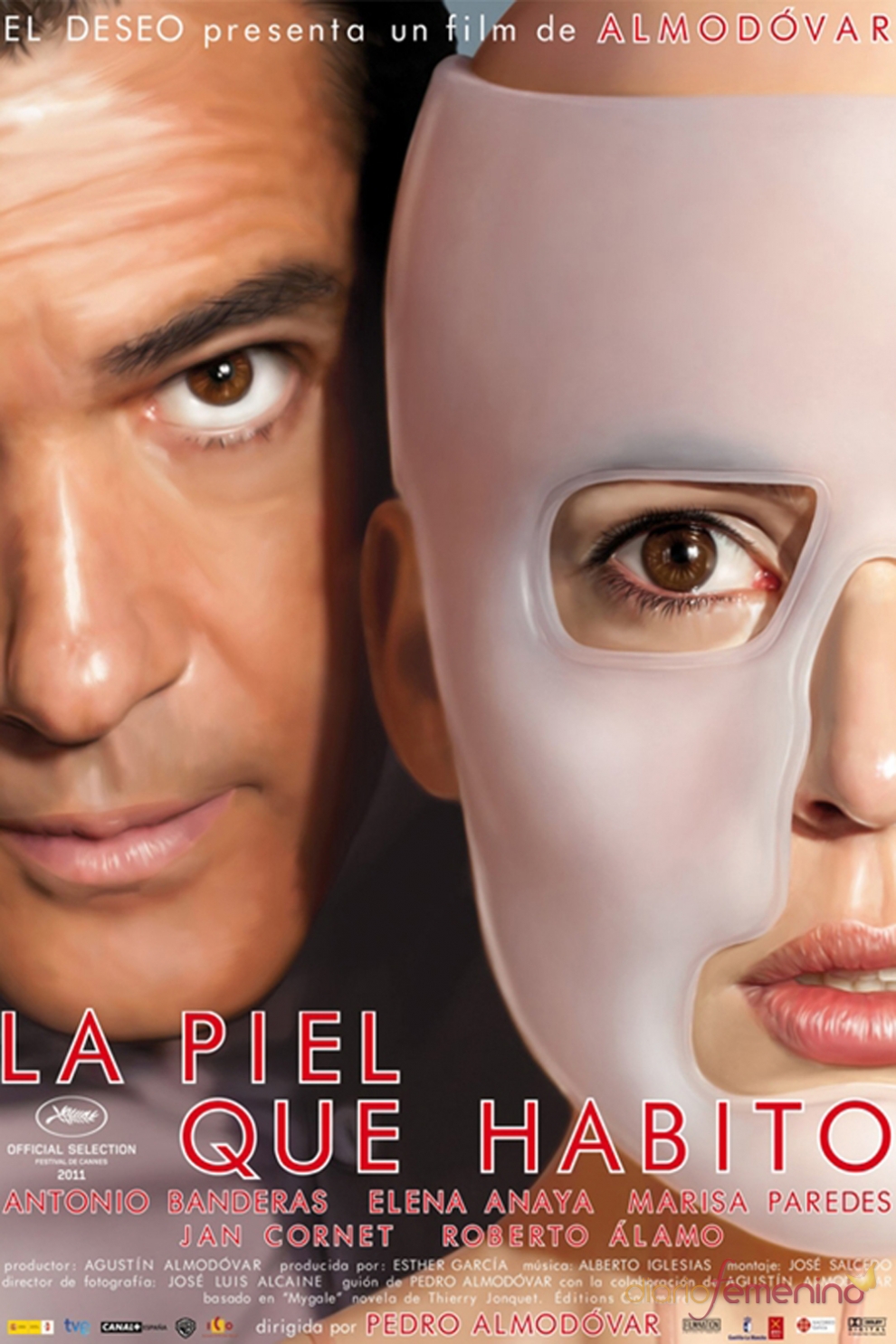
 There is an inherent joy in being a cinephile with wide-ranging interests in different types of films because one can easily go from watching something wholesome and endearing to something completely off-the-wall bizarre and often even morally ambiguous. One of the most fascinating films I’ve seen recently is The Skin I Live In (Spanish: La piel que habito), a psychological thriller from the extraordinary Pedro Almodóvar, who has shown throughout his long and storied career to be one of the most incredibly diverse and versatile filmmakers in terms of genre and theme, with The Skin I Live In being one of his most enthralling films, and a truly mesmerizing piece of surreal psychological horror.
Dr. Robert Ledgard (Antonio Banderas) is a wealthy plastic surgeon known for his experimental and innovative experimentation, particularly in the field of skin-grafting, which is a result of his wife dying soon after nearly perishing in a brutal inferno caused by a dreadful car accident. Ledgard is clearly a calculating, slightly deranged individual, and using his own lack of morals combined with the loss of his wife, he experiments on Vera (Elena Anaya), a young woman that is kept locked up in Ledgard’s mansion, where she is his captive and victim. He intends to create a new type of skin that can prevent burns and destruction that real human skin cannot prevent, and along the way, Dr. Ledgard and Vera’s respective secrets are revealed, resulting in this film venturing off into the deepest, darkest voids of the soul as we discover how truly demented human nature can be, and how a simply tragedy can turn someone to conduct themselves with a complete lack of integrity after the brutal corruption of the soul. If this sounds a little verbose, you’ll understand the impact this film has, and how such strong language has to be used to describe it.
Antonio Banderas is one of the most notable Spanish actors, and while he has found success in mainstream Hollywood cinema with his roles in films such as Zorro and Shrek (I honestly can’t believe I need to reduce Banderas’ career to mentioning Shrek, but alas), I will always find his work in his native country to be far more notable and effective. The Skin I Live In is his first collaboration with Almodóvar in over two decades, and while naturally I’d expect the likes of Javier Bardem to be given this kind of role (he’s been typecast in these kinds of psychopathic, over-romantic and sinister geniuses for years now, as well as being an actor known across the world, thus having mainstream appeal – not that Almodóvar has ever really cared too much about that it seems), I was delighted to actually see Banderas take on the role and craft such an elegantly sinister character out of it. His performance is subtle and nuanced, and whereas a more bombastic actor would have played the character as far more of the archetypal evil genius, Banderas played him as far more human and realistic as possible. Perhaps what shocked me the most about this film was despite being truly appalling in terms of its story (I use that in the best sense of the word), it is acted like a normal neo-realist drama, which doesn’t distract from the often surreal elements, but highlights them. Banderas is extraordinary in this film and proves himself to be one of the most magnetically charming performers working today, even when he is playing such a deranged character.
Aside from Banderas’ terrific leading performance, the supporting cast is tremendous as well. Elena Anaya holds her own against Banderas, with her desperate and beautifully complex performance as Vera being terrifyingly heartbreaking and wonderfully subtle in showing her plight. I refuse to give away too much about this film, because I went in almost completely blind to the story, and it resulted in one of the most outrageously brilliant twists I have ever seen, but through her incredible attention to the small nuances of her character, throughout the film, Anaya develops Vera to a point where she is almost unrecognizable in terms of motivation. This speaks to both Almodóvar’s brilliant script and Anaya’s excellent and consistent performance that proves to be one of the most deeply disturbing performances I’ve seen in a while. Marisa Paredes was also outstanding as Ledgard’s loyal housekeeper who is hiding dark secrets of her own. My own qualm with this film was that it didn’t venture far enough into exploring her as a character nearly enough, even though we are shown that she is far more complex than she first appears.
The Skin I Live In is a great example of a postmodern film, mainly because it contains one element of postmodern art that I am particularly fond of – hybridity. Particularly, The Skin I Live is a hybrid of genre, with Almodóvar creating a film inspired by several genres – romantic drama, psychological thriller, medical horror and even a touch of science fiction. Almodóvar is playful with cinematic conventions, and as a result, his film is a complex amalgamation of several different types of filmmaking, which allows The Skin I Live In to venture off to some very dark recesses of narrative, where Almodóvar can explore themes much darker than shown in any film that relies on traditional narrative standards. Almodóvar has never been one to avoid making his films unreasonably complex, but somehow I feel like The Skin I Live In is his most audacious work in terms of looking at the human condition through a particular lens of how events can shape and corrupt us. It is a beautifully frightful film that serves to have several nasty surprises lurking within, ready to shock audiences and prove that Pedro Almodóvar is a genius at creating art that mimics the nuances of human condition perfectly.
However, as dark and despairing The Skin I Live In is, it is far from being isolated in terms of its themes, with the main motivation behind this film being socially-relevant. There is a multitude of themes that can be garnered through looking at this film, not as a psychological horror, but as a piece of social commentary. Almodóvar has always shown an ability to make his film socially-conscious, and The Skin I Live In touches on some important modern subjects, such as infidelity, fatherhood, and mourning, as well as issues of sexual assault and one very complex issue that I won’t mention by name, as it gives the major twist of this film away. As I’ve mentioned before, The Skin I Live In isn’t a terrifying film because it is about a horrible man doing awful things to a seemingly innocent victim, but because this film shows the reasons why this man is doing those things, as well as convincing us that he isn’t necessarily a horrible person, but rather someone who has a good reason for his malicious and immoral experiments. Any film that makes us feel complete sympathy for the villain is of interest, and villains don’t get much more sympathetic than Dr. Robert Ledgard in The Skin I Live In.
The filmmaking in The Skin I Live In was absolutely brilliant, and serve to accentuate and sometimes even exaggerate the central themes lurking beneath this film. Almodóvar has shown himself to be a talented filmmaker, not only in his masterful directing and extraordinary writing but also towards imbuing his films with a deeply complex set of creative and technical marvels. The cinematography in this film may not seem particularly special from the outset, but as the audience ventures deeper into the twisted story, we see how the sterile, cold nature of the operating room is used to create a truly shocking sense of dread and despair, as well as the film’s occasional forays into the outside world, where we see the causes and effects of the events of the film, the moments that influenced the decisions behind the characters, and the repercussions therein. José Luis Alcaine is a cinematographer who has constantly worked alongside Almodóvar, with both creative geniuses bringing out the best in each other. Moreover, Alberto Iglesias’ tremendously powerful score for The Skin I Live In became a character of its own in a way, with the triumphant and transcendental beauty of the interplay of instruments working with the frightful imagery to create an atmosphere of hypnotic despair. It isn’t enough that The Skin I Live In has a deeply unsettling story at its core, it is only as brilliant as it is through the combination of story with the creative and technical fields that work towards giving this film its lingering effect.
I found The Skin I Live In to be an exquisite film – the central performance of Antonio Banderas was absolutely terrific, and the supporting cast worked well together and had their own unique storylines that developed them to be sympathetic and full-dimensional characters. The creative and technical aspects of this film worked in complete synchronicity with the detailed and complex story, and the result is a terrifying, brutal story of desire and revenge, and a perfect example of psychological horror in the best sense of the word. Like any great horror film, it understands that sometimes the most horrifying moments are those that are real and uncanny, and the way in which Almodóvar constructed this film leaves an indelible impression, and truly convinces me that this is one of the great modern psychological horrors, and one that I hope rises in status as the years go on. Simply a wonderful and effective piece of cinema that serves to be completely unforgettable.
 The Postmodern Pelican