 Perhaps the best way to describe Beatriz at Dinner is to consider it as a mumblecore dramedy as made by Darren Aronofsky and Terrence Malick. That isn’t to praise Beatriz at Dinner as anything close to what those two filmmakers have made, but there are several themes in this film that locates it alongside the films of those directors, specifically in terms of how it is about environmental issues as well as nature and transcendence of the human consciousness. There are several problems with Beatriz at Dinner, but ultimately tries to be an entertaining and endearing independent dramedy that has some merits that distract us from the glaring problems that exist within this film, both thematically and in terms of the filmmaking process. But not for long, unfortunately.
In Beatriz at Dinner, we encounter the titular character, Beatriz Luna (Salma Hayek), a massage therapist and practitioner of alternative medicine, who works at a cancer treatment facility. One afternoon, she visits one of her wealthy clients, Kathy (Connie Britton), who is hosting a very important dinner that night. When Beatriz’s car breaks down as she is about to leave, she is persuaded to stay for dinner. Throughout the evening, she encounters the guests, all of which mean well, but are shown to be the epitome of ignorant white privilege. When one guest in particular, real estate tycoon and dubiously-titled philanthropist Doug Strutt (John Lithgow) proves to go against Beatriz’s morals and values, they enter into a fierce battle of trying to prove their ideology is the most superior.
Before we get to discussing the problems with Beatriz at Dinner, let’s just point out some of the wonderful aspects of this film, of which there are quite a few. First of all, this features one of Salma Hayek’s best performances. Hayek is one of the most reliably great performers, and even when she appears in the most questionable of films, she elevates the material to a space where it is actually bearable. Beatriz at Dinner gives Hayek the opportunity to show off a very different kind of performance, one where she is simply required to find the deeper meaning within a very sensitive character. Hayek is such a talented actress, and her performance in Beatriz at Dinner is a wonderfully complex role that shows Hayek at her peak, playing a character who is eternally likable, but still incredibly flawed. However, this film does somewhat compensate for these flaws by creating a character who is so good in her intentions, we forget her imperfections.
John Lithgow had a major role in this film, and much like Hayek, he is an actor who can take even the dullest, contrived material and make it into something meaningful. Lithgow is a great actor, which is why I found his performance here to be a little…disappointing. Doug Strutt is supposedly portrayed to be this egotistical, truly nasty villain, but he just never reaches those peaks and actually becomes a victim to Beatriz’s ramblings. He actually comes off as far more decent and humane than Beatriz would believe, and perhaps it was my own view that Doug, while still a terrible person due to his associations with the capitalist project that exists in our world today, really wasn’t nearly as bad as this film suggested he was, to the extent that even this film struggled to make him come across as anything more than just a stubborn and sarcastic businessman, not nearly the cruel, malicious antagonist we’d expect from the way Beatriz reacts to him. The problem isn’t with Lithgow’s performance because he is as great as always, it lies in his character, who is just half-baked and not worth the time this film spends on locating him as a legitimate villain, which never actually materializes.
This problem with Lithgow’s character just speaks to one of the biggest flaws of this film, which is losing its character motivations. None of these characters are fully-developed, and the less said about the supporting cast the better. Hayek was wonderful, and Lithgow was great – yet the rest of the cast, all of which are notable performers who have done great work in the past, are merely underutilized instruments of this film’s incapacity to just be anything close to as meaningful as it wants to be. Connie Britton plays the typical airhead wife who needs to obey every word her husband (or any male character) says, and her performance doesn’t extend much further than just being reactionary. Chloë Sevigny is an actress that can be remarkable when given the right material, but her character of Shannon just fades into the background and doesn’t do anything special, and it seems almost an insult to offer this to an actress who can clearly do so much more than what she was given here. Amy Landecker has shown how she is a truly mesmerizing actress with her roles in Louie and Transparent, but once again she is given the role of the loyal wife, dressed impeccably and forced to just be the victim of her husband’s often sexist meandering ramblings.
However, at least the women in this film had some sense of personality, because the male characters other than Doug were so unforgettable, and actually pretty awful – David Warchofsky does nothing except desperately trying to please Doug, which just takes the form of awful agreement, without any character development. Jay Duplass similarly does nothing except get drunk, and much like Sevigny just fades away and becomes an object upon which the events of this film. The character development in Beatriz at Dinner is honestly some of the worst I’ve seen, which seems a tragedy considering such a conversational, dialogue-heavy will would naturally result in some sense of character progression. Yet this is a film far too preoccupied with “righting the wrongs” to pay attention to the fact that having a meaningful story means absolutely nothing if the characters residing within that story are dull, insignificant and honestly just utterly boring and unremarkable. Sadly, not even the talents of these actors can compensate for the fact that this is a film that just doesn’t care about its characters, even if the actors do try their best to give these stereotypical, one-dimensional characters some personality. The material just isn’t there.
The problem, as I’ve alluded to, is that Beatriz at Dinner is a “message film”, essentially a film that has some overriding theme of social or world change that needs to occur, and it represents this message through the progression of the story. There’s absolutely nothing wrong with a film that does this, and I’d even argue some of the greatest films of all time are films that contain important messages. The way in which Beatriz at Dinner spectacularly fails is in its constant allusion to this message – in fact, I’d even say that “allusion” is the wrong word, mainly because this film simply throws this theme into the atmosphere, rather than subtly inserting it. What would have otherwise been a touching and effective film became something overly preachy and far too concerned with showing how important the message is. I am not entirely sure why Mike White decided to go so low with this film – he’s made some remarkable works before, with his show Enlightened being the exact thing this film wanted to be, but couldn’t.
The film comes off as unlikable, meandering and just had a false sense of transcendent beauty. The ending of this film is one that I found so ridiculously and unintentionally hilarious, as it was the epitome of pretentious filmmaking, with the apparent profound resolution just leaving me shaking my head. The climax of this film, where we discover Beatriz’s real reason for hating Doug, was so utterly disappointing, and whether it was literal or metaphorical, it didn’t change how overly ridiculous it was. The problem with this film is that it doesn’t know what it wants to be, and it falls into a category of films that are unable to find a home within a genre, and rather just become messy, pretentious amalgamations of the worst of each genre. There isn’t anything funny about this film, with the only vaguely humorous moments coming at the expect of the worst examples of awful cringe comedy tropes, such as moments where Beatriz is mistaken for a maid (somehow characters thinking the only Hispanic woman near them is part of the service staff is so hilarious), or the fact that the unmarried Beatriz has a goat that sleeps in her room with her and believes in alternative medicine is so incredibly funny and deserves the other characters to scoff at her. For a film that wants to have a powerful social message, it resorts to stereotype far too much, including some of the most parodic and ridiculous exemplifications of white privilege that only Saturday Night Live could concoct. The heart of this film was in the right place, but if you’re going to exploit stereotype to make a point, then at least do it properly. The result is just simply a misguided mess.
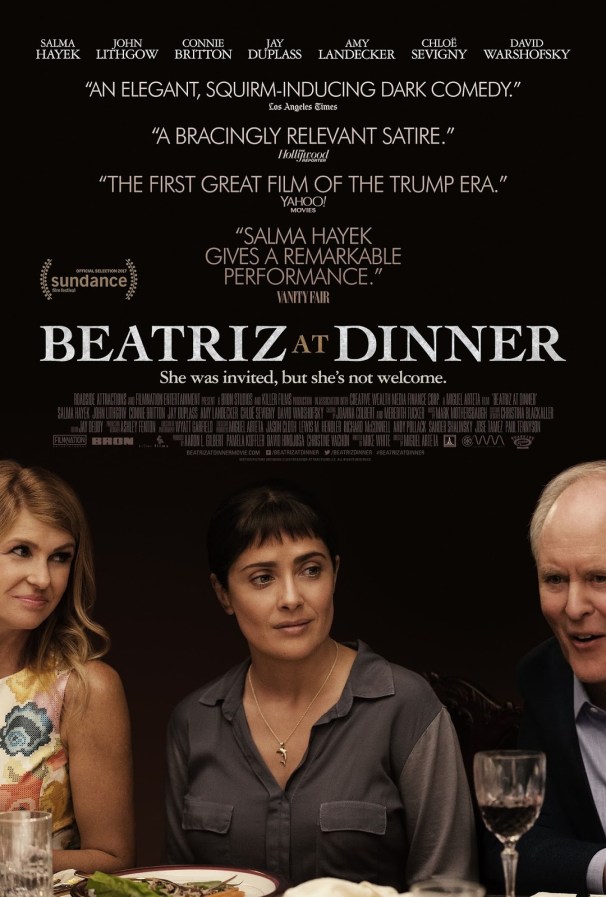
Needless to say, I didn’t particularly like Beatriz at Dinner. It was a film that I enjoyed in the moment, but the second I realized what this film was trying to do, and how it was failing to do that, I found it to be contrived and far too self-absorbed to be enjoyable. Not even the great central performances of Hayek and Lithgow can compensate for this film’s deeply misguided, overly-preachy and often pretentious view of society. It is one of the more disappointing films of the year, and its especially annoying to consider it comes from Mike White, a writer who has shown deeply profound meditations on the human condition so many times before. Beatriz at Dinner is just a rare misstep for everyone involved. To say I’m bitterly disappointed is an understatement. Just looking at the poster below, where this film is called “an elegant, squirm-inducing dark comedy”, “a bracingly relevant satire” and “the first great film of the Trump era” are all contradictory to the fact that this is just a film that doesn’t care about its characters, putting its message at the forefront and not even executing it well enough. Just a misguided attempt at being profound, which is unfortunate.
 The Postmodern Pelican