 I first read about Paris, Texas years ago, when I was still a young burgeoning cinephile. I read how it is considered one of the most heartbreakingly beautiful films ever made, and a film that takes a unique look at the United States of America. My question is this: why is it that I waited until this past weekend to watch it for the first time? The honest answer is because like much of the cinephile community, I was heartbroken to learn that Harry Dean Stanton, quite possibly the greatest character actor of all time, died this past Friday. Paris, Texas was one of a myriad of films that Stanton was a part of, and at this point, it was his first leading role – and even if we put aside his performance for a moment (which we will get to in detail a bit later, trust me), Paris, Texas was one of the most transcendent cinematic experiences I have ever had, a truly extraordinary piece of film that will likely stay with me for a very long time.
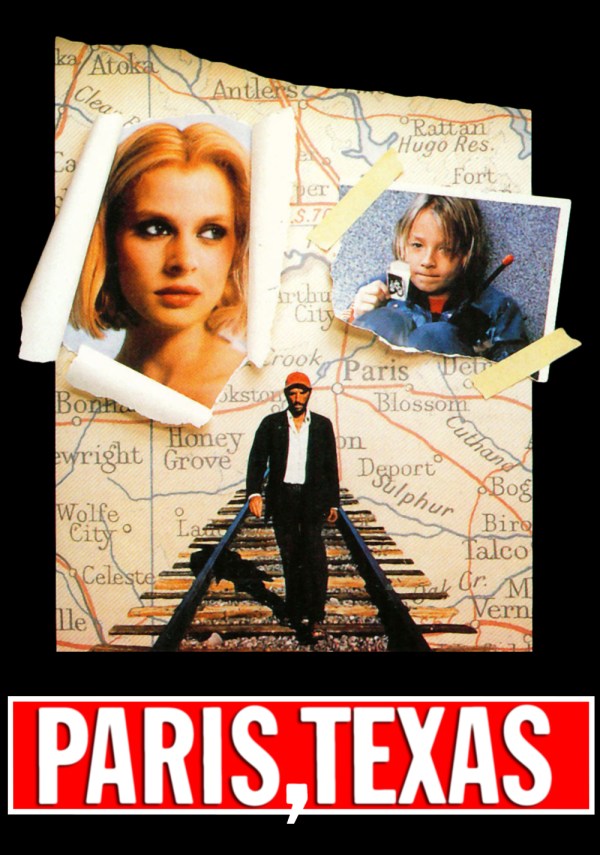
The first shot of this film is a sweeping shot of the Texan desert. We see a man stumbling through the arid landscape. That man is Travis Henderson (Harry Dean Stanton), who we soon learn has been wandering the desert for four years, and only after he faints from exhaustion is he reunited with his family – his brother Walt (Dean Stockwell), his sister-in-law Anne (Aurore Clément) and most importantly, his son, Hunter (Hunter Carson). One person missing from this reunion is Travis’ wife and Hunter’s mother, Jane (Nastassja Kinski), and feeling the need to give himself closure, he and Hunter travel back to Texas so that Travis may make amends for his wrongdoings, and for Hunter to be reunited with his mother after Travis’ abusive actions forced them to become separated.
Where do I begin to praise Harry Dean Stanton? There aren’t too many opportunities to focus on him as an actor, because unfortunately (or perhaps fortunately, depending on how you look at it), his career as a character actor limited him mainly to smaller roles. However, that doesn’t make his performance any less impactful. 1984 was a fantastic year for Stanton, as the combination of Paris, Texas and Repo Man gave him a necessary visibility boost, and showed that he was able to have a major role in a film, proving that a movie star isn’t always the person you’d expect. Repo Man is a film that I need to rewatch, but I think I’ll always find his performance in Paris, Texas to be far more impactful. He has a certain delicacy about him, a rough everyman charm that makes his character a tragic figure. Stanton is beyond incredible in this film – and he was one of those few actors that managed to give a poignant and deeply meaningful performance regardless of the role, and even when his character says nothing at all, Stanton manages to use his extraordinary non-verbal talents to create a character so conventional, but so utterly extraordinary.
Travis is such a beautifully-constructed character, and while I may still be riding high on the transcendental experience of watching this film so recently, there isn’t any doubt in my head that what Stanton managed to do here resulted in one of the finest cinematic performances of all time. It is a subtle, nuanced performance with such deep meaning behind it, it proves that a great performance doesn’t need histrionics and overly excessive artificiality to make an impact. This role required an actor who could say so much with so little, and Stanton proved himself countless times to be the epitome of reliable when it comes to making the best out of any character in absolutely any film. I personally will miss him as an actor, because he was always a welcome presence, and with a career that spans over half a century, Harry Dean Stanton was (and through his vast body of work and an amazing legacy, will always remain) a part of cinematic history.
Paris, Texas is a film about family, more than anything else, and thus while the focus was on Travis, his family played an extraordinarily important role in the film. From the outset, we feel a certain connection to his brother Walt, who is shown to be a consistently caring and sympathetic character who cares for his family, even his mysterious and morally ambiguous brother. Dean Stockwell is truly remarkable in this film, and he is a scene-stealer of note. Some of the best moments in Paris, Texas involve the brotherly interactions between Stanton and Stockwell, whose remarkable chemistry is delightful and often very funny, as well as being very touching in its authenticity. The emotional core of this film, however, lies in the interactions between Travis and two other characters. Nastassja Kinski is truly remarkable, and while she may only make her first appearance in the final act of the film, she makes such a tremendous impact as the hopelessly lost woman searching for some meaning, driven to working in a sex club simply because it is all she feels she is worth. Arguably, her two big scenes are conversations with Stanton, and they play off each other so well, bringing out the melancholic despair present in both actors. Kinski is absolutely brilliant in the film, and her lingering look of regret for the past stays in your mind for a long time.
However, the true heart of this film is Hunter Carson. I was expecting another solid child actor performance, meaning that it is a young actor that isn’t actively bad but doesn’t make much of an impact. I was shocked to discover my perceptions were wrong, as Carson’s performance was unbelievably good – not only was he absolutely adorable, bringing inherent levity and sweetness to an otherwise warmly bleak film, he actually managed to exude the persona of a young child trying to find some meaning, just to make sense of everything happening around him – he is old enough to vaguely remember his parents, but too young to understand that sometimes people deserve a second chance. The cast has great chemistry, but none as incredible as Stanton and Carson, and every moment the two share the screen is a heartbreaking gem and whether it resulted in laughter or tears, they made an enormous impact.
I did find Paris, Texas to be an extraordinarily well-acted film, but to just look at this film through the performances would force one to neglect all the other nuances Wim Wenders placed into his film to make it this unbelievable masterpiece. For example, the music in Paris, Texas becomes a character of its own. It isn’t simply a score used to accentuate the themes of the film – it is a presence that follows the story and its characters, reminding us of what this film is trying to say. Ry Cooder created a soundtrack that flowed with the film with incredible ease – the moments of despair, the periods of joyful bliss and the bleak nature of reality, are all brought out by this raw score that evokes thoughts of a flawed but still beautiful American Dream. It is a soundtrack that initially seems to be derivative and repetitive, but as one gets deeper into the film, one notices the nuances that shift between this score, analogous to the shifting emotions of the film as a whole.
Moreover, Paris, Texas has some of the most undeniably gorgeous cinematography ever committed to film. Robby Müller is an absolute genius of a cinematographer, if not unfortunately unheralded and not as noted as an influential figure in film photography as his body of work would suggest he should be. From the opening moments, a sweeping shot of the desert landscape, to the juxtaposition between rural Texas to suburban Los Angeles, the cinematography in this film is some of the most beautiful I personally have ever seen. Even the small details, such as the use of color (with red being a notable motif, to the point where I searched for some meaning behind the recurring use of the color, from beginning to end), to the ability to show different sides of the United States of America through remarkable technical prowess, Müller and Wenders truly created something extraordinary.
In reading about this film, I have seen it referred to as some modern Western, which is not entirely false – and its ability to switch between genres and themes is wonderful. The arid desert landscape that we keep returning to throughout the film creates the idea that Paris, Texas is a film that has those same themes of loss, making amends and a strong sense of family. It has the same feeling of a lonesome, isolated and alienated individual setting out with a mission to find someone and tie up all the loose ends. The landscape this film finds itself in, with a stranger searching for something, comments critically but affectionately on Western films, and like many of them, Paris, Texas has a protagonist that is mysterious with a past that is a blur from the outset and is slowly revealed throughout the film, while still retaining his position as a morally strong and willful individual setting out to right all his past wrongs.
Each and every character in this film is undergoing their own search for meaning and closure, trying to make sense in a harsh world that pays no attention to you if you don’t actively try and find a reason to exist and keep moving. It is a film that has elements of tragedy in it, despite its often hopeful and optimistic themes, and its ultimate goal of showing that anyone can get redemption if they are willing to go out and make amends. This is a film that shows how it is important to confront your past if you ever want to move forward. Wim Wenders has shown a remarkable ability to portray characters searching for some kind of meaning in their lives, whether it is through achieving something such as amending past wrongdoings and gaining closure or finding someone who you have dedicated your life to pursuing for whatever reason. Paris, Texas is a film that is as much about the physical journey as the spiritual and emotional journey that these characters embark on, and while this is a film that will likely impact you tremendously, it is also a film that will make you think about your own life and make you reconsider your own position in reality. Perhaps one doesn’t have the same regrets as Travis, but we all certainly are on our own search for meaning, and we are embarking on our own personal journeys. Travis’ ultimate goal was to reach Paris, Texas – and whether he does remains irrelevant because his true purpose was to find that closure he felt he and his loved ones deserved, and that was the real journey. Clearly, there is a multitude of philosophical discussions that can be had about this extraordinary film, which only proves the fact that it is beyond incredible.
Honestly, I was moved beyond belief by this film. Paris, Texas is a film that left me an emotional wreck. There are moments throughout this film that elicit joyful laughter, but more than a few that move you to tears of despair and utter sadness. It is a film that has a heavy heart, and much like the majority of Sam Shepard’s work (a great artist who we also tragically lost this year), Paris, Texas shows us that family is worth fighting for, even if there is no such thing as a happy ending. The final moments of this film hit you hard, and you feel the full brunt of bleak reality – even if you do fix all your wrongdoings, sometimes you need to sacrifice far more than your pride. However, that can be liberating, and even if Paris, Texas doesn’t have the ending I wanted, it gave us the ending the film needed. It is a truly magnificent, towering work. The combination of beautiful performances, incredible cinematography, and a tragic yet hopeful story makes this a seminal piece of filmmaking, and certainly one of the most extraordinary films ever made.
 The Postmodern Pelican