 A little while ago, I watched Satan’s Brew (German: Satansbraten). It was, in my personal opinion, one of the lowest moments in the professional career of Rainer Werner Fassbinder, a filmmaker I have grown to be tremendously interested in. This film came only two years after one of the most extraordinary films I have ever seen, Ali: Fear Eats the Soul (German: Angst essen Seele auf). In between those two films, Fassbinder (who was unbelievably prolific) made seven films – one of those being Fox and His Friends (German: Faustrecht der Freiheit). If there was any doubt that Fassbinder was one of the most incredibly talented filmmakers of his generation, then Fox and His Friends proves to be further proof – a film so unbelievably good, it makes up for every one of his cinematic sins, which can occur when you direct films at such a rapid pace. Needless to say, Fox and His Friends is an exceptionally brilliant film and a piece of art that I am still unable to get out of my mind, hours after watching it.
With Fox and His Friends, Fassbinder has crafted an elegant and soul-crushingly bleak social drama. Fassbinder had a true talent for covering topics that were multifaceted in how socially-relevant they were, serving to be resonant in the social context of the 1970s as well as the present day, and in the locale of Germany, as well as most of the world. Fassbinder made films that were very often heart-wrenchingly difficult to watch, but was very rarely unflinching in their warmth and beauty, even if those elements are hidden by the hideous social connotations that his films often portray. Fassbinder was a socially-minded filmmaker, and Fox and His Friends serves to be one of his most tragic films, as it shows a subject that isn’t necessarily obscure, but rather too often ignored, or not shown in such a raw and heartbreaking manner.
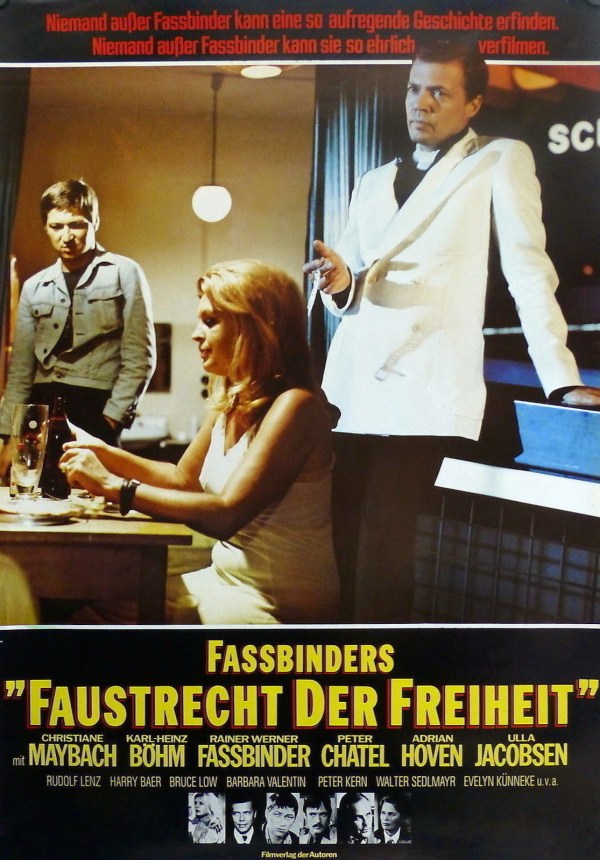
When Fox and His Friends begins, we are introduced to Franz Biberkopf, who goes by the epithet “Fox”. He is an uncomplicated man – barely literate, and working at a fairground as “Fox the Talking Head” – but when his boyfriend is arrested, Fox is forced to reconsider where his life is headed. A lucky lottery ticket propels him to a huge fortune, and when he accidentally finds himself in the clutches of a group of high-class homosexual men, he discovers that there is a dark side to society, where people who claim to be decent, upstanding individuals are willing to exploit someone they see as lower than them. Throughout the film, Fox is thrown around as a plaything to these men, who see him as an object to be manipulated, and they slowly deplete him of everything he has – his fortune, his dignity, his identity and eventually (as shown in this film’s heartbreaking final scene) his life. This film portrays a downfall of an individual the likes of which are very rarely shown so explicitly as it is here, and it leaves one feeling shocked and moved by the absolutely exquisite display of raw human emotion shown throughout this film, and remains one of the most tragic and bleak films I have ever seen.
There was something inherently personal about this film, which can be gauged from a number of elements in Fox and His Friends – the most obvious example being that Fassbinder himself was a very openly gay man, and the 1970s was a decade where gay issues were still far from being as accepted as they are today, where the Stonewall Riots, having occurred only five years before this film was made, set in motion a movement where the LGBT community could start to gain a voice in mainstream issues. In this regard, Fox and His Friends seems somewhat autobiographical, and we can see this in Fassbinder’s decision to cast himself as the titular character. For someone who often took only small roles in his films (such as the bigoted son-in-law of the main character in Ali: Fear Eats the Soul, a completely different character than we have here), Fassbinder showed that he was able to lead a film as convincingly from the front of the camera as well as behind it. It is a delicate, nuanced performance, where Fassbinder breaks your heart with his sweet-natured approach, which is contrasted with the absolute maliciousness of the other characters. Fox is an unfortunate soul that relies on his own naiveté and assumption that everyone is good, and it leads to his tragic downfall. It is difficult to not feel something for Fox, a character who serves to be one of the complex protagonists in cinema.
Fassbinder leads this film well, but the supporting is equally as remarkable. Peter Chatel as the second largest role in this film as Eugen, Fox’s lover who only uses him as a useful resource of entertainment and money, nothing more. His performance is hideous in how distastefully vile the character is, and very rarely do I come to despise a character as much as I did here – and that is credit to Chatel’s unhinged and truly off-putting performance as a deeply dreadful character. The entire cast was exceptional, with many of the smaller roles making a huge impact. There is something I really appreciate about Fassbinder – he brings different actors into his films, but most of the time he relies on a set of regular collaborators, and while he isn’t the first or last director to make use of a recurring ensemble, Fassbinder uses these actors in some extraordinary ways – such as Brigitte Mira, who previously lead Ali: Fear Eats the Soul, but here has a minor role as a storeowner, and would go on to have a small supporting role in Satan’s Brew. This is just one of many examples of Fassbinder’s innovative use of actors – they can easily serve as the primary lead of a film, and then have a very small role in the next. It lends a sense of family to these films, showing how Fassbinder, as controversial a figure as he was, was able to imbue his films with a sense of familiarity.
I have to massively praise Karlheinz Böhm, who gives a performance that somehow left me more shocked than his performance in Peeping Tom. Max is a character that that doesn’t have any direct impact on Fox’s downfall – in fact, if anything, he is sympathetic to Fox and one of the more inherently moral characters in this film. He is a constant presence throughout this film, watching over the way his friends abuse Fox with a muted terror, wanting to intervene, but understanding that Fox may not be worth the time and effort, even if Max clearly does show some empathy towards Fox and his plight. Max is a character that deserves far more than this film presented him with, and his complicated distance in this film – being present and absent from the film’s ethical core throughout – left him as a complicated figure, and one of Fassbinder’s most enigmatic characters. Even if the film was primarily concerned with Fox and Eugen’s central relationship and the former’s eventual decline into a tragic demise, Böhm’s performance as Max leaves an equally shocking impact, and his involvement in the final moments of this film are some of the most caunterizing out of Fassbinder’s entire filmography.
Fox and His Friends is primarily concerned with two major themes. The first is the obvious one, which I have mentioned previously. Fox and His Friends looks at homosexuality in society, allowing Fassbinder to reflect his own views and experiences as a vocal (albeit massively controversial) gay man in an era where homosexuality was still a very taboo subject. I would be reluctant to call this a “gay film”, because the way it deals with the issues it sets out to explore is nothing short of bleak and hopeless. It doesn’t look at homosexuality – it stares at it with a cold and sterile gaze, forcing the audience to experience some latently heartbreaking moments of pure dread, as we see someone trying to long for love and acceptance be abused, being forced into prostitution, where he becomes the victim of a group of men that have nothing better to do than prey on someone who is inferior to them. The way this film looks at gay issues is not the most politically correct, with several moments of awful objectification and abuse, and ends with a very dark turn of events. Fox and His Friends is a very honest depiction of much of society’s preconceptions with labelling individuals and treating them in those regards.
The second theme is the one I am most fascinated by – because, as I mentioned, Fox and His Friends is not strictly a “gay film”, but rather a gay-related film that has a multitude of ideas flowing through it, with the major theme being society and class. Fox and His Friends is a film more concerned with showing the disparity between class within society than anything else. Fox is a man without any intention other than to live his life comfortably. He is illiterate but good-natured, but as Fassbinder shows, having a good heart can be a flaw in a broken society, where these upper-class men take advantage of Fox’s lower-class sensibilities and exploit him relentlessly. Fox and His Friends covers the dauntingly-resonant theme that money makes the individual, and Fox, a man who was previously invisible to the upper echelons of society, is now suddenly an exquisite object to be used by people, who are willing to invest some of their time and effort, as it results in their benefit, and Fox’s eventual loss of everything he holds dear. Fox and His Friends makes some scathing statements surrounding social issues, and how class is deeply divided. The life of excess that Fox is forced into living only results in him being robbed of everything important to him. It is difficult to decide what is more horrifying – how Fox and His Friends displays class and society, or how socially-relevant this was, and remains to this day.
Fox and Friends is a film about division in every sense. Fox is divided from his boyfriend Klaus, who is shown to be the only person who treats Fox with complete fairness and doesn’t see him as an object that is lesser than him. It is a film about social division, as there is a clear division of class – Fox sits at the bottom of the proverbial food-chain, but is fooled into thinking that he has risen above his lower position through the malicious manipulations of the men who claim to care for him and put on the illusion that he is welcome as a part of their social circle. There is even division between the gay community shown in this film, with Fox belonging to two different cliques – the upper-class gay men that exploit him, and the lower-class bar patrons that accept him unconditionally, but not without their fair share of abuse on his account. Fox is a character caught between social division, and his death at the end of the film is even more tragic when you consider how it was brought about by his failure to find a place – he was too lower-class to be accepted into the upper echelons of society, but he was perceived as being too much of a snob to be embraced by the working-class gay men that he used to call his friends.
To be perfectly honest, Fox and His Friends is a film that left me absolutely shaken. Fassbinder created a film that is socially-aware. It is a film that is unbelievably difficult to watch – it is filled with existential angst and social horror that leaves the viewer completely shocked. However, below the surface is a delicate and beautifully-constructed film by a true genius of cinema, who had the preoccupation of showing society in all of its faults, and without offering any solution, held up a mirror to the world and reflected the flaws that exist and pervade our society. Fassbinder’s films have aged well, perhaps not in filmmaking terms, but their narratives are so socially-resonant and leave the audience absolutely mesmerized, while still remaining bleak and relentlessly disturbing. Fox and His Friends is a magnificent work, and Fassbinder was an absolute genius.
 The Postmodern Pelican