
There are just some films that speak to the individual on a personal level. Many films are made to be relatable to a vast majority of people, but there are also films that are made to appeal to a specific kind of people – and Wilson is one such film. Now I won’t pretend like Wilson is some kind of crowd-pleasing masterpiece that will be endearing to absolutely everyone – in fact, I will go ahead and say that Wilson is a very divisive film. I can understand the complaints towards this film – but luckily, I don’t agree with them in the least – in my opinion, Wilson is one of the most endearing, hilarious films of the year, and one that I have been anticipating since it was announced, and I wasn’t left disappointed in the least.
Wilson is about the titular character, played by Woody Harrelson. Wilson is a middle-aged man who is divorced, and is living a very mundane life. It doesn’t help that he is a brutally honest and often-times very misanthropic individual, and it results in some hilarious moments, as well as some heartbreaking moments where the pretty endearing Wilson is left without a single person caring about him. Throughout the film, Wilson goes on a journey to find meaning – which includes getting in contact with his ex-wife, Pippi (Laura Dern) and the duo setting out to find their daughter that was given up for adoption. Along the way, Wilson learns quite a bit about himself and goes through some experiences that can only be described as depressingly comedic.
I consider myself a massive fan of graphic novels, but I tend to avoid mainstream superhero comic books, just because they are seemingly over-exposed and far too wide-ranging to actually follow in a logical manner, especially for someone who wants to get into them later in their life rather than growing up with it. I have always preferred to company of a more obscure mode of graphic novelization, and thus it was only natural that I looked towards underground comic books artists that produced work that wasn’t mainstream, but was most certainly excellent. Examples include the incredible Robert Crumb, Art Spiegelman (whose historically resonant Maus is one of the greatest pieces of art ever produced) amongst many others, notably Daniel Clowes, who is the subject of this idea.
Clowes is one of the greatest cartoonists of all time, and I have read his work countless times – and while Ghost World is a masterpiece, both as a graphic novel and as a brilliant film, I always found myself drawn (pun absolutely intended) to Wilson, a true work of misanthropic art. I found myself drawn to the titular character – a world-weary, cynical misanthrope with a childlike wonder for life, as well as an inherent search for meaning. Unfortunately, I identify with the character a bit too much – but as anyone who has read the novel (or seen the film) will tell you, Wilson may be a pretty odd character, but he is endearing beyond words and one of the great literary creations of the current century. It was only logical that this lovable curmudgeon would have to make it to the screen at some point, and I am so glad it did, even if the popular consensus feels quite differently, for some reason.
I want to be completely honest here – I think Woody Harrelson is an amazing actor, and one of the most versatile character actors working today. He has found a niche with hardened, tough-guy characters, but it is important to remember that Harrelson has given some truly original performances in his time, and Wilson may be Harrelson at his very best. He is just so effortlessly incredible in this film. He takes a character like Wilson and throws him onto the screen with a combination of reckless cynicism and childlike fascination with everything. Somehow, Harrelson made even the most mundane moments in this film seem hilarious. Nearly every moment he is on screen (which is the entire film) is outright hilarious. However, he also manages ot capture the inherent sadness that exists within this film’s adorable anti-hero – Harrelson finds the humanity in an unlikable character and forces the audience to love him, and when you have such a dedicated performance from a talented actor like Harrelson, it is difficult to not connect with the character. I am in constant awe of what Harrelson does with roles when he is given the chance to do something different, and he gives arguably his best comedic performance here, and continues his steady march into the pantheons of effortlessly likable and endearing actors who are as talented as they are versatile.
Harrelson is not the only revelation in this film – Laura Dern gives one of her most surprising performances yet. I love Dern (as well as her iconic parents, but that is a discussion for another day), and in Wilson she gives a tremendous performance. It reminded me somewhat of her wonderful performance in Enlightened, another role that proves Dern is an expert at playing characters that struggle to hide their volatility behind a thin veneer of dignity. It also helps that Dern and Harrelson have remarkable chemistry, and work wonderfully together, playing characters that are supposed to be unlikable, but we can’t help being wooed by their quirky charms. Dern is wonderful in Wilson, but then again, she is outstanding in absolutely everything she does. In terms of the supporting cast, Margo Martindale and Judy Greer (both brilliant actresses deserving of bigger breakthroughs in film) are both great in this film.
The biggest complaint I’ve heard about Wilson is the tone – and while it is true that this film switches from being a quirky comedy at the beginning to a slightly more melodramatic dark comedy at the end, I don’t see that as a flaw. What many people don’t understand is that this film is supposed to be about an ordinary man and his ex-wife, and as much as films are supposed to present us with characters that are supposed to appear perfect, that isn’t the central concern of Wilson. The tone of this film fluctuates because it was necessary – we needed to understand Wilson’s own conflicts, and this is a film showing his attempts at finding meaning. One can find many flaws in Wilson (and I really can’t find a single flaw big enough to bother mentioning), the tone was the least of my worries with this film.
Wilson was a novel that was inevitably going to make it to the screen somehow – I could’ve easily have seen a television series following the exploits of the main character, but luckily it got the big-screen treatment, which is wonderful for a small film like this. It makes sense that it found its home in independent cinema – it is a quirky little film with a strange sense of humour that simply would not have worked in with a bigger budget. Craig Johnson made The Skeleton Twins in 2014, one of the most incredible and audacious films of the year, and one that strove to capture the essense of humanity in a way as true as possible, and it achieved that through its wonderful independent sensibilities. Wilson is no different, and more than that, it has meaning behind it, and it handles it in a true and honest way that only independent cinema can, because mainstream films, unfortunately, often gloss over characterization and development – one can say what they want about Wilson, but no one can deny that a single one of these characters in this film is derivative or unoriginal – everyone from Harrelson and Dern, to Margo Martindale and Judy Greer, to the adorable dog, have tons of personality, and that is something rare and wonderful.
Yet, what is the meaning of Wilson? It is far more than just a quirky independent comedy. It is a film that made me laugh tremendously, but it is also one with a massive amount of heart and soul. It is beautifully made in terms of being emotionally resonant, and there is not a single false moment in this film. It is about the search for meaning, which each and every one of us in undertaking, whether we know it or not. There is an inherent desire in all of us to find our place in this world – and while some do seem to find it, others continue searching for their entire lives. Wilson, for those that have looked at the novel or any of Clowes’ work, is a hilarious story, but also one with a much deeper sense of trying to understand humanity, and there wasn’t a chance any filmmaker that adapted this book with the intention of creating something that reflected the novel in some way wasn’t going to be appealing to everyone – but it certainly amused me, and for that I loved it.
I really can’t bring myself to nitpick this film. It may be a very imperfect film, but it is certainly still an abundantly amusing one and a film with genuine heart and soul. It is worth it simply for the performances from Harrelson and Dern, and the fact that it is a pretty poignant and wonderful story with genuine meaning is even better. Added to that, it is often hilarious and endlessly amusing. It may not be an masterpiece of a film, but it is entertaining, and serves its purpose. It is a wonderful film with positives that massively outweigh the negatives. It is definitely worth watching, if only for the fact that it is unique and a breath of fresh air from traditional comedies – it is one with meaning and a poignant sense of humour, and it deserves a much warmer reception, because it is a genuinely sweet and endearing film. Watch this film if you can (and if you haven’t, read Daniel Clowes’ and his contemporaries’ graphic novels – independent comic books need as much support as they can get)
 The Postmodern Pelican
I really enjoyed reading your review even though I dont agree with what you say. I have described this as “a pointless film about an obnoxious self-obsessed nobody”; its unlikeable characters are all alienating and no amount of Harrelson’s talent can save it.
This is a common complaint against the film, and I certainly see where it comes from. I personally thought it was quite entertaining, and Harrelson was great enough to rise above the material. But thank you for the kind words! 😀 your reviews are wonderful and I enjoy reading them! 🙂
In the 2013 Best Picture nominee Philomena, Best Actress nominee Judi Dench plays an Irish woman searching for the illegitimate baby taken from her 50 years earlier and adopted by an American couple. As she nears reuniting with her lost son, the woman who has long yearned for her boy obsesses over the grown child’s appearance. She fears that he will be obese, because she has read that Americans eat such large portions.
That is not the case for Wilson (Woody Harrelson) who finds his now 17 year old daughter who was adopted by an affluent couple at birth. Harrelson looks upon his daughter, now a morbidly obese adolescent, with a profound expression of unconditional love. As he watches her from afar in a suburban mall from behind a ficus tree, he sees her peers approach and cruelly ridicule her size. Filled with rage, Wilson leaps from his hiding place and attacks the lead bully to defend his daughter. He screams and tears at the terrified teenage boy. Wilson, in his mind, is making reparations for the years he wasn’t there. I really wanted to like the new movie Wilson in this moment. The moment doesn’t last.
Director Terry Zwigoff collaborated with novice screenwriter Daniel Clowes to adapt Clowes’s graphic novel, Ghost World. The resulting film was a brilliant artistic effort. Clowes has now adapted another of his graphic novels, Wilson, for the screen. The effort fails to capture the quirky, addictive quality of the earlier effort.
Wilson is a lonely middle aged man. Quite literally, it appears his only friend is his dog. Yet, the dog is really only present as an excuse for an amusing shot. Early in the film, Wilson is walking his dog next to a revival house screening Umberto D. The dog leaves the film quickly after the visual joke.
The story turns to Wilson reuniting with his ex-wife Pippi. He regrets that she aborted their child. She reminds him that he signed papers giving their daughter up for adoption. And the two now have a mission to find the lost nuclear family that might save Wilson and Pippi from the misery they inflict upon themselves. They quickly find the girl and make contact.
In a telling sequence, the couple take their biological daughter to an amusement park for preschoolers. They ride a train.
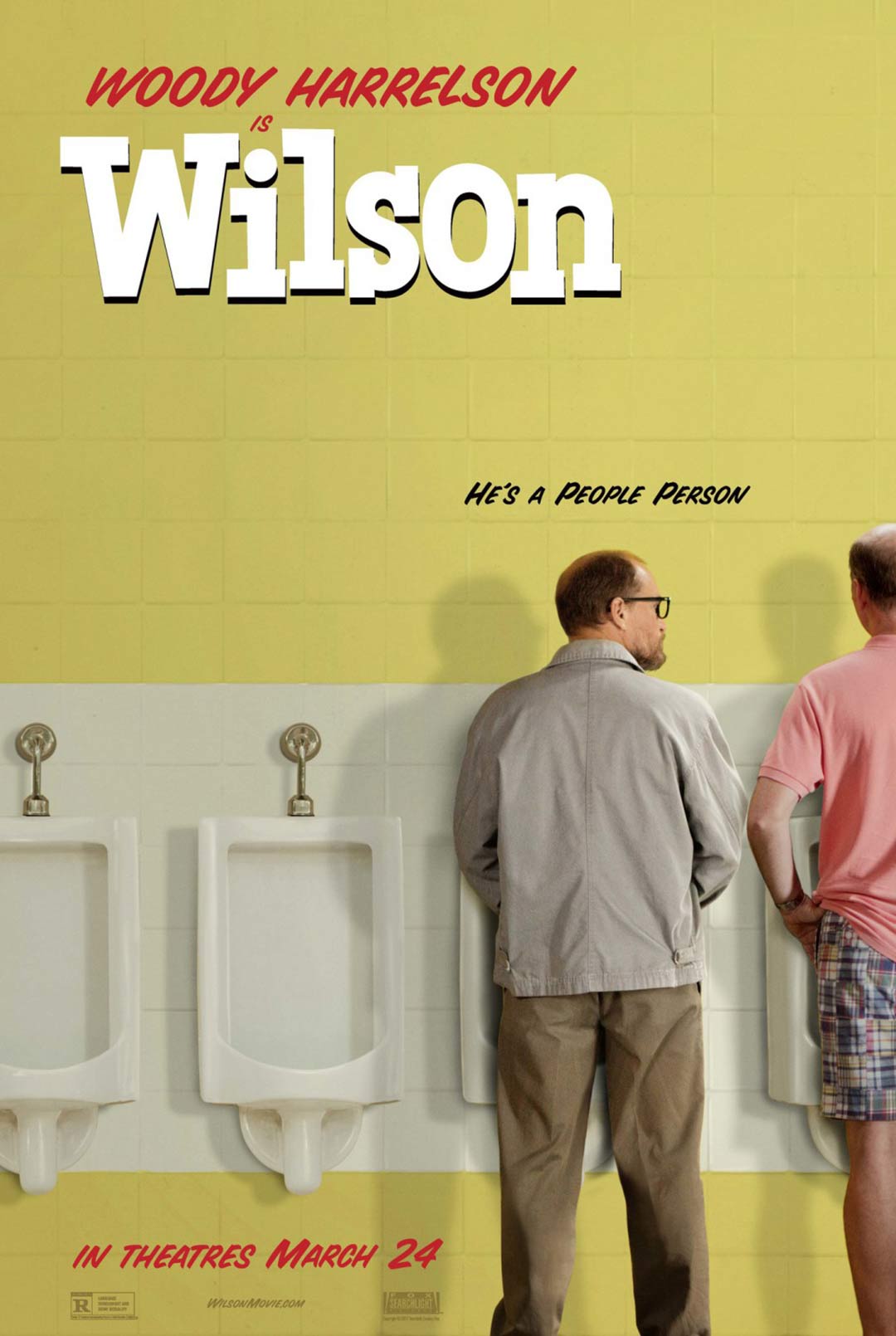
They strive to create the childhood that might have been. Wilson heads to the men’s room. At a far urinal is another father. Celebrating this new adventure of parenthood, Wilson takes the urinal next to the man and begins to commiserate over teenagers. This moment highlights everything wrong and right about Wilson. The initial moment of engagement is highly uncomfortable. Yet we like Wilson. We root for him to survive his social ineptitude. And he does. Then Clowes pushes the moment with one too many cringe inducing stunts. As Wilson leaves, he leans his face to see the man’s penis and compliments its appearance.
The film is based on a non-linear graphic novel that strings together disparate events that are told in a single page. The film attempts to provide such an experience. Yet, the last awkward interaction again and again shatters the audience’s suspension of disbelief. Part of the problem is Harrelson’s performance. In Ghost World, Thora Birch (whatever happened to her?) underplayed the jokes with a deadpan delivery. Harrelson is bursting with an energy that plays against the writing.
Laura Dern as Pippi has a better handle on the material. She is simply superb as a woman whose addictive personality and manifest insecurity will shortly undermine her newest peace or happiness. We love her endearing imperfections that will ultimately destroy her latest attempt at finding joy. Pippi’s lean torso, dyed blonde hair, assorted tattoos, and a face that tells every emotion is in reality quite close to her biological daughter’s weighty, awkward body that seeks to protect her from hurt.
In the end, the imperfect film is given a fine analogy when contrasted with a touching Skype conversation that is overridden with glitches.