 There are very few films that have made me openly weep with bitter sadness and melancholy – and one that is possibly the most emotional response to a film I’ve ever had was Grave of the Fireflies, one of the greatest animated Japanese films ever made. The man behind that film, Isao Takahata, is a genius, and along with Hayao Miyazaki took Japanese animation to a whole new level with their Studio Ghibli platform. It seemed like no one could ever overtake them as the masters of brilliant Japanese animated storytelling.
That was until Makoto Shinkai came along, and he has seemed to ascend the heights to become a logical successor to Takahata and Miyazaki. I was dubious about this fact until I watched Your Name, a masterful and emotionally resonant piece of storytelling than transcends its themes and uses its animation to craft one of the most bitterly heartbreaking and utterly beautiful films of recent years, proving that animation is far from being just for children, and that in the right hands, anything is possible, and if those hands are daring enough, even the impossible can be done, and Your Name proves my theory that animation is able to tell stories that live-action films just can’t, not because animation allows you more freedom in terms of visuals, but because the combination of story and artistry is often something to behold (Toy Story would not nearly be as beloved as it is if it wasn’t for the emotion at the core of the film, let’s be honest).
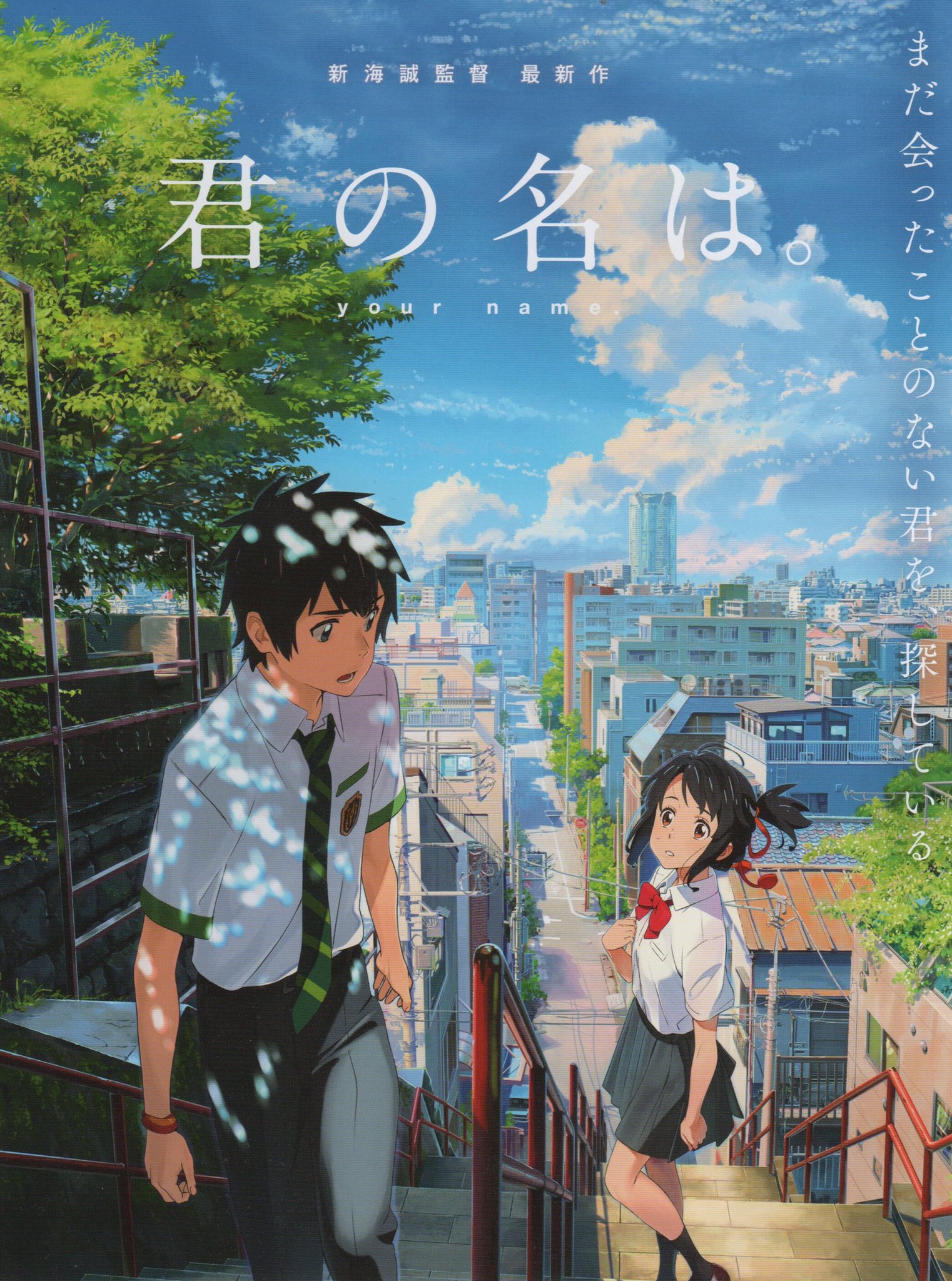
Your Name is a story with a concept bigger than I ever expected – the story follows Taki and Mitsuha, two people from very different lives – Taki is a priviledged Tokyo schoolboy, whereas Mitsuha is a girl from a small town that suffers from poverty. One is free from the constraints of family traditions, and the other is suffocating from the confines of her small town. However, they soon find themselves able to switch bodies, and periodically live the others’ life for them. Of course, there are problems that go with this that make it far different from the Freaky Friday/Prince and the Pauper cliche we often see, but because I want everyone to see this film, I won’t reveal how this film develops, but I will just tell you it manages to become far more complex than many live-action films ever could hope to be, and unlike many films with similar themes, Your Name is never confusing or too complex for its own good, a problem that faces many high-concept films.
Your Name has an undeniably complex concept, but it actually manages to pull it off with such brilliance. There is not a single moment in this film that wasn’t absolutely captivating, and it blew my mind at an adequate pace, and frequently. It is a film that brings in elements of fantasy and a smattering of science fiction to craft something so layered but utterly beautiful. The reason for Your Name being so great is because the filmmakers had this concept that they truly believed in, and they did their absolute best to bring it to the screen, not as an animated film, but rather as a film that just happens to be animated as well.
The animation of Your Name is beyond spectacular – it may not be particularly noteworthy from the start, but there is just something about it right from the outset that is just so damn stunning, and as this film progresses, it just becomes so gorgeous to look at, culminating in some of the most beautiful animation ever produced. Both in the high-concept moments of this film, and the very minimalistic and simple scenes, the animation is just superb. Honestly, there is a warmth of these kinds of films that made Studio Ghibli films so distinctive, and Shinkai successfully taps into that warmth and imbues his film with an abundance of heart and soul, making sure that he shows more than he tells, and the visuals, even though they may sometimes seem unremarkable, are filled with such emotion. Its just the utter beauty of Your Name that just makes it a masterpiece.
It isn’t common that a film is this emotionally raw – there is just something about the story of Your Name that makes it so unique in terms of how its tells its story – and it seems to be a magical realist film, one that takes the common “slice-of-life” narrative and merges it with the high-concept of fantastical science fiction. This isn’t quite a science fiction film in any way, but rather a rivetting drama that takes a look at life through the lens of what can’t possibly be possible, even though it is real. The fact that this film is framed by the theme of a comet flying over the Earth only adds to the mystical nature of this film – it is truly a magical film in a very simple package, and one that will elicit a myriad of complex emotions in the audience.
Finally, I want to talk about the music. There is no way to deny that music is integral to film (even the absence of music, such as in the case of No Country for Old Men, where the lack of a score was done for effect) – but very rarely is the music of a film somewhat of a character of its own – but in Your Name, we see a score that is so deeply moving and incredible, it is no surprise that it was written specifically for the film, as a direct response to the themes that Your Name tells. I urge everyone to seek out the music of Your Name and listen to it (and obviously watch the film) – RADWIMPS create such a mesmerizing, beautiful and intricate score that exceeded my expectations and elevated this film to heavenly heights.
So in conclusion, Your Name is just an incredible experience. It has a story that may bear shades of other films, but a concept high enough to make it just different enough for it to be unique. It also manages to execute the concept with such grace and beauty. Your Name is one of the most emotionally complex films I have ever seen, and the ending is so powerful, I gasped in its utter beauty. This film will make you openly weep, but that’s a good thing – it is a true, honest display of humanity that is just so incredible in so many ways. Watch this film, you won’t regret it. It is just too beautiful for words, so please seek it out – I swear, you’ll adore it.
 The Postmodern Pelican
Parallel universes, body swaps, or heavenly bodies colliding with Earth are all fairly common plot devices in science fiction. Ambitious screenwriter and director Makoto Shinkai explores all three in his 2016 animated film Your Name.
The film tells of a teenage girl living in rural Japan and a teenage boy living in Tokyo who each awake to find their mind in the other’s body. The story starts with the exploration of the new body before attempting to navigate the day without arousing too much concern.
As the story advances, we begin to learn about the lives of the two characters. The girl lives with her grandmother. Her mother died and her father is an important figure in the community who has little interest in her and her sister beyond the scope of public opinion. The boy is afforded freedoms which match his street smarts.
At first, the sexual nature of a young man and a young woman testing out body parts of the opposite gender is played for smirks and giggles. The story soon begins to play with gender roles. One of Taki’s buddies speaks of romantic feelings for his pal when Mitsuha inhabits Taki’s physical form. Mitsuha makes a date with the Taki’s heartthrob and is disappointed when Taki goes on the date.
Mitsuha, pretty and virginal, performs a traditional ritual when she chews a mouthful of rice and spews the mixture of saliva and masticated rice into a wooden box to ferment. This ancient and rather distasteful preparation process produces kuchikamizake sake. When the body swapping ends as mysteriously as it once began, Taki begins to explore Mitsuha’s life. A swig of kuchikamizake sake and Taki learns that the switching is part of the side effects of preparing the libation. Taki also learns that three years earlier Mitsuha was killed with 500 other Itomori residents when a comet destroyed her town. The film then evolves into a mystical chase to see if Taki can reverse the past and save Mitsuha.
This literary device of a parallel universe is not new. However, the best efforts have been in stories set at Christmas. Both A Christmas Carol and It’s a Wonderful Life look at how the lives of those around us could change based on the actions of the individual. Each classic tale relies on a guide to lead the protagonist through the scenario. As Your Name is an animated film, Shinkai replaces the guide with stylistic drawings.
The parts of the story set in rural Itomori are completed primarily in watercolor-like images which lend a softer visual to match the pace of country life. Action in Tokyo is conveyed in precise and detailed visuals. Lines are exact and busy to embrace the efficiency of an urban existence.
Once the story moves into a non-linear approach where the viewer must discern whether characters are in the present or the recent past before the devastation left by the comet, things are not so clear. At first frustrating, it begins to appear that the smudged time frames are purposeful. Time doesn’t seem to matter when compared to saving the life of this vibrant young woman Taki loves.
However, Shinkai’s inability to draw the story to a satisfactory conclusion remains frustrating and ultimately debilitating to the film. Mitsuha will be saved as she runs from the comet streaking across the sky, but then she falls and strikes her head. Such red herrings come fast and often at the end of the film. Taki recalls Mitsuha. Mitsuha forgets Taki. They repeatedly see one another but really don’t. Arghhh! The storytelling embraces the stylistic sensibilities of 20th century daytime soap operas where characters never really die, stories can improbably change at whim, and closure simply doesn’t exist.
And I suppose that is the audience for Your Name. In my own adolescence I loved the pathos and drama of such scenarios. I no longer find such histrionics engaging which is probably why next Christmas Eve I will be enjoying the treasured company of the small town of Bedford Falls and not revisiting the small town of Itomori.