 As I previously mentioned in my review of White Dog, racism and bigotry is not taboo for filmmakers, and while some films made these days addressing the issue can be suitably heavy and almost controversial, they are nothing compared to older films that tackled the subject decades ago. Perhaps one of the most influential films to ever address the topic is Guess Who’s Coming to Dinner. However, that is far from what the film actually is, and it has become iconic for other reasons apart from its very progressive political stance.
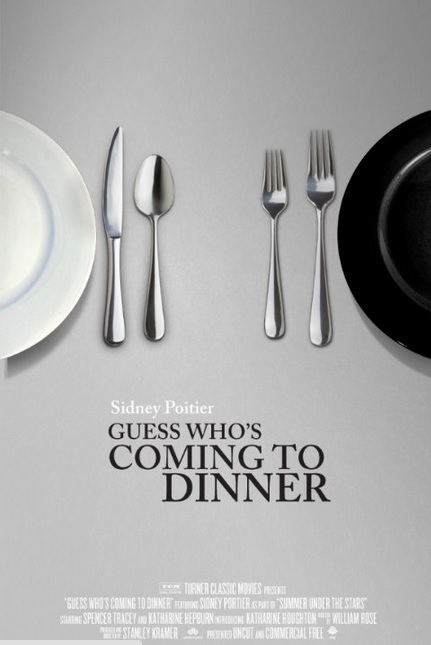
Guess Who’s Coming to Dinner has a simple enough premise – Katharine Houghton, a dainty and quirky little newcomer to film, plays Joanna, a spoiled rich girl who brings her recently-discovered fiancee home to her parents. Her fiance is played by none other than the legendary Sidney Poitier. Her parents are equal (maybe even bigger) screen legends Katharine Hepburn and Spencer Tracy. When you have that sheer amount of acting talent in a room, you are bound to receive the acting showcase to end all similar ones. Throughout the film, I grappled with the question as to who actually was the best in show – was it the iconic Katharine Hepburn, as the fiery but loving mother with a heart of gold and a tounge of venom? Was it Sidney Poitier, playing a more humorous and relaxed character that is a welcome break from his intense roles of the past? Was it Spencer Tracy, who overcame incredible illness to play the part of the conflicted father? There is no answer right now, and there probably never will be. The entire cast was insanely strong, and each and every castmember – from the legends, right down to the brief performances of the supporting cast – made this one of the most riveting examples of acting in history.
I think Stanley Kramer is an immensely talented director, and I previously made my love of his other film addressing racism, The Defiant Ones, known. While he never made a huge impact on the mainstream of cinema, he did indeed help form the base of progressive cinema, and his daring and risky looks at social issues significantly affected the way audiences thought and felt about these inevitable hot topics. To make a film such as The Defiant Ones, Inherit the Wind and Guess Who’s Coming to Dinner in a time when swords and sandal epics and broad comedies were very popular makes Kramer all the more of an underrated legend of filmmaking. Even though Guess Who’s Coming to Dinner is firmly progressive and liberal in its message, it had a hugely positive reaction all around the United States…ironically even in the Southern States. It puzzled me at first why such a film would be so popular at the time, and I came to the conclusion that Kramer was such a meticulous and dedicated craftsmen to his stories, he could make the most serious and dire of issues entertaining and easy to digest, and his films allow us to see real-life issues portrayed on screen, allow thoughts to stir in our minds and most importantly, entertain us and instead of making us feel emotions of sadness and horror at the stories, allow us to see a slice of life that isn’t supposed to be heavy, but instead simply be real.
Guess Who’s Coming to Dinner is an unusually funny film considering its subject matter. It is always very serious, but there are some genuinely humorous moments throughout, which make this even more realistic – I doubt that in 1967, in the inevitable case of this event actually happening, that it would be completely serious and somber. It is a great piece of light drama that takes a look at the subject matter in a way easy enough for us to sit down and actually enjoy. Of course, a lot of the film’s brilliance comes from the chemistry between the cast. The legendary scandalous couple of Katharine Hepburn and Spencer Tracy have some of the greatest chemistry in any of the ten films they did together. It is almost bittersweet that their last film together would be Tracy’s very last. Sidney Poitier, of course, is as brilliant here as he always is, and I stand by my belief that he is one of the greatest actors of all time, if not the very best. Although he takes a back seat to Hepburn and Tracy, he is still incredibly good and steals many of the moments in the film.
Guess Who’s Coming to Dinner is a legendary film – not only does it tackle a very important and at the time, controversial, topic with grace and tact, it is also a fiercely powerful acting showcase that brings out the best in all the castmembers, even with seasoned icons like Katharine Hepburn and Spencer Tracy. Progressive films like this need to be made, because stories like this need to be told, and I am so glad we have such a brilliant film like this. A true masterpiece.
 The Postmodern Pelican
I love Guess Who’s Coming to Dinner. I have little patience with those who don’t.
The naysayers are led by failed playwright Clifford Mason. In 1967 he wrote an op-ed piece for the New York Times in which he referred to Sidney Poitier as “a showcase n—–.” The article generated much publicity and wounded Poitier so badly that he stepped back from the limelight, despite starring in three of the year’s biggest box office hits – In the Heat of The Night, To Sir With Love and Guess Who’s Coming to Dinner. Mason was an opportunist who sought attention on the back of Poitier.
It was challenging to be in an interracially mixed theater audience in 1967. When Poitier slapped the face of the elderly racist rich white man, the sound in the theater was almost tangible. Some cheered, Some gasped. Some looked for the exit. Poitier reportedly told producers that Detective Virgil Tibbs must slap Eric Endicott or Poitier would not do the film. The scene in Guess Who’s Coming to Dinner when the interracial, engaged couple embrace and kiss in the back of the taxi cab was no less incendiary in the Civil Rights Era.
In the Heat of the Night is a great movie, but I love Guess Who’s Coming to Dinner more. Audiences then did too, The sophisticated comedy of manners made twice the box office of the Mississippi murder mystery. I believe a lot of that success is the astonishing work of the actors.
Guess Who’s Coming to Dinner features a wealth of great character actors gathered to support the three leads. Beah Richards, a great actress and political activist, won a supporting Oscar nomination as Mrs. Prentice. She has a moving moment opposite Tracy on the patio that overlooks San Francisco. Richards is eloquent and moving. Seated and small, she dominates the screen. Richards steals the moment from Spencer Tracy. Not many can authoritatively make that claim. Celebrated South African actor Cecil Kellaway won hearts and a supporting Oscar nomination as the family priest who serves to challenge Matt Drayton’s initial reluctance to have his daughter marry outside her race to a renowned physician after a whirlwind romance.
Of course, the screen is owned by the leads. Katharine Houghton is named for her aunt, Katharine Hepburn. She is comfortable on screen. Perhaps her most difficult line delivery is in her childhood bedroom with her mother as she packs a suitcase to leave home and marry. Her mother, Christina, modestly hints for information on the status of the couple’s love like. Joey matter-of-factly informs her mother that the two have not yet slept together. He declined.
Poitier plays the confident medical professional as a man who is comfortable in his success but unnerved by his sudden romance with a white woman. He notes that Joey is much younger than he is. John Wade Prentice lost his wife and young son several years earlier in a tragic accident. Poitier beautifully modulates the visual cues of his anxiety as he struggles with his love for this woman, the guilt for his lost family that his joy raises, and his complete inability to control the situation of his family and Joey’s family meeting for dinner.
Hepburn most deservedly won an Oscar for her work here. I would contend that it is her finest performance. The best of Hepburn is almost always an intelligent woman who thrives due to her ability to articulate her ideas. Here the script asks Christina to react, to listen. Hepburn delivers as required. Her first reaction shot of note is when Joey tells her of her romance. She sees Prentice enter the room from the study and realizes the social stigma her only child has chosen for herself. (It is important to remember that the United States Supreme Court had only recently ruled that the anti-miscegenation marriage laws were unconstitutional. That occurred on June 12, 1967, six months before the film’s Christmas release.) That famed reaction shot builds with more screen time mid film when Christina is alone on the patio as the sun is setting. The light catches and sparkles in the tears that threaten to fall across that iconic face. Each time I watch the deeply moving scene, I find myself breathing in rhythm with Hepburn. She employs air to calm the character, nurture her, and embolden her. All of this is conveyed in a single marvelous take.
Tracy also deserved an Oscar. His comedic timing is impeccable. Matt and Christina slip out of the house to visit a drive in restaurant for some ice cream. Tracy plays the befuddled man whose frustration is vented on a bowl of ice cream and a parking space for maximum hilarity. And then Tracy turns on a dime to play pathos quite movingly. His final monologue filmed less than a month before the terminally ill actor’s death is a wonder of screen acting. I do admit to chuckling as Matt explains the day to the assembled guests. Tracy was a great naturalistic actor. Every movement, every line reading, every expression was based in truth. Tracy was also an actor who notoriously repeatedly failed to hit his marks. In that final sequence, Tracy says his lines, puts his head down, walks to his next mark, looks up and continues with his lines. The action is obvious. And yet, the great movie star is so skilled that we can see the novice move and accept it as how Matt Drayton moves. Of course, the highlight is when Matt talks about his passion for Christina. The silent look shared by Tracy and Hepburn speaks volumes. It is entirely reasonable that Hepburn famously said she could never watch the scene. The emotion present was too powerful for the normally stoic actress.
This is Hollywood filmmaking at its finest.